
The Old King’s Crown
Designed by: Pablo Clark
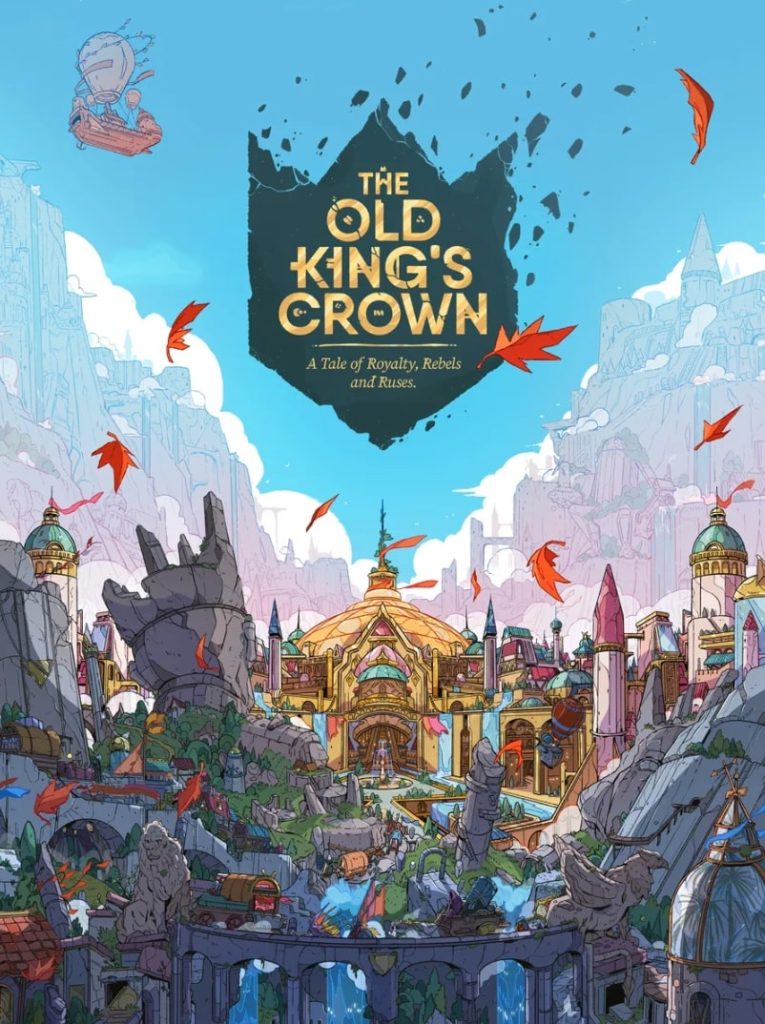
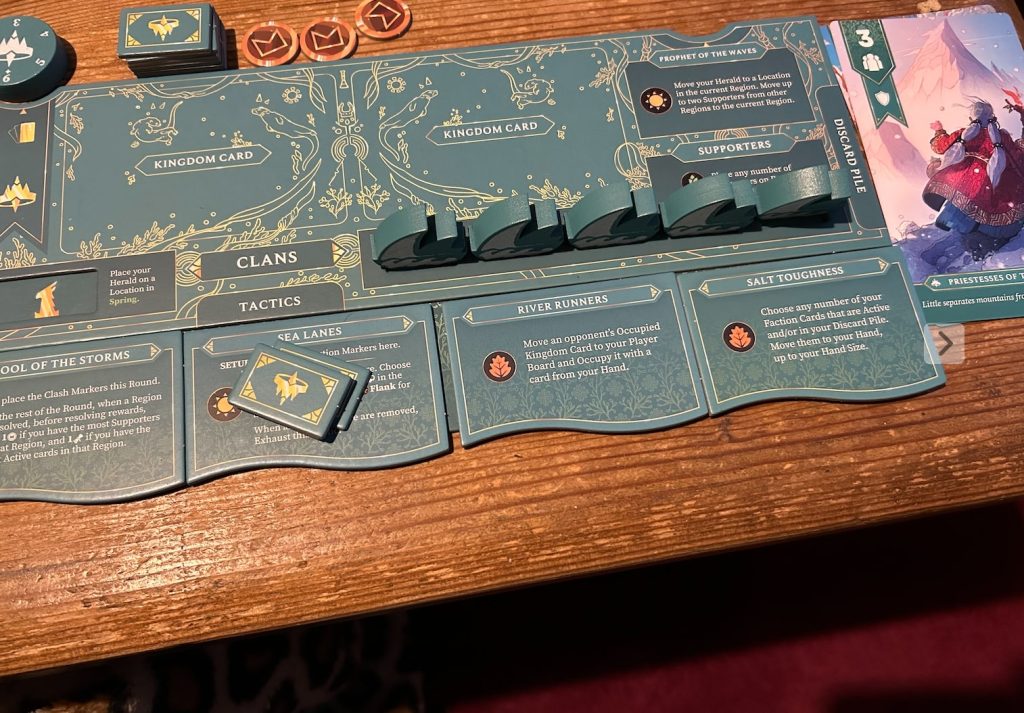
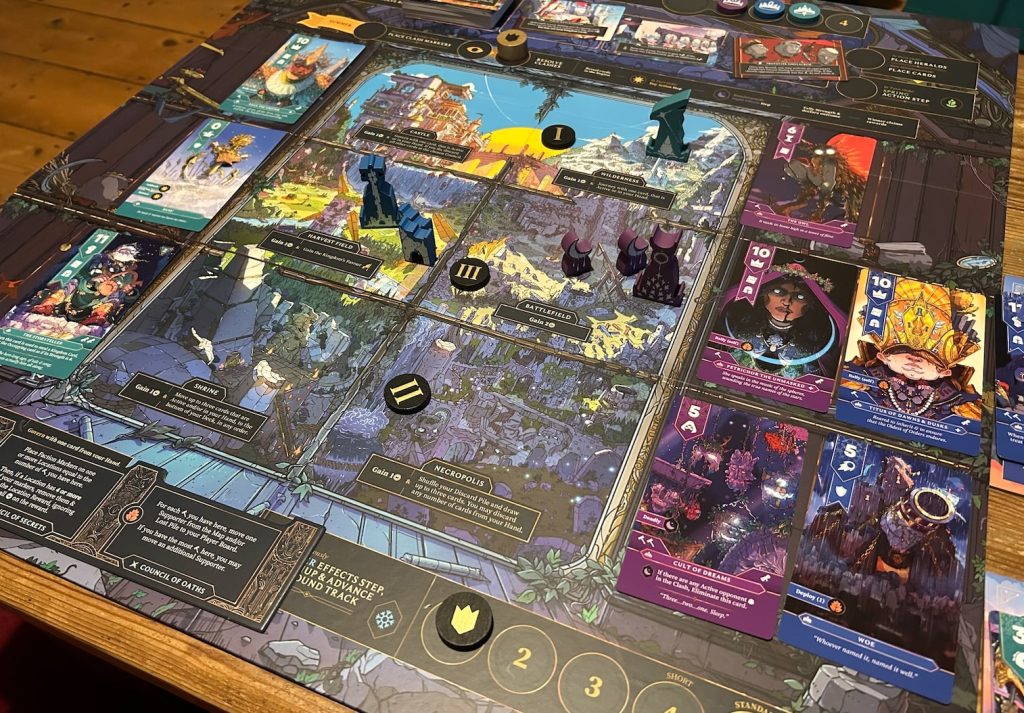
Set in a world where the old king has passed on, The Old King’s Crown asks the players to shrewdly position themselves as the new monarch. It’s a fairly complex game, but we’ll give a broad impression here rather than attempting to explain every detail.
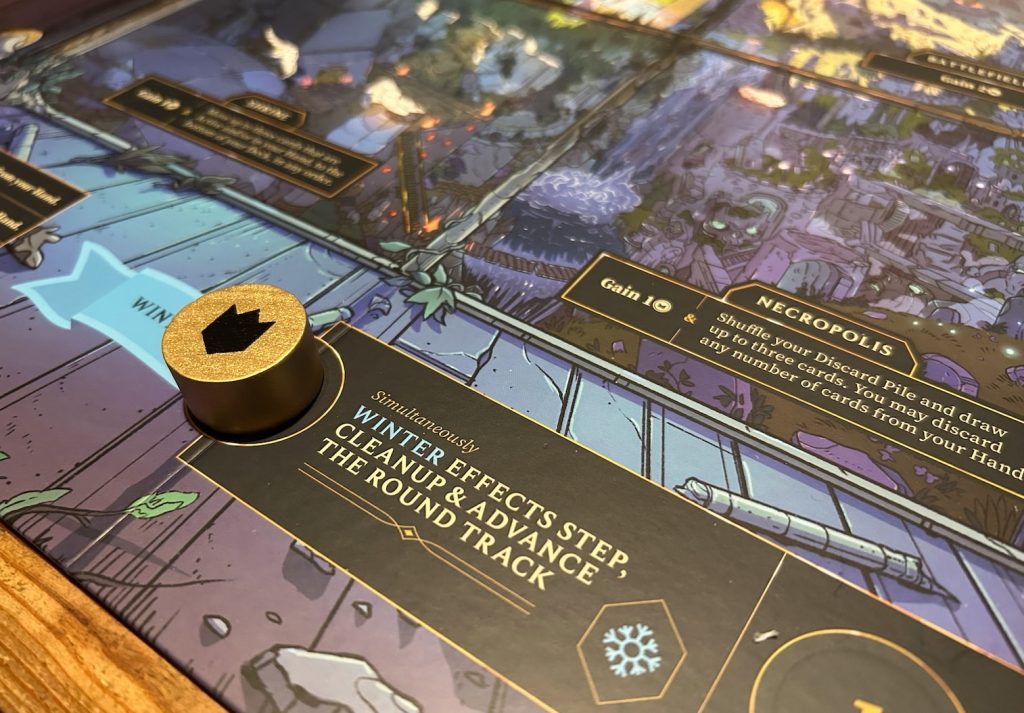
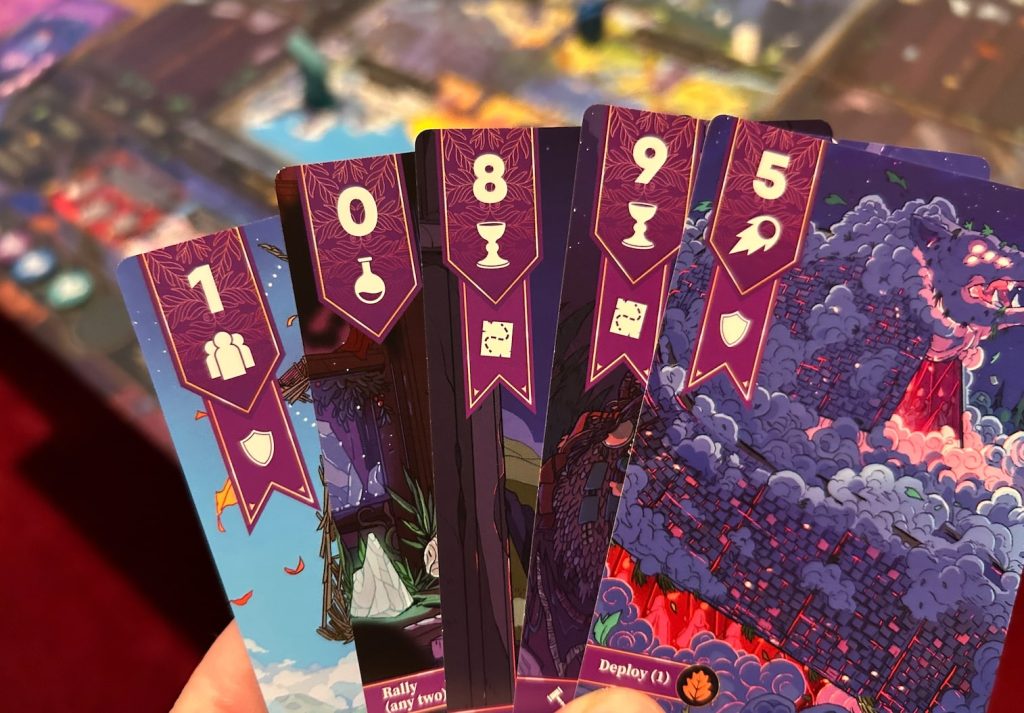
The large board tracks the rounds of the game, and the phases during each round. It also has spaces where players will play cards to try and grab rewards – the metric of success here is influence, and that’s represented by tokens. The game’s core is the fight over these spaces: in each round, each player places a card from their hand face-down in each row, before all are revealed simultaneously. In theory, the strongest card (ie the highest number) will win, but occasionally there can be a sting in the tail. The rewards for winning always contain influence (basically victory points) but also something else as well: gaining one-off or ongoing rewards, or cashing in cards for Lore, which can be used to add more powerful cards into your starting deck.
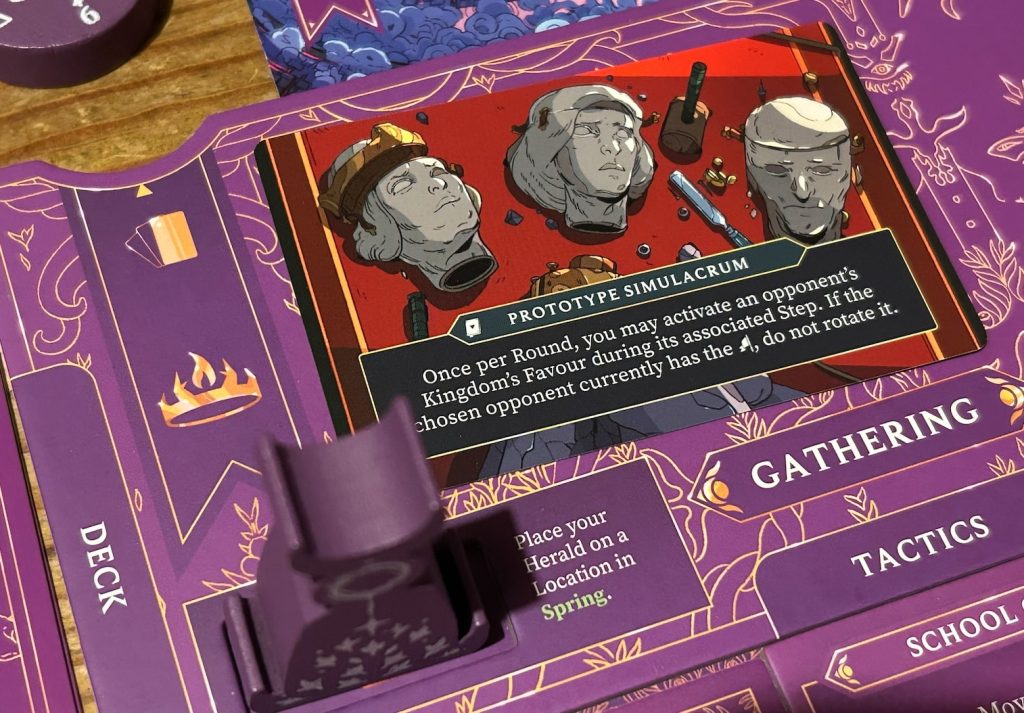
It might sound like you should always play high if you can, but you need to bear in mind future rounds, when for example the 9 and 10 you just played may not – will certainly not, initially – be available to you. You also have a limited supply of Supporters with which to bolster the strength of these bids – essentially what the cards represent; a bid for control. Around that central premise there is also a fair bit of secondary action: the aforementioned Council powers can change hands, players bid for Kingdom Cards – special powers – each round, but can also steal them from each other, and the cards themselves form a kind of economy, as every time your personal deck runs out you suffer ‘attrition’ – your maximum hand size shrinks, reducing your options.
That’s not all: everyone has a zero value card that allows you to either retreat from the bidding, or add a second card to it. Each player is a faction with its own special powers, and the turn order in each round changes to reflect the current influence standings: the player leading will go first, and the player with the least has the advantage of going last. Whilst this has no bearing on the simultaneous reveal in the fight over the card rows, other aspects of the game play out in turn order, and going last is an advantage on going first.
When the agreed number of rounds are up – 4 or 5, depending on whether you want a short or standard game – the player with the most influence will win the crown.
Sam says
It’s quite an extraordinary achievement, especially all coming from the mind and pen of one person, designer/illustrator Pablo Clark. The setting doesn’t excite me hugely – I’m never that compelled by games that ask you to step into a world with its own lore and backstory, because I’m more interested in the game itself – but the experience of playing it is really interesting. It’s heavier than the kind of thing I usually seek out, and asks a lot of you in terms of plate-spinning every element, let alone doing so successfully. That aspect of it could feel a bit chaotic, but Old King’s Crown sidesteps the potential kitchen-sink criticism by having everything around the bids basically in support of them: if not directly, then indirectly – by offering counterfoils, compromises, catches and general opportunity for chicanery. All good stuff in my book. As I write I’ve only played it a couple of times though, and I wouldn’t say I’ve fully gotten my head around everything the game does – it’s still a collection of possibilities for me at the moment that isn’t completely in focus. But I appreciate the high level of interaction, and it does look stunning.
-

Take That!
Very present. The nub of each round is essentially a bidding war, and around it are shenanigans aplenty
-

Fidget Factor!
High on a first play, dropping to low/moderate with familiarity
-

Brain Burn!
Where to start? Despite the huge rulebook the rules aren't biblical (much of it is taken up with examples, and the text is pretty big) but Old King's Crown asks you to balance lots of different things: primary and secondary goals, economies, predicting opponent behaviour, and above everything: timing.
-

Again Again!
If you like the game, there is a lot to explore here and even people playing it strategically different ways can shake up the experience


