
Things in Rings
Designed by: Peter C Hayward
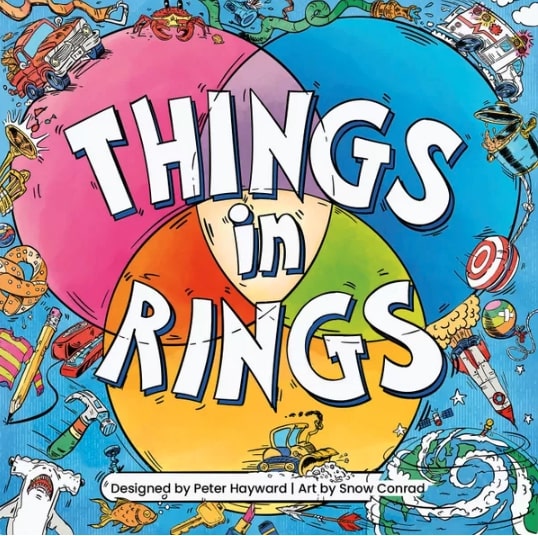
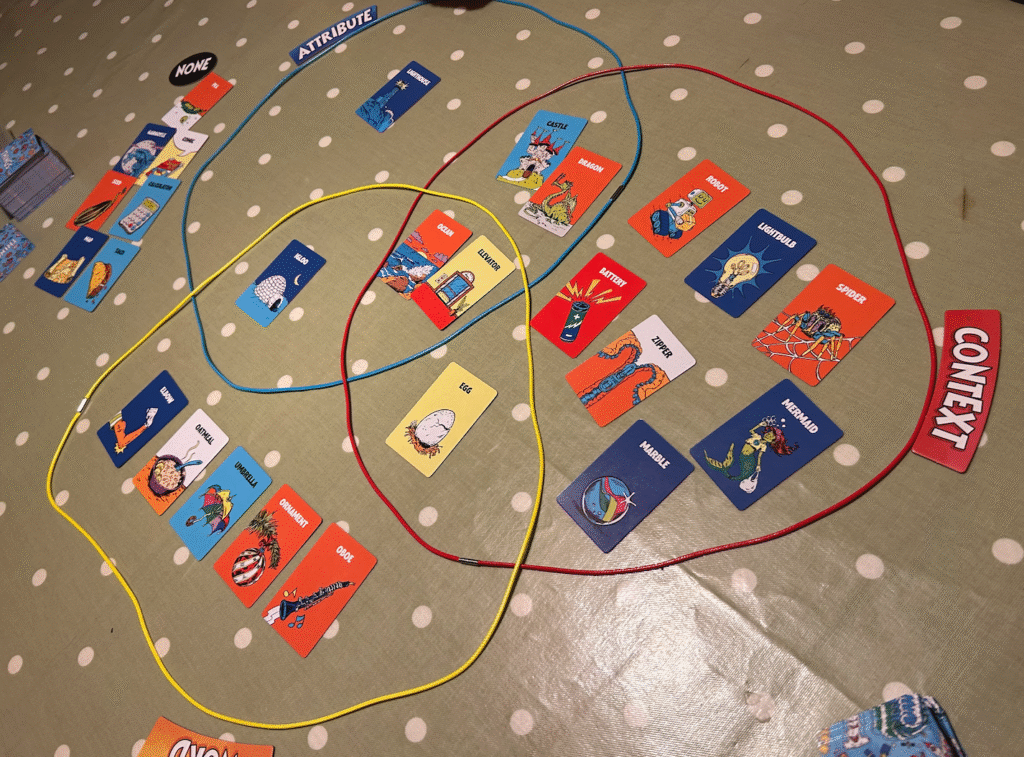
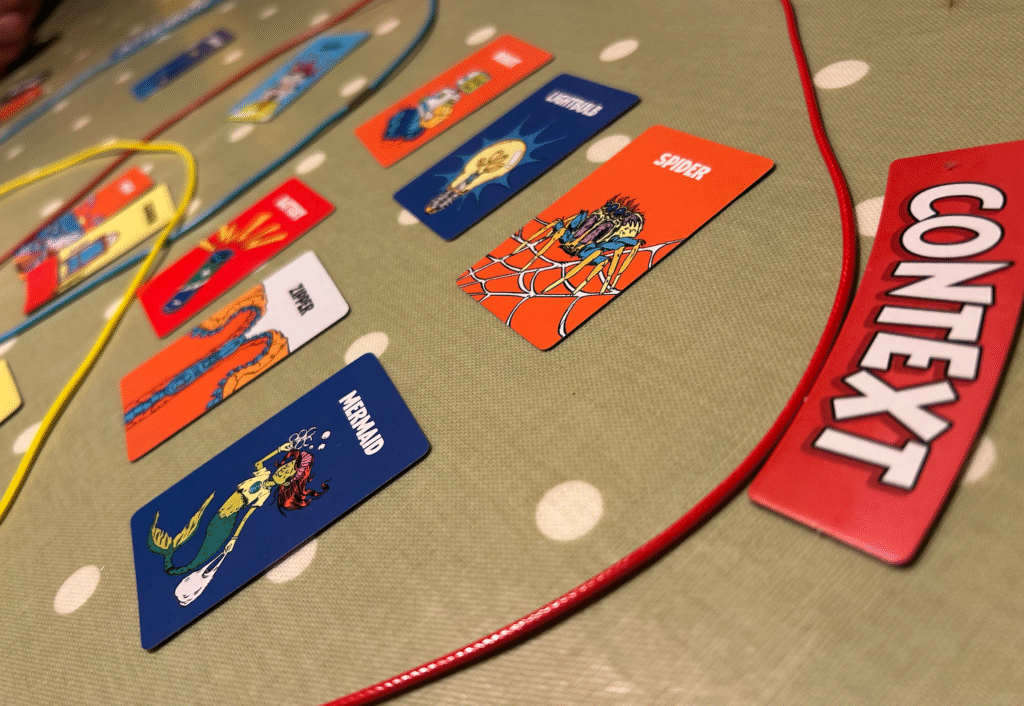
Things in Rings is a party game inspired by that great party staple, the Venn diagram. But here the diagram is not an avenue to information – it’s more of a barrier, and your goal is to figure out what it means…
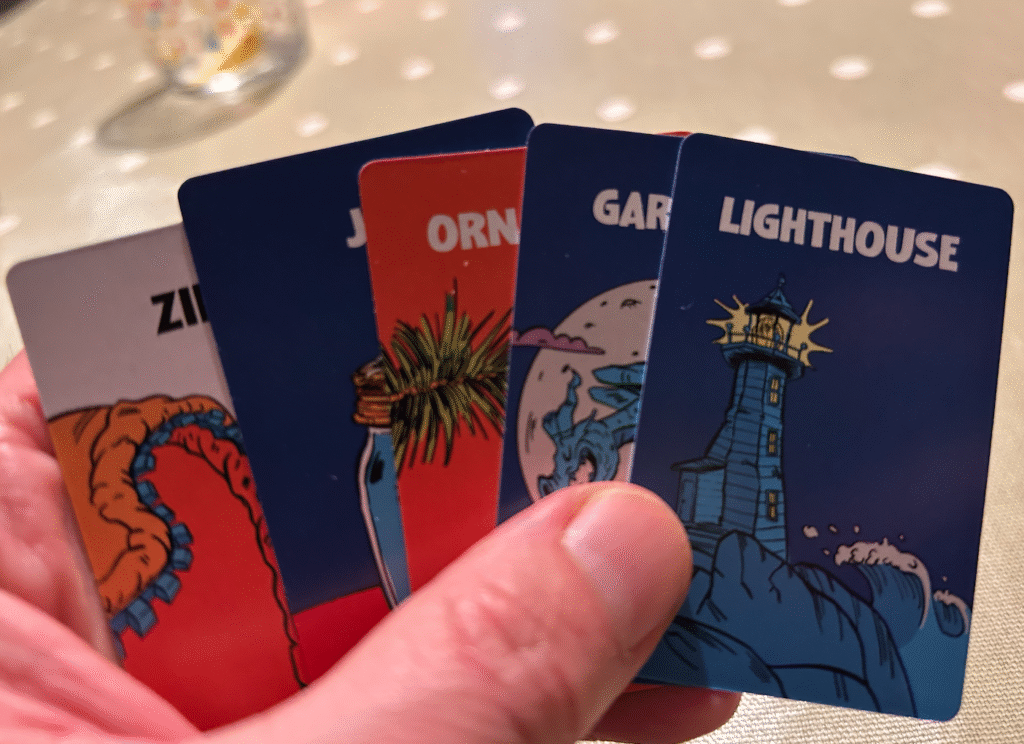
The game is set up by creating the diagram itself from three loops of string (for a first game, you might decide to just use two). One player is the ‘knower’ who has access to what each loop means, and there are three loose categories that the guessers also know: one loop is about the attribute of the word (for example: bigger than a person) one is about the context of the word (eg found in a school) and one is about the composition of the word itself (eg contains exactly two vowels). At this point you may well be asking What word? – and that’s where the other players come in. Each is dealt a hand of cards with a single word on it, and to win you must place each of your word cards into the correct part of the Venn diagram. So using our examples above, the word dragon would go on the overlap between bigger than a person and contains exactly two vowels.
Our problem of course is that we don’t have the knower’s knowledge about what these secret categories are, and most figure them out during play. On your turn you choose one of your cards and place it somewhere in the diagram that you think/hope is accurate, and it’s the knower’s job to determine if that’s where the word should be, or whether it goes elsewhere in the diagram – or indeed, doesn’t belong in the diagram at all (you’re also allowed to guess this as well). If you were right, you get another turn. If you were wrong, you take a replacement card from the deck.
The deduction is a process that starts out pretty much as blind luck but becomes more of a logic puzzle as play continues. Although the knower seeds each circle with a single word at the start as <the vaguest of> clues, inevitably the opening few rounds are largely baffling. As the diagram fills up with words though, you may – hopefully! – begin to see patterns emerge. And in doing so you get an idea of where your words might go, and your random guesswork takes on a more rationalising, deductive aspect. You don’t even need to figure out the categories with utmost precision: the goal, remember, is to be first to shed all your cards. Do that, and you win.
There’s also a co-operative version of the game where the Knower adds more cards of their own over ten rounds, giving more and more context, and all the players need to shed all their cards before the end of that tenth round.
Sam says
Not a million miles from Zendo, Things in Rings feels like a classic parlour game where one person knows the ‘rules’ and everyone else is trying to figure them out. In Zendo the challenge is spatial, and with Things in Rings its about words. Some people will find the opacity – especially at the start of the game – too wide open and obfuscating to feel like fun, especially as the Knower has a job that is, at times, highly subjective. Is a dog flammable? Is a ladder something you’d find in a school? How literal are we being? Others may enjoy the silliness and bendy oddness of it all, and I think the co-operative version is probably an easier avenue into the game than the competitive, because everyone sharing information and theories can be as much, if not more, fun than silently engineering a win. An unusual game, and an intriguing one that we enjoy.
-

Take That!
None.
-

Fidget Factor!
Extremely low. When it's not your turn you're interested in what the other players are speculating on, because everything is information.
-

Brain Burn!
Rules-wise it's extremely light. But puzzling out the meanings has a certain cog-clicking inscrutability.
-

Again Again!
There are numerous cards and different difficulty settings.


