
Torchlit
Designed by: David Spalinski
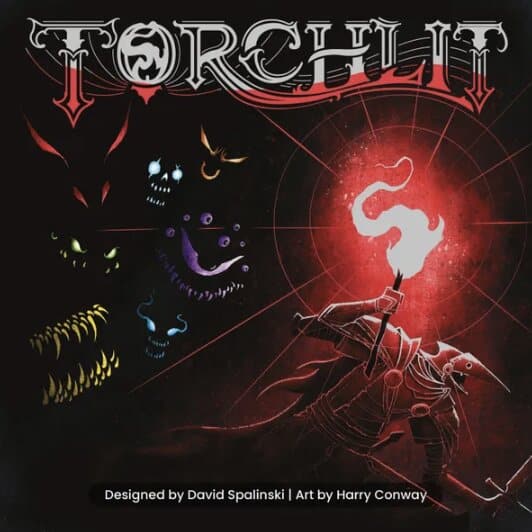
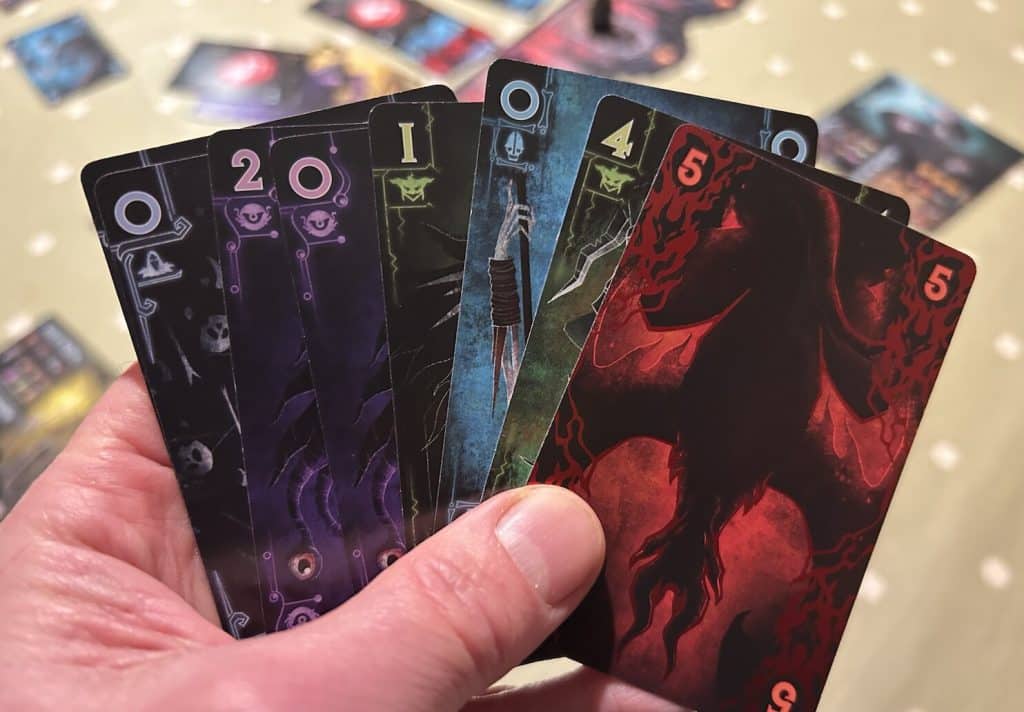
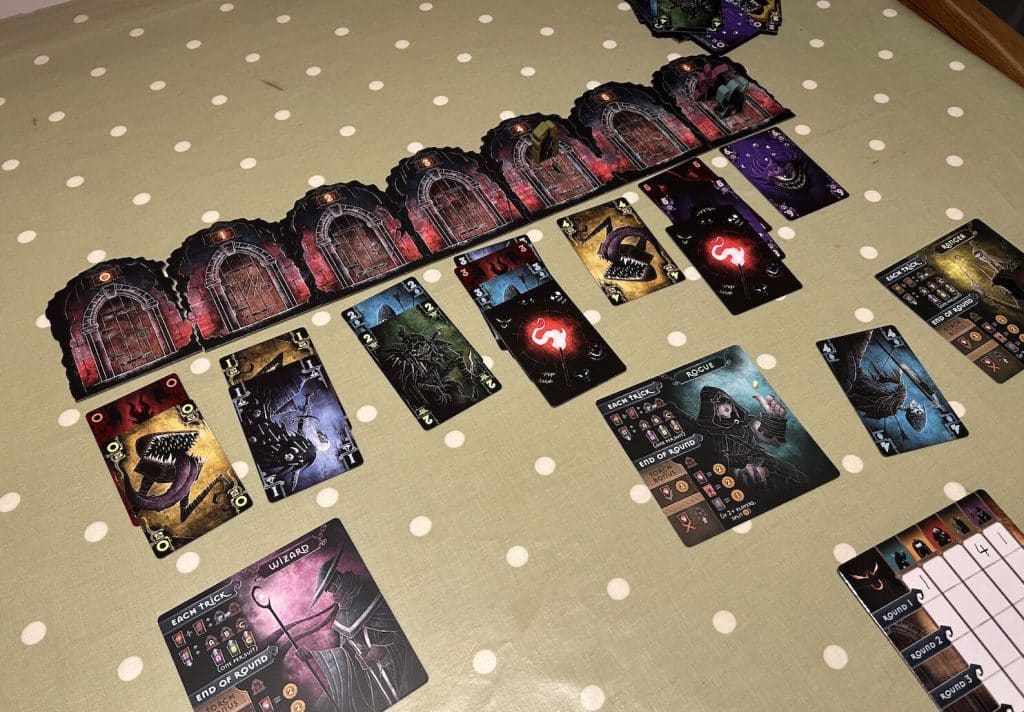
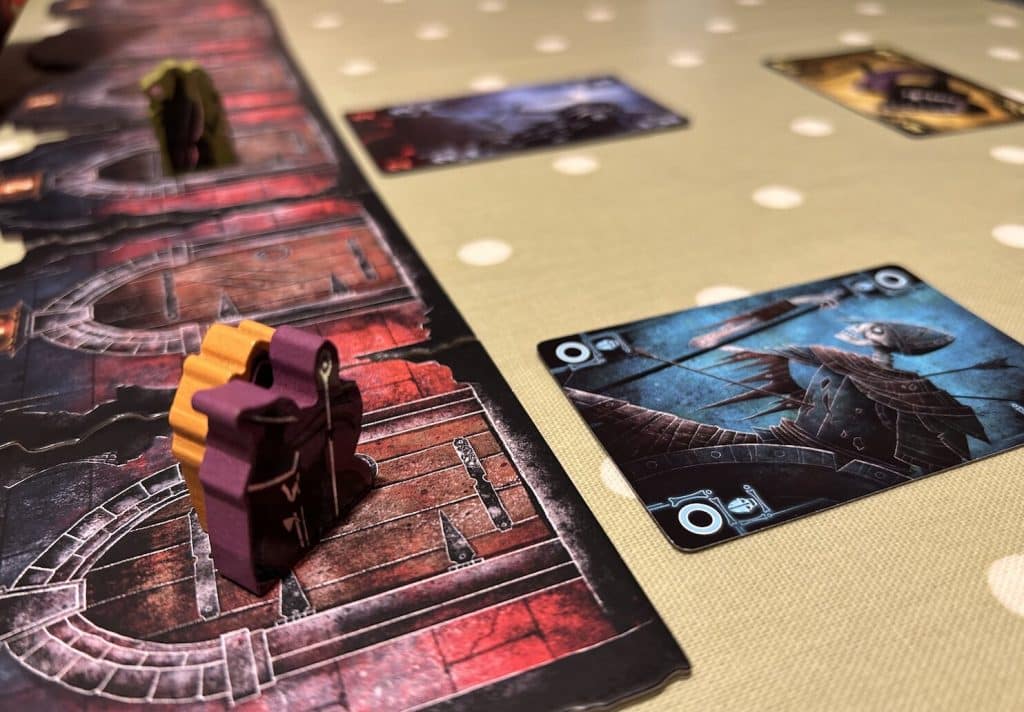
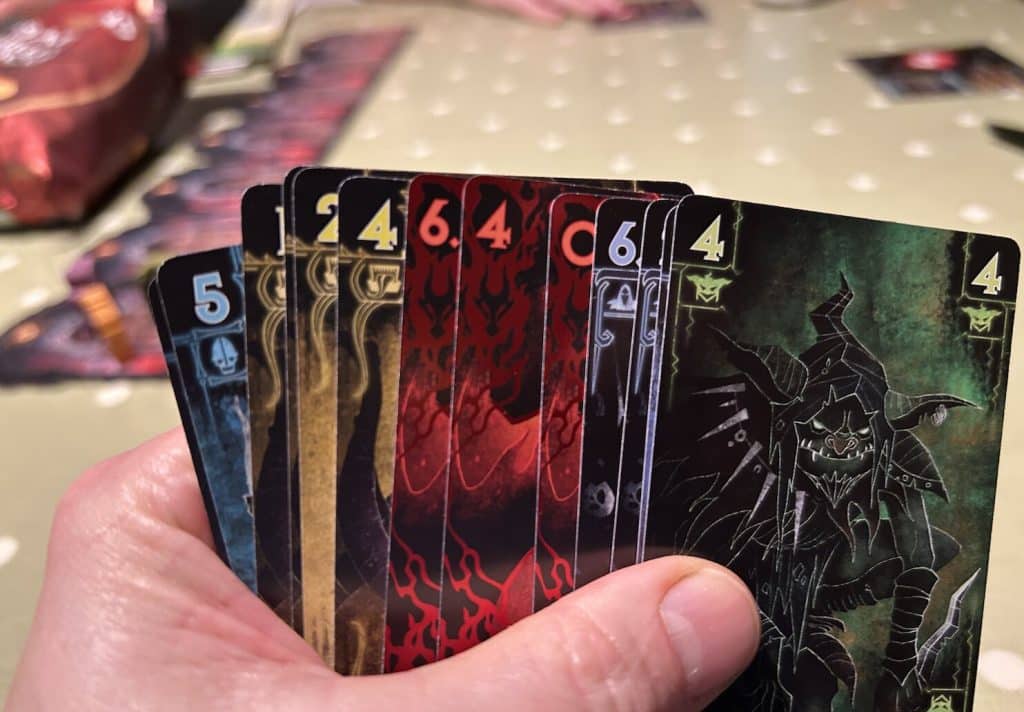
Torchlit is a trick-taking game with a dungeon-crawler theme: players make their way along various rooms of the dungeon, and will score depending on what room they occupy come the end of the round. If you can predict where you’ll finish, there are bonus points to be claimed as well!
The board is a series of rooms laid out in a row (-see pics above) and how many varies depending on player-count. Players place their Adventurer pieces on room zero, and are dealt a hand of cards: there are seven suits numbered 0-7, and one suit is considered trump: it’s the strongest suit.
Play is reasonably straight-forward, following classic trick-taker conventions. The starting player (here called the torch-bearer) leads a card of their choice, and the other players must follow suit if they can. If you cannot follow, you can play a card of another suit: this might be to dump a card you don’t want, or to trump in and try and win the trick. The highest value card is considered the winner, and that player will move along the dungeon and into the next room. But! Anyone who played the same rank card as the winner will also move to the next room as well: one of Torchlit’s little twists.
The lowest ranked card – regardless of suit – will become the torch-bearer for the next hand. They must also add one card of each suit played to the trick beneath its matching room. Let’s say you led 5 green, I followed with 2 green, and a third player couldn’t follow suit so played 5 orange. You win the trick, and so move to the next room. The player who played a 5 will also move to the next room. I played the lowest card so I must add the 5 orange to Room 5 – it’s the only orange card out there – and I can choose whether to add the green 5 to room 5 or the green 2 to room 2.
Why you might do one or the other will hopefully become clear as we explain scoring. Before any tricks are played, at the very start of each round everyone puts a single card aside as a prediction, planning (and hoping) that that card’s number will match the room your adventurer will be in at the end of the round. If your prediction is correct, you score three points. You’ll also score points – whether you predict correctly or not – for how many cards are beneath the room your adventurer is in. So if you hope to make it to room 5, for example, you want to be placing as many 5 cards beneath that room as possible.
Whilst achieving the measure of control you’d like is tricky – no pun intended – Torchlit does give you a kind of last-chance-saloon moment on the final trick, when you’re allowed – should you want to – to swap over your remaining hand card for your prediction card. The game plays over three rounds, and the player with the most points after the finale is the winner.
Sam says
The presentation – the rooms, the adventurers, the burning torches – does give Torchlit a sense of setting, but really this is as abstracted as any trick-taker – the rooms could easily be a single board with a track on it. That’s not a criticism: I think the presentation is fun. But peel back the surface and the game is fairly themeless: if you loved Dungeons and Dragons or Talisman for the theme, you may find Torchlit a disappointment. However lovers of trick-takers may enjoy it a lot – the system of discarding-for-points is sort of bonkers and the Hail Mary of the final trick can add some moments of drama too. If I’m super-picky I think it verges towards the chaotic side of organised chaos, and with more than three players (-my recommendation) can feel a bit long. I’m not sure I’d place it above any of the recommends to the right. But it’s fun regardless, and maybe a nice way in to trick-taking games.
-

Take That!
It's as interactive as any trick-taker - maybe a little more. But despite the theme, there's no fighting or death
-

Fidget Factor!
It would take a stodgy adventurer to make this game grind to a halt
-

Brain Burn!
The scoring system is pretty nuts, but that's more about ramifications than complexity.
-

Again Again!
It's a moreish one for lovers of trick-takers, rather than lovers of dungeon-crawls


