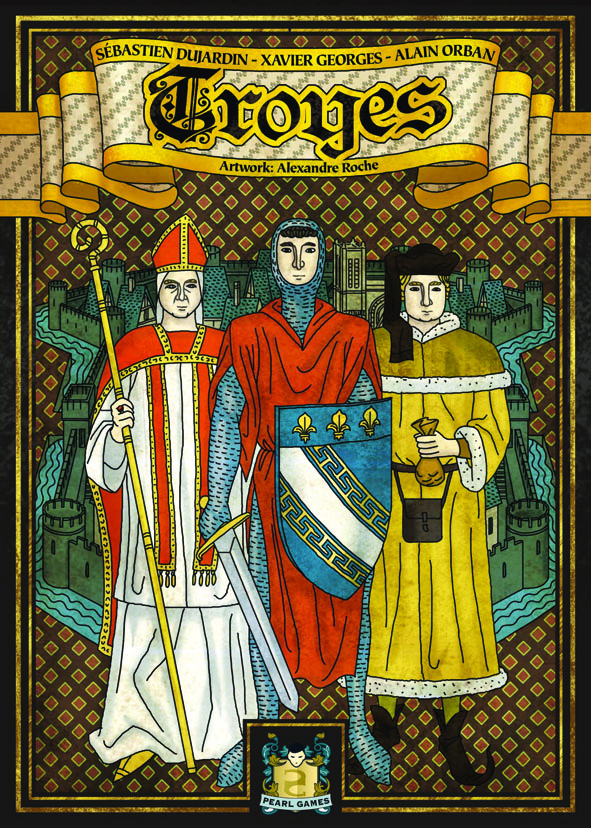
Troyes is a rather dry-sounding game where you and your fellow players work (but in competition) to build a cathedral in the French city: playing the game represents 4 centuries in the town’s history. The board shows the city itself, and during play you’ll compete over three areas: the palace, the bishopric and the city hall, in all of which you can place your pieces to establish influence there. These pieces represent your influence in the military (red), religious (white) and mercantile (yellow) areas, and determine how many of each coloured dice you get to roll.
We can’t give a detailed breakdown of the rules here, but basically your dice are your actions for the turn – although you can also buy dice from other players as well. The dice are used to activate activity cards, combat events that threaten the city, construct the cathedral, and add your own pieces to the three areas mentioned above, increasing your share of the dice in subsequent turns. It’s pretty straightforward up to now, but added to this are a couple of interesting features:
There’s also an influence track — this is a point track that you can use to manipulate your dice rolls; one influence point will allow you to re-roll a dice, and four influence points will allow you to turn up to three of your dice to their reverse side – great if you roll a bunch of ones or twos. Influence is relatively easy to come by, and your space on the track will tend to ebb and flow during the game.
The other interesting thing is the 6 special characters — each player at the start of the game gets one of these, and keeps it secret. Each character gives points at the end of the game for various things — 5, 10 or 15 points on the influence track, for instance. The thing with these is that all players will receive these points if they’ve met the card criteria, so while each player has a secret objective, if you can deduce your opponents’ correctly you can make sure you too collect influence and reap the rewards.
It’s a clever game with a multitude of options, and if you can wrap your head around them there are some very creative ways to score points. One for the deep thinkers and Sudoku addicts.
Sam says
Cognitive overload! I’m afraid Troyes was too much for me to really fall in love with. Despite the dice this is a dry, thinky experience where your challenge – very much as with the likes of Bruxelles 1893 – is harnessing the games disparate parts into a cohesive whole. I find myself admiring those types of designs more than desiring to play them – at least with any great frequency – and that was my experience here. It’s intriguing, but it’s also complex and convoluted, at least more so than in any way that scratches my gaming itches.