
Undaunted: Battle of Britain
Designed by: David Thompson,Trevor Benjamin
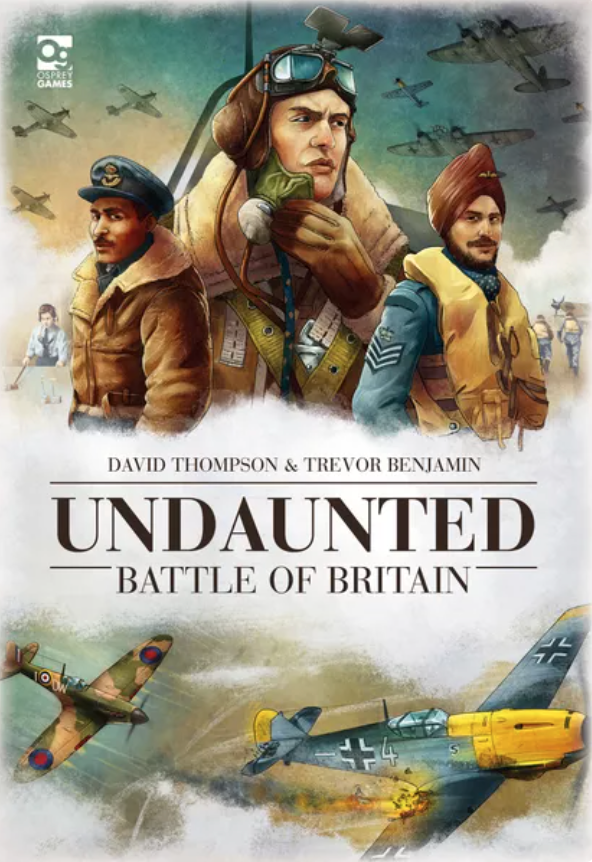
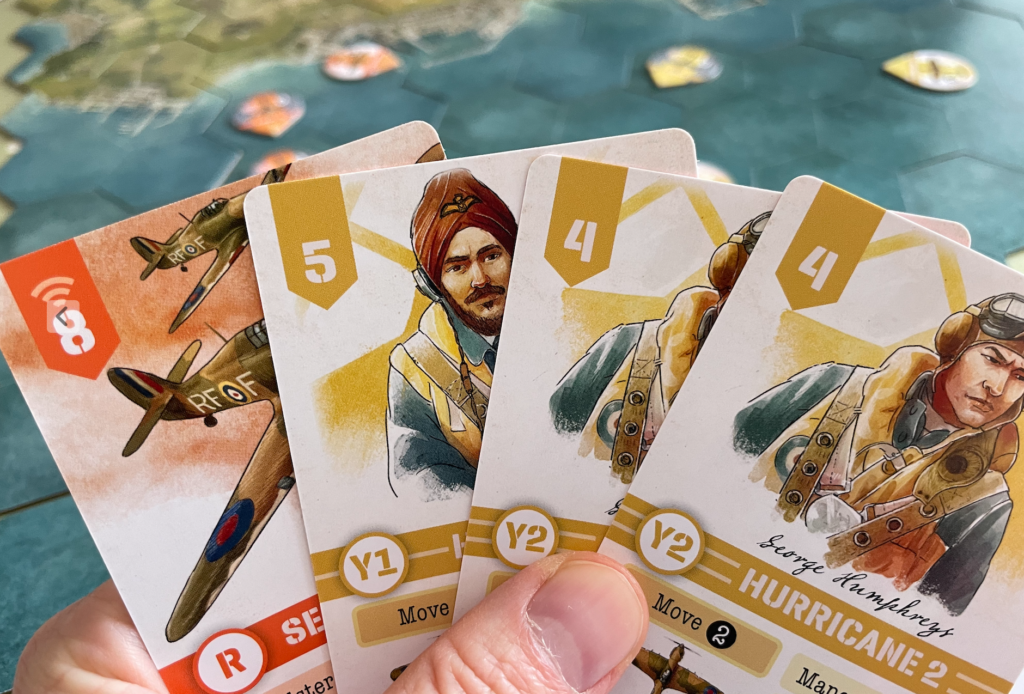
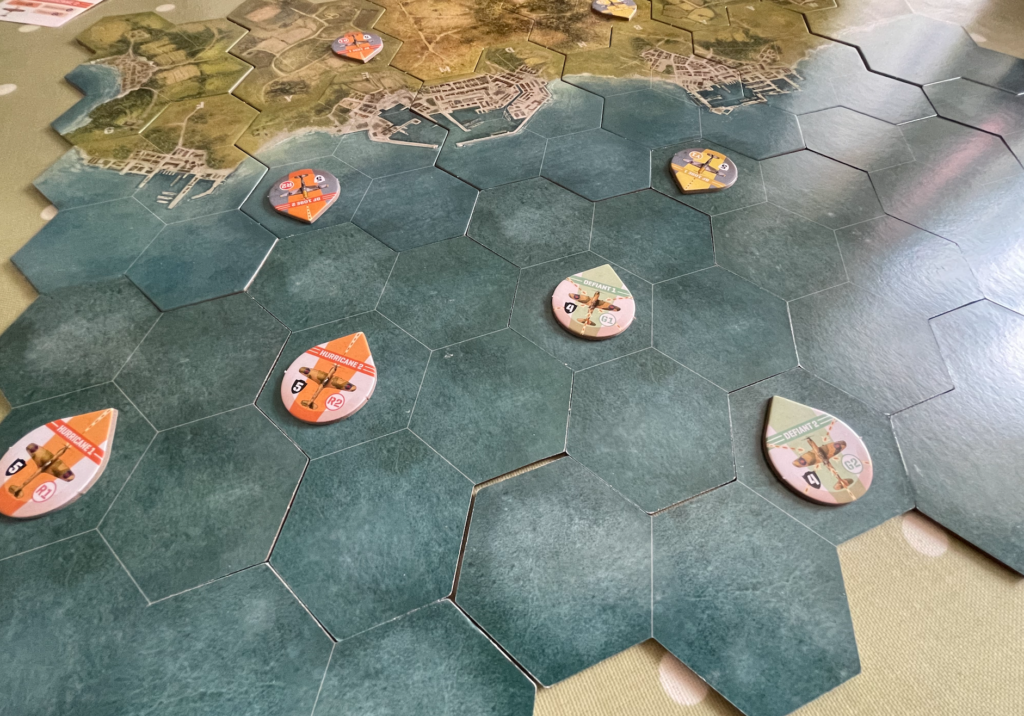
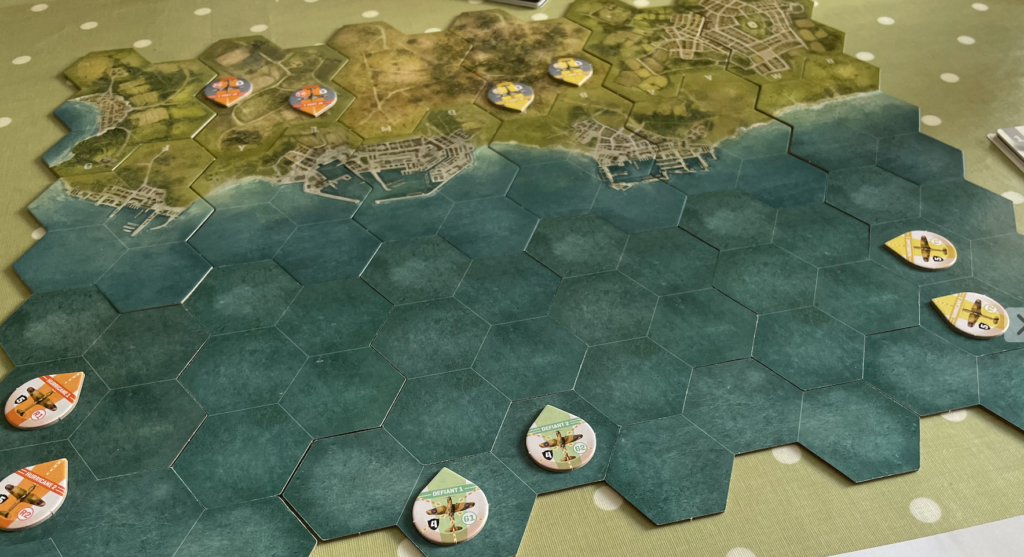
Undaunted: Battle of Britain is a two-player battle of the skies, recreating moments from the pivotal air battles of WWII. One side are the RAF, and the other the Luftwaffe, each with distinct airplanes and objectives.
The game comes with a scenario book which gives you ten different battles to explore: they can be played in any order, but start with the simplest, which we’ll explain in brief here. The board is made up of tiles which mark out the available airspace. Both sides have planes – in matching sections – in their starting positions, and a deck of available cards, plus a supply deck, from which you can add more cards to your deck during the game.
In each round, both sides draw four cards from their deck and then play a card for it’s initiative value – who goes first – and then play begins in earnest. Each card is either a Combat card corresponding to a specific plane of yours on the board, or is a Communications card – we’ll come to the latter shortly. Combat cards are played to move planes: the card tells you how far it can move, how many manoeuvres (turns) it can make and how many dice it rolls when attacking. Note that a plane cannot manoeuvre on the same turn it attacks, and vice versa. And it must always move at least one hex. Each manoeuvre allows your plane to turn by a single hex side: if you’ve a manoeuvre value of two, for instance, you can turn one hex side but then must move before turning again: being planes, they can’t simply do U-turn or take a hard left!
Combat is simple: each plane has a defence value that gets added to the distance from the attacker, and if any of the dice rolled equal or exceed that number, it’s a hit: the defending player must discard a combat card for that plane from their hand, discards, or deck. If they cannot do so, the plane is neutralised. In scenario one, the RAF need to neutralised two enemy planes to win, whereas the Luftwaffe must neutralise three.
We did mention communications cards, though, and here’s where Undaunted takes on more tactical nuance. Communications (comms) cards can be powerful, but their effectiveness depends on the aircraft from the matching section being within two hexes of each other: further apart, they are considered to have lost radio contact – playing them now will add Discord cards to your deck! These are bad. But before we get to why, let’s look at what comms cards can do.
Comms cards can be played for a number of things: inspiring a previously-activated aircraft to move and attack again, commanding more cards from your deck into your hand for playing this turn, bolstering to add cards from your supply into your accessible deck, or co-ordinating to shed discords from your hand.
Discord cards are unhelpful. Representing the chaos of battle, they clog up your hand and can only be used for initiative. So getting shot of them is a real boon. The sum total of the card mechanics may sound like a lot to think about, but once you’ve played a few rounds of scenario 1, things speed – and hot- up, with combat cards very easily understood and comms cards giving you room to manoeuvre in slightly less literal, more strategic ways.
As the scenarios develop, Undaunted slowly introduces some further concepts in barrage balloons to avoid, ships or land targets to bomb and different objectives to be met.
Sam says
Although I’ve not played others in the Undaunted series (Africa, Stalingrad) I enjoyed Normandy a lot and Battle of Britain feels like an evolution of that system. It’s quite convoluted to explain for a game that, once up and running, speeds along fairly breezily, but what’s great about it is the tangible feel that it was designed with the actual history in mind. With war-themed games there’s a double-edged sword: if they are not re-examining the history with a critical eye, they can feel oddly celebratory. But beyond the sense of play that a game is meant to provide, there is something to be said for keeping history in mind, and board games are part of the cultural heft that takes that responsibility on. Obviously it’s not an depth critique of the insidious nature of fascism, but games like Undaunted serve as both a functional thing, and part of the broader legacy we are all part of.
-

Take That!
High. It is after all a fight, and often to the death.
-

Fidget Factor!
Low, once the rules drop away and the focus is on the play instead. Unless someone is a real agoniser, turns tend to be pretty zippy
-

Brain Burn!
The hand of cards being limited to - usually - four prevents the brain being overloaded with a multitude of options. Tactically, it's about attack and defence on the board (if you're unable to attack, you can still potentially pilot a plane to a relatively safe space) as well as managing the cards at your disposal, and trying to avoid having a hand of discords.
-

Again Again!
There's a whole bunch of scenarios to explore, and each one is asymmetric and eminently revisitable.


