
Vijayanagara: The Deccan Empires of Medieval India 1290-1398
Designed by: Aman Matthews,Cory Graham,Mathieu Johnson,Saverio Spagnolie
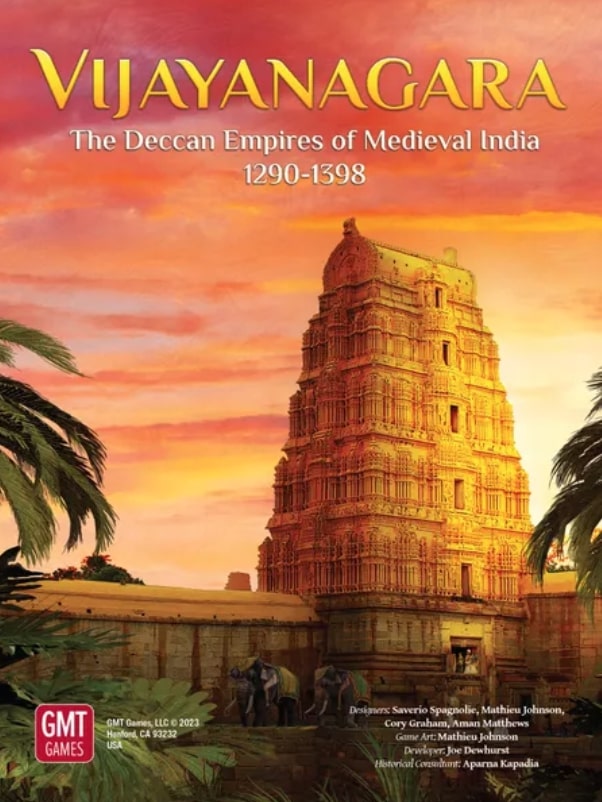
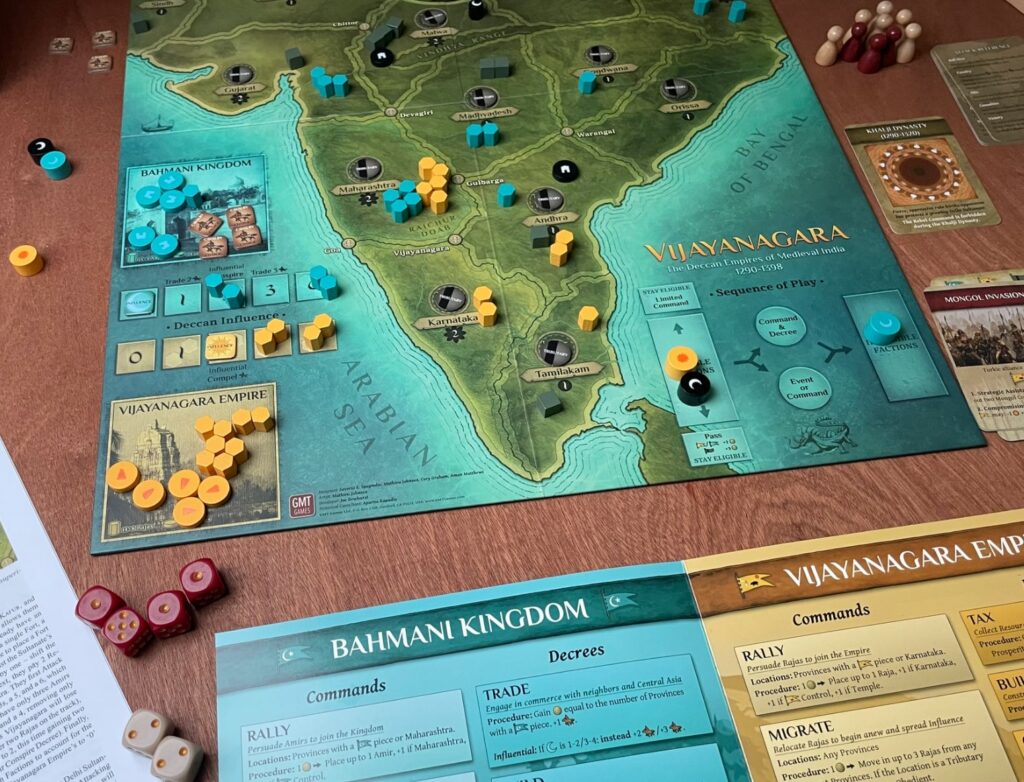
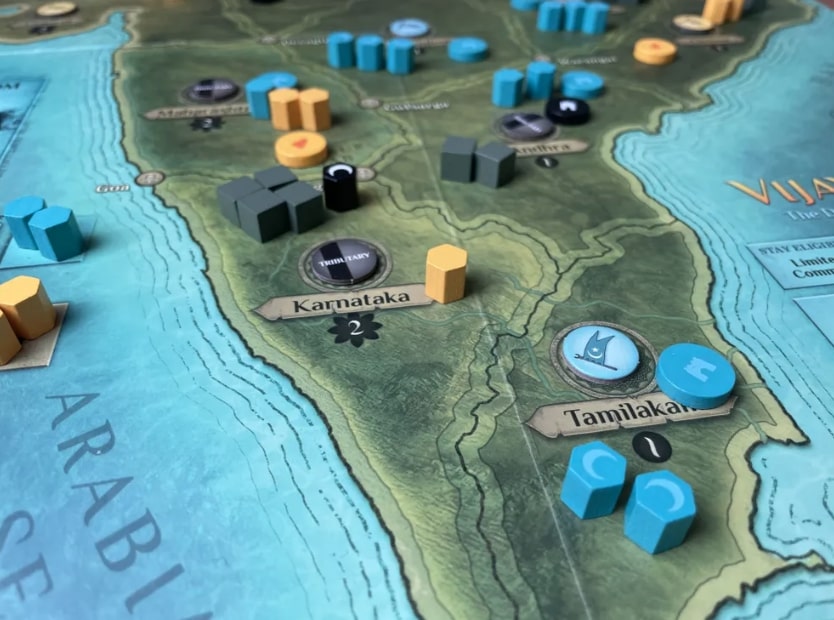
Vijayanagara: The Deccan Empires of Medieval India 1290-1398 is a game for, ideally, three players, where a trio of empires struggle for control of the subcontinent. Vijayanagara isn’t just a punch-up though, but a landscape of shifting sands, temporary alliances, and careful management of resources.
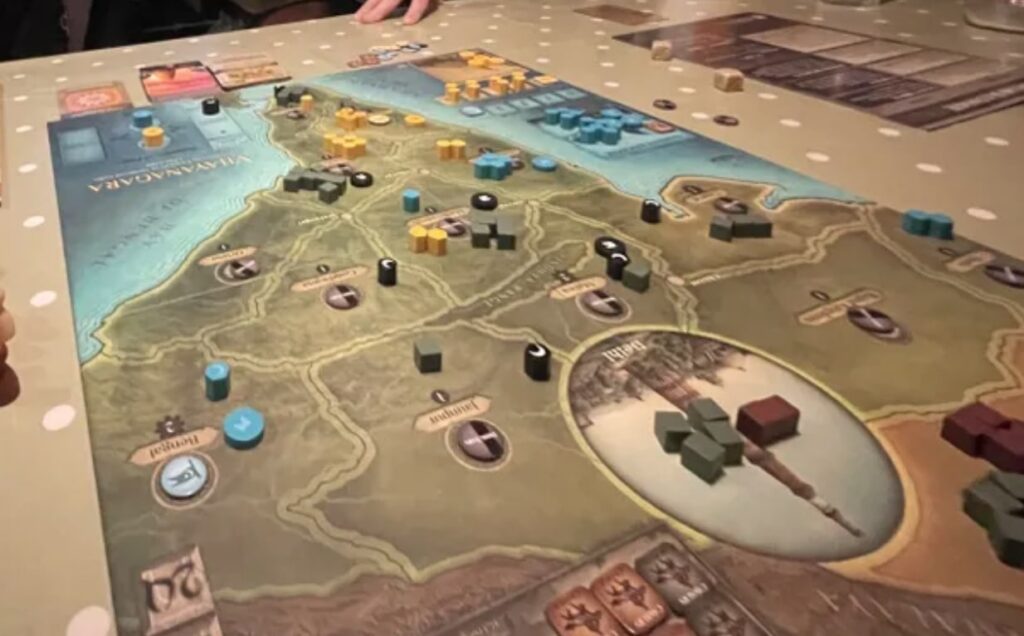
One player is the Delhi Sultanate, who begins the game in control of every province on the map. Each province has a prosperity value, so when the game begins the Sultanate’s victory point marker is all the way up at a maximum of 18. They also have access to a large number of troops, so life seems pretty rosy.
But in the south, there’s stirrings of unrest. Minor empires Vijayanagara and the Bahmani – the other players – can sense the Sultanate weakening and are eager to capitalise. As the game progresses, they will take control of provinces – and their prosperity value! – pushing their victory markers up the track, and devaluing the Sultanate’s in the process.
Everything takes place with the flip of a card: each round a new card gives players a turn order and offers events to be claimed and actions to be taken. Each player’s reference sheet gives them a set of Commands and Decrees: both are essentially actions, and without going through them exhaustively here the commands are basically get pieces on the board, move pieces on the board, attack enemies and – for the upstart empires – rebel against Sultanate control, taking a province for yourself. Decrees involve constructing buildings – worth a victory point, but also helpful in battle – gathering resources (which are needed to pay for commands) and, for every faction, some kind of political or cultural manoeuvering to bend things your way, like causing an opponent piece to defect to your side. The Sultanate’s actions are largely the same, although they have more pieces at their disposal. But they have other concerns too, as we’ll see…
The first player has four options: they can take an event, simply following the text on the card. They can Command and Decree (both; in as many different provinces as you can afford), they can take a limited command (in one province only) or pass, to collect a few resources. Why would you do these seemingly underpowered latter actions, when both the events and command + decree are several degrees more appealing? Two reasons. One is that you may have no choice: only one player can take the event, and only one make take Command + Decree. The other is that the latter option, and many Events, make the player ineligible for the next round, leaving them at a temporary disadvantage. So you might choose a limited command anyway, because you sense the next round is when you’ll make a particularly daring move!
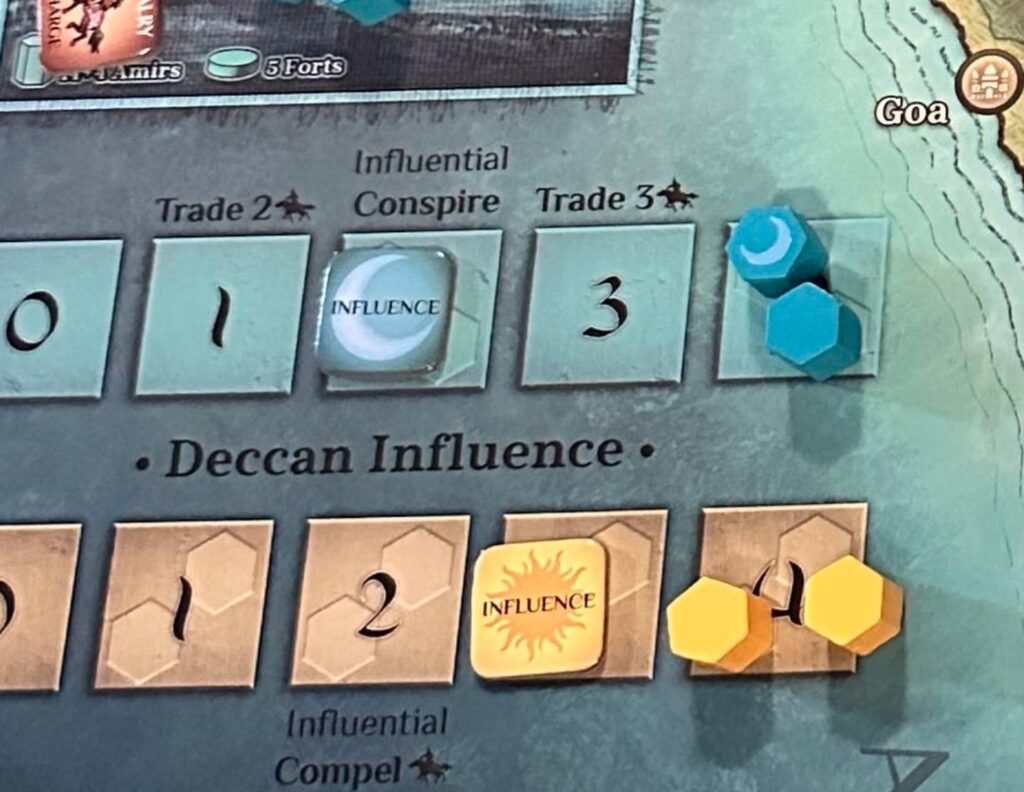
The Bahmani and Vijayanagara players both have an Influence track on the board, which certain events or actions cause to rise and fall. Their influence also has a direct correlation with their victory marker (eg influence +1 means victory marker also +1) but perhaps just as crucially, having increased influence also boosts your commands/decrees. It also means you can strike deals with the Mongols when they invade, potentially adding Cavalry (-useful for combat) to your arsenal.
The Sultanate player is powerful at the start, but faces a battle. As well as the upstart empires to deal with, there are also Mongols invading Delhi from the north (triggered by cards seeded in the deck). When they attack, they also plunder, causing the Sultanate to lose troops dotted around the map. When the game ends – again, triggered by cards seeded in the deck – they also face a final Mongol attack, from which they can potentially glean a substantial 3 points if they survive it. But they can lose up to 3 as well…
Sam says
Not a lighthearted one for the family after dinner, but also not a dense 6-hour rules-heavy behemoth that publisher GMT’s titles sometimes skew towards. Our first play of Vijayanagara took two hours, in part because once past the nomenclature of tax, migrate, compel, et cetera, the actions are actually fairly simple… and in part because Vijayanagara is not an optimising game of high strategy and long-term planning: it’s a reactive, tactical fight, where the landscape is constantly shifting and you need to try and further your own goals whilst simultaneously undermining others. Not being much of a long-term strategist, this really lands in a great place for me as an experience, and I love that the setting isn’t yet another WWII/Civil War theme but an oft-neglected aspect of history in gaming, away from the western fronts. It looks great, plays great – is great. As long as you don’t mind a bit of nasty.
-

Take That!
There is a very high quotient of shenanigans. It’s not a game for the easily-slighted.
-

Fidget Factor!
The classic first-play issues of gaming will be tangible on the first few rounds, as everyone gets a handle on the cogs and wheels and specificities of their own faction. But when you’re up to speed, things move along pretty quickly.
-

Brain Burn!
Vijayanagara is a game that constantly presents you with options: sometimes they’re easier choices than others, but the task at hand is developing (or keeping) your power on the board whilst undermining others. Timing is critical too: not only on when to make the sacrifice of ‘ineligibility’ – essentially, missing a turn! - but making sure you’re in a strong position as the game reaches it’s final furlong.
-

Again Again!
Each play of Vijayanagara has some randomness in the cards (you never use all of them in one game) and you can also try the different factions. Combat involve dice rolls – mitigated by Cavalry, to some extent – so there are plenty enough variables to give each visit a distinct story.


