
Wilmot’s Warehouse
Designed by: David King, Richard Hogg, Ricky Haggett

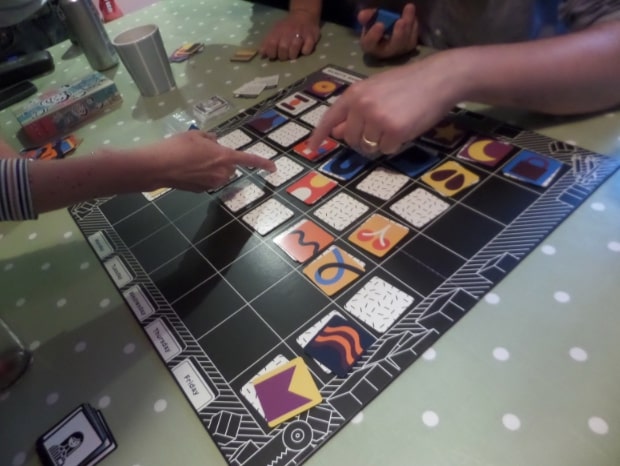
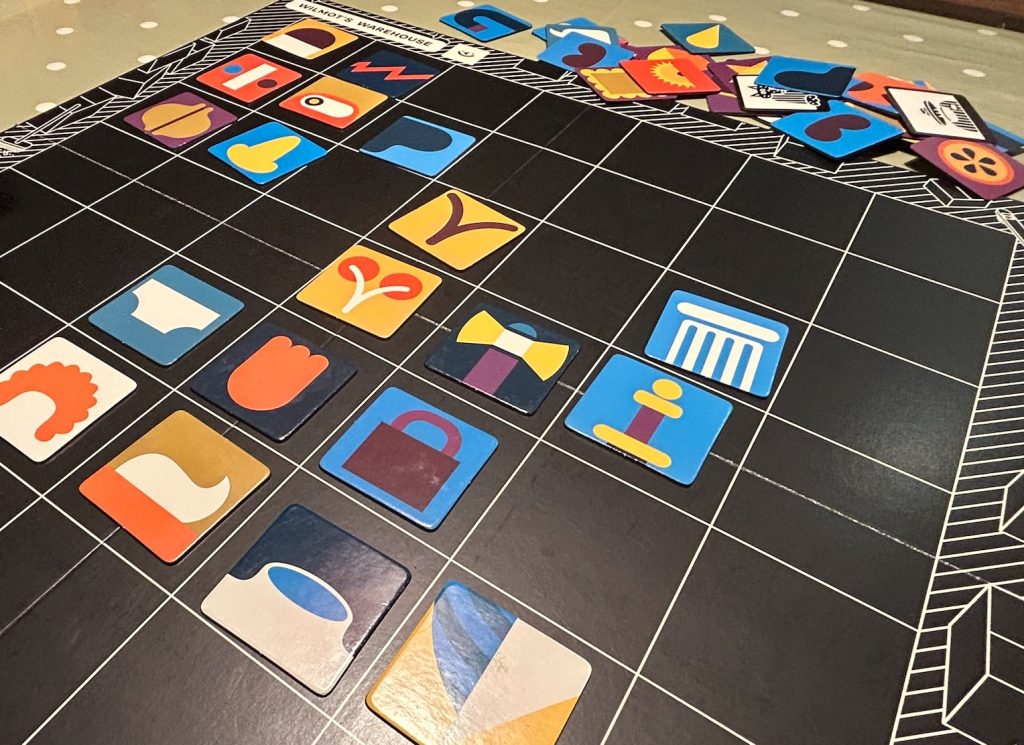
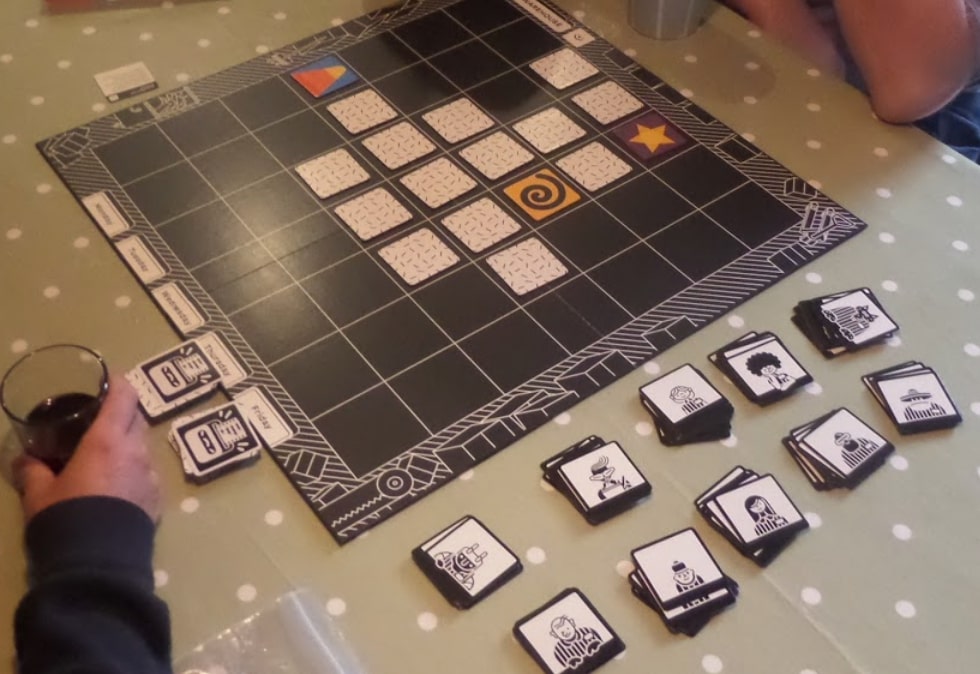
Wilmot’s Warehouse is built around a simple construct: how telling stories work as an aid to memory.
The premise of the game is that we are warehouse workers, placing various boxes into the bays of the warehouse where the customers – who arrive at the end of the game – can find them. Each of the five rounds represent days of the week, and one by one, another tile is revealed and looked at by all the players – who may now discuss where best to add it into the warehouse. There are two catches: one is that it must be adjacent to a previously-placed tile. And the other – critically – is that it is played face-down.
This means the ongoing challenge is remembering which ‘parcel’ is where, and the way Wilmot’s Warehouse encourages you to navigate the challenge is by telling a story. Maybe a certain tile looks like a nose, so you place it next to where you placed the flower, as a character coming in to sniff it. The next tile looks like a bucket, so your nose character ‘buys’ the flower and places it in a bucket. The stories players tell as they play get increasingly absurd… but as a way to remember the locations of all the parcels, it (can) work surprisingly well.
When all parcels are in place, players divide up the customer cards: there are hundreds, but you know 35 of them will match the parcels. Then everyone gets five minutes to place the customer cards where you think they match the parcel underneath. Players can discuss and debate, but your score, if you care about such things, will be higher if you do it quicker. After all cards are placed (or the time runs out) the parcels are revealed again: ideally, matching the customers! There is a scoring system based on time spent and number of wrong matches. Once you’ve played the base game, you can add in the Mandatory Idea cards, that bring an extra rule specific to each day in the warehouse: for example, players may only say one word, or something like that. The game is flexible: if you get a mandatory idea you don’t like, you’re encouraged to switch it out for another.
Sam says
The game is essentially a placing of 35 tiles face-down, and trying to remember where they are. But if that sounds an underwhelming premise for the half-hour or so Wilmot’s Warehouse takes, then be reassured that, if you enjoy games that test the collective memory of the group, it’s a surprisingly fun undertaking, and the story-creating dynamic is a more powerful mnemonic than you might suspect. A great one for families too – kids often have better recall than adults.
-

Take That!
None – the players work co-operatively
-

Fidget Factor!
Everyone is involved on all turns
-

Brain Burn!
Very low on the rules! Monday to Friday is basically ‘place a tile face down’.
-

Again Again!
There’s a huge bag of parcel tiles, most if not all of which have more than one interpretation as to their visual meaning.


