
World Wonders
Designed by: Zé Mendes
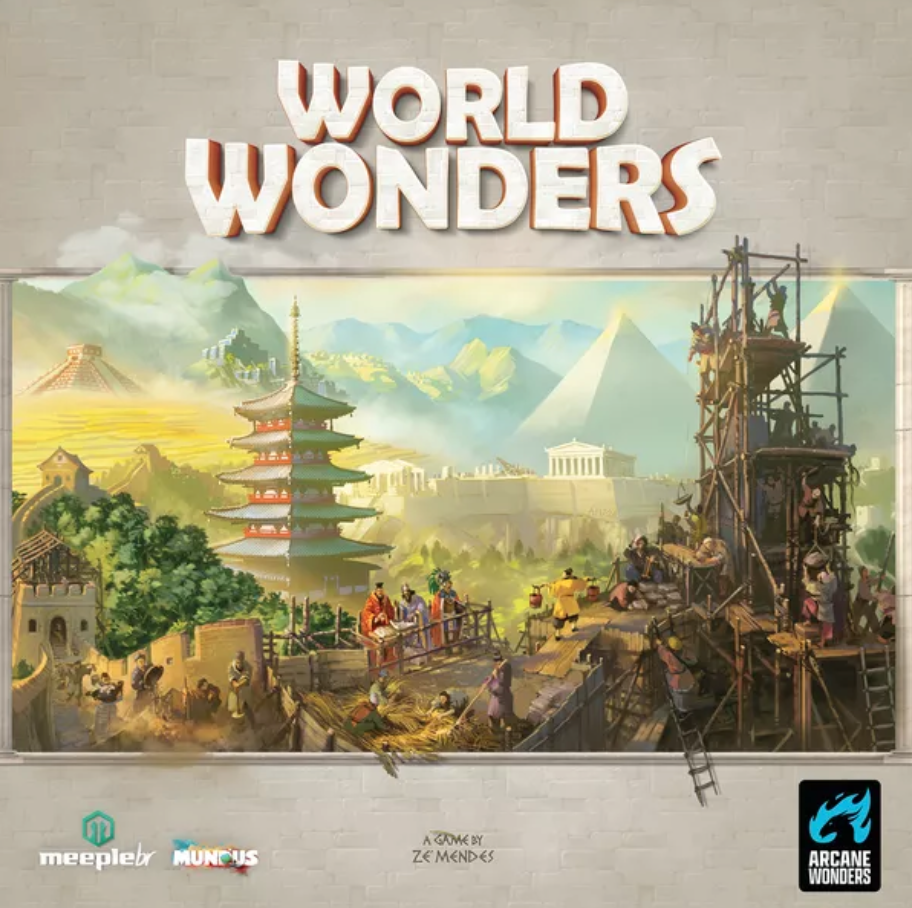
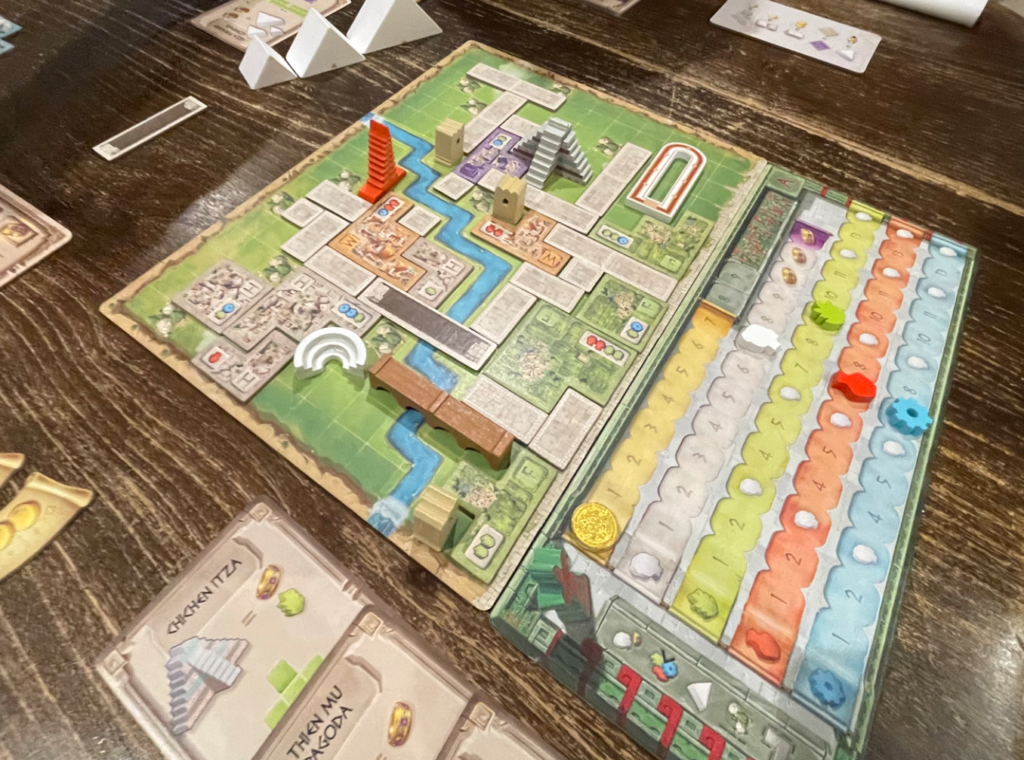
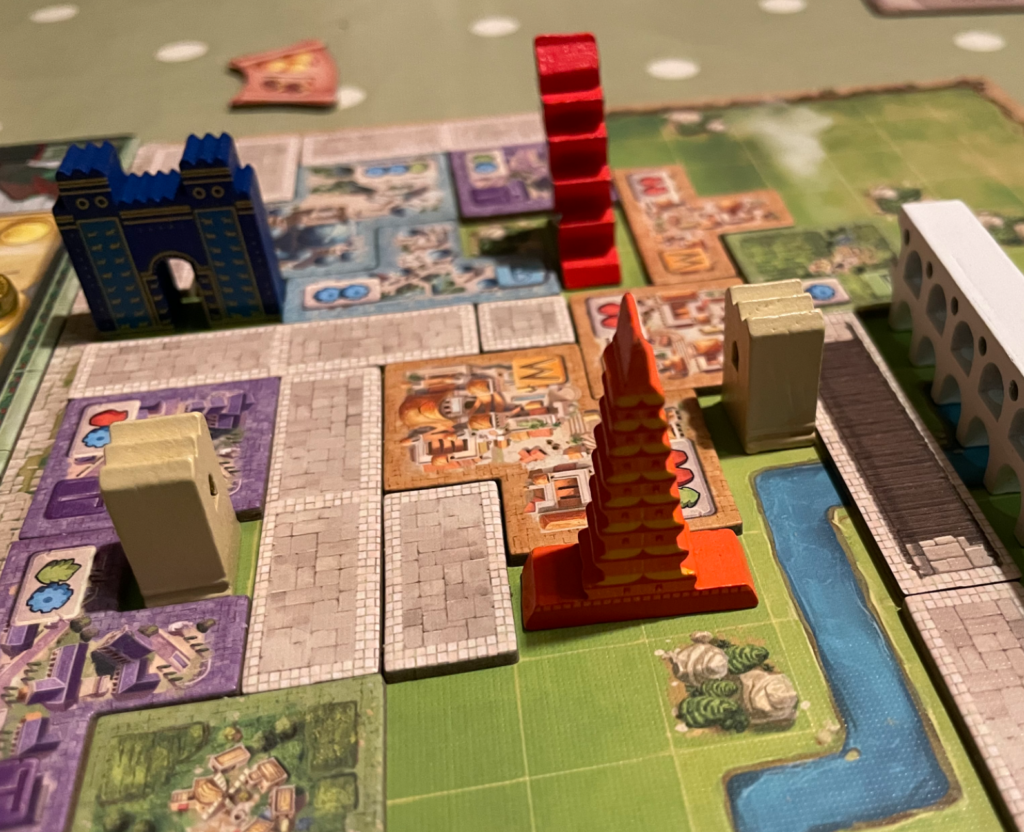
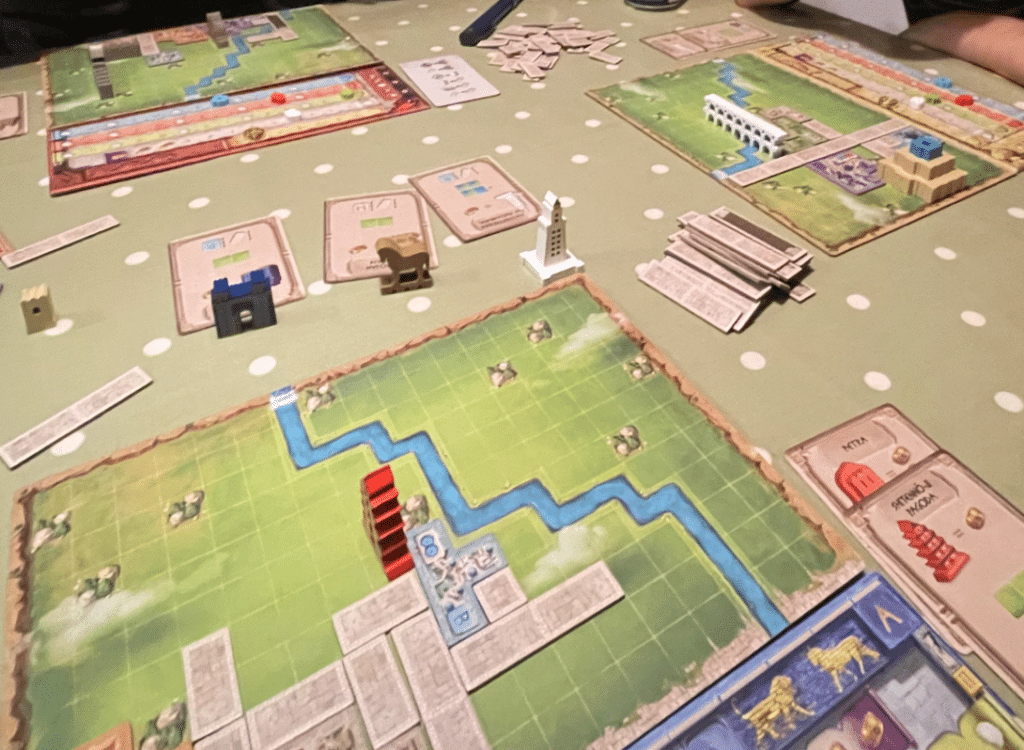
In World Wonders, each player is building their own unique society on their own, Tetris-like map board: buildings, roads and towers… and of course, the wonders of the title. With happy disregard for geography, history, and scant attention to planning permission, everyone is trying to score the most points by surrounding buildings, accessing natural resources (printed on the boards), and pushing up their resource tracks. Plus, of course, the wonders themselves.
The game plays over ten rounds and in each round each player has seven gold to spend. Central on the table is a market where a number of building tiles will be available, along with the comparatively cheap roads and tower. In turn order you spend gold to buy these tiles, adding them to your own board following some simple placement rules: buildings must go next to a road or a building of their own colour. Roads must connect to either another road, a tower, or the bottom of the board. Towers can go next to any previously-played piece, and are a helpful way to fill holes, or start new a road construction. You can also spend one gold to move up to first or second in turn order, which is nice as your get more choice!
The wonders always cost whatever gold you have left (at least 1) so building them later in the round is more beneficial. They each have a card that shows where they want to be placed (eg next to a blue building and a road) and what you get from them: usually just a point, but sometimes a little boost up your resource tracks.
Oh yes, resource tracks! Everyone has a second board where they track their gold and resources: placing a building always triggers movement on at least one (often more) resource track, so you move the matching marker up, which may in turn trigger movement on another. You don’t need to really worry too much about the resources because they are never spent: their sole purpose is that at the end of the game you’ll score your lowest resource in points.
Finally, players have the option of taking a loan at any point (although you can only take a second if you’ve paid back the first). Loans give you two extra gold to spend, but cost three gold to pay off. If you’ve an unpaid loan at the end of the game, it costs you two points.
Sam says
The appeal of World Wonders is twofold: the spatial pattern-forming satisfaction that has seen Tetris remain such an appealing game to so many in an age of VR and gazillion-bit consoles, and the rather beautiful wooden pieces representing the wonders. I don’t think ‘great bits’ are ever a substitute for a great game experience, but fortunately World Wonders is a solid game, possibly best for 2 or 3. It’s a mite more fiddly than some polyomino games, and there’s an argument the wonders are underpowered as they only actually score a point (I have seen it suggested they score a point per number of requirements instead, which seems a good idea). But it’s nice that the wonders give the game a little extra tension, because maybe both you and I can build the Ishtar Gate but neither of us want to overpay for it (we’ve found the pyramids often remain unbuilt as they demand so much space!). I don’t think it’s a unique game mechanically in any sense, but it’s a very nice combination of elements, and the presentation is top notch.
-

Take That!
Nobody can interfere with your board or steal gold. The only sense of interference is other players claiming tiles and/or wonders you wanted.
-

Fidget Factor!
With four or five players the game can start to stretch out into slightly ponderous lulls, as you’re waiting for 3-4 people to make decisions involving what tiles are available, what gold they have, the state of their board and so on. The pace feels friendlier and more consistent with what the game is trying to be with 2 or 3 players.
-

Brain Burn!
See above! What can you afford, where can you place it. Is it worth making a space for the Moai statues if someone else might get them first? Most of the burning relates to the spatial element, but there are other aspects to factor in.
-

Again Again!
World Wonders might not feel like an all-time classic, but it must be said we’ve found it very moreish!


