
High Frontier
Designed by: Phil Eklund
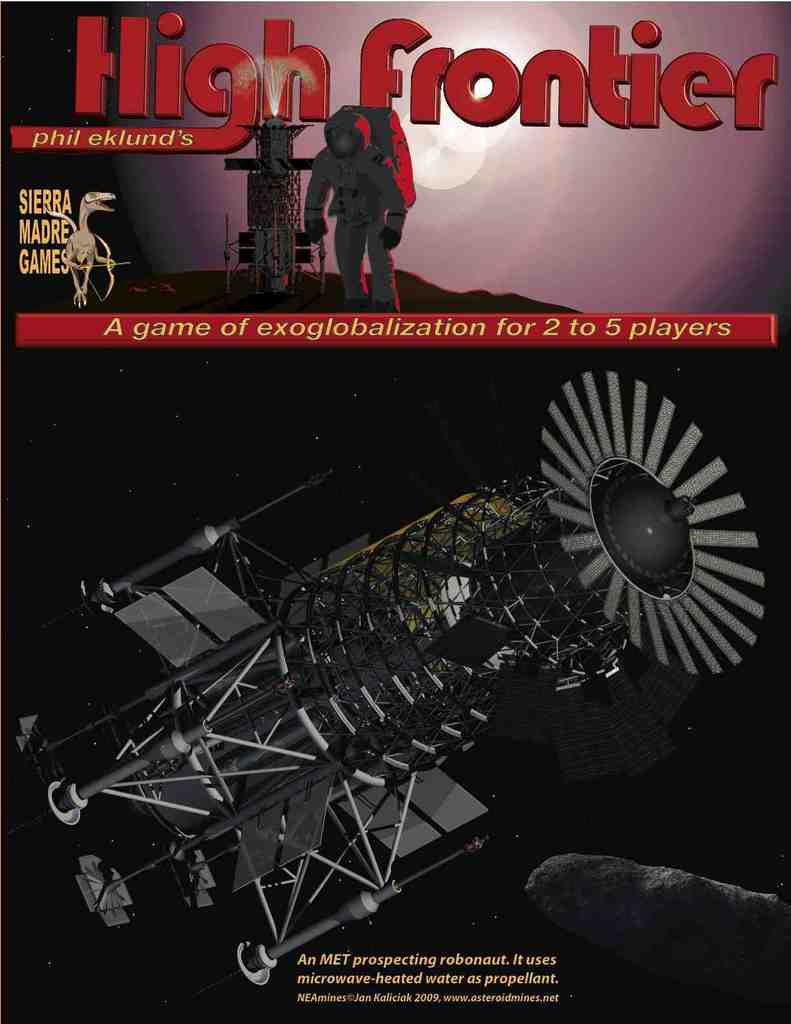
There are space games and space games – if you want to fly a jerry-rigged spaceship through pirates and meteor storms, go for Galaxy Trucker. If you want to develop technologies and fight crazy battles, then Ascending Empires, Quantum or Eclipse will float your boat. If however, you want to go through the genuine, thematically sound (the game is designed by a rocket scientist) struggle of building a rocket, getting it off the ground and somewhere – anywhere! – off Earth, then High Frontier is the game for you.
Every player starts on Earth, with the same goal – build a rocket, get it into space, try to land somewhere and establish a factory – having done so, you can begin to sell what you produce back to Earth. The currency of the game is water – water is what powers your spaceships, and it’s what you bid for your rocket components whilst still on earth. So far, so simple. But how much you spend on building your rocket will affect how much water you have to power it. If you can get it into orbit, that’s a good enough place to refuel. Having done so, you then need to move on into deeper space, and generally speaking the farther you go, the greater the potential rewards. But as well as building and powering, you need to factor in a couple of other things: first, how heavy your rockets are. If you’ve loaded them up with water that’s great, but they now weigh a lot more and their movement is compromised.
Secondly, where are you going to land and prospect? Different destinations have different mass, and therefore different gravitational pull. You need to factor that into your thinking too. And despite all your careful planning, you might find that at a rather inopportune moment, your spaceship explodes. Deep at the heart of this carefully thought-out and intricate game of planning and economy, is the simple roll of a die to determine success or failure. Why? Because that’s what space exploration is like! Just ask NASA.
Sam says
High Frontier is a game I can admire from a safe distance. For my tastes it’s rather long; and for my limited cognitive power, it’s rather heavy, and it feels like a game with the least abstraction possible for the subject matter: more like a simulation, in fact. Some people absolutely love the immersive experience it offers, right down to the potentially doomed destinies of all your hard work. I get that; but for me a game needs to be slightly more *fun* in an instantly-gratifying sense, with less of a huge obstacle to find your way through the door, before – hours later – finally into space. Perhaps if I revisited the game a few times I would move past that sense of obfuscation and enjoy what High Frontier – designed by a rocket scientist, no less – offers. But my one experience was a five-hour marathon, and I’m not sure I got enough out of it to return.
-

Take That!
Bidding can be important in High Frontier, but there's no space battle - at least, not in the basic game.
-

Fidget Factor!
Potentially high. High Frontier is a game that demands thought and at times, a bit of calculation.
-

Brain Burn!
High. The game will sometimes offer simple decisions, but other turns may be a little more taxing...
-

Again Again!
It's rather long and can be unforgiving. But if you like space as a theme there's no truer more honest representation of attempting the near-impossible - and potentially pulling it off.


