
Othello
Designed by: Goro Hasegawa, John W. Mollett, Lewis Waterman
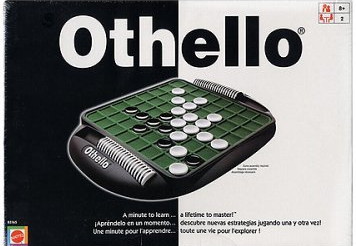
Othello is an abstract game for two, made up of a board and a set of double-sided discs – black one side, white the other. The different colours represent either player, and your goal is to have the most discs on the board showing your colour.
Play begins with 4 discs in the centre of the board, two of each colour. On your turn, you add a disc – ‘your’ side up – adjacent to the discs already there. The disc you place must bracket an opponents disc/s – i.e. you add a disc to a line where somewhere along the line another disc of your colour is present. All opponent’s disc in-between get flipped to represent your colour.
If you cannot flip any discs, you miss that turn.
Play continues until neither player can go or the board is full, at which point the player with the most discs face-up in their own colour – wins.
Sam says
The fact Othello is still going – relatively – strong after so many years (it originally appeared in the 19th century as Reversi) shows it has its fans. I have fond memories of playing this as a boy, and I like the almost instant accessibility of it. Strategically you’re trying to get your pieces into the corners, as those spots really are key to victory. Beyond that I’m more interested in the origin story, where two men both claimed to have invented it at the same time, before a century later, some tweaks were made by Goro Hasegawa, which became the known and accepted version after being used in an ad campaign.
-

Take That!
The entire game is a battle, so the Take That factor is high.
-

Fidget Factor!
Depends on who you're playing against, but the rules are simple.
-

Brain Burn!
Nothing to give you a headache.
-

Again Again!
It depends on your fondness for abstracts. There are games out there with far more variety, but Othello does reward strategic thinking and repeat visits will improve your game.


