
Rajas of the Ganges
Designed by: Inka Brand, Markus Brand
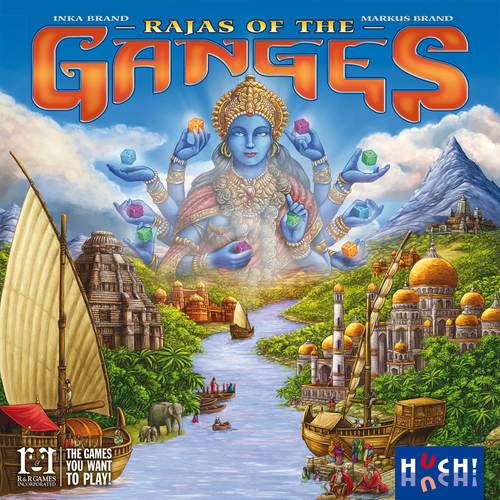


Rajas of the Ganges takes you back to 16th century India, and you the players are rival nobles seeking to develop your provinces and out-Raja each other, in a game of dice-rolling that nonetheless has little reliance on chance; your goal is to push your cash marker along one track (counter-clockwise) and your fame marker along another (clockwise) until at least one player has the markers pass each other!
You begin the game with two workers. In each round, players will take turns placing their workers on the board for a benefit of some kind – actions. When all workers are placed and actions taken, they return to their owners, and a new round begins. Players also begin the game with four dice (one of each colour) which can be used to pay for actions, and a province board they will develop during the game by laying connecting tiles on it.
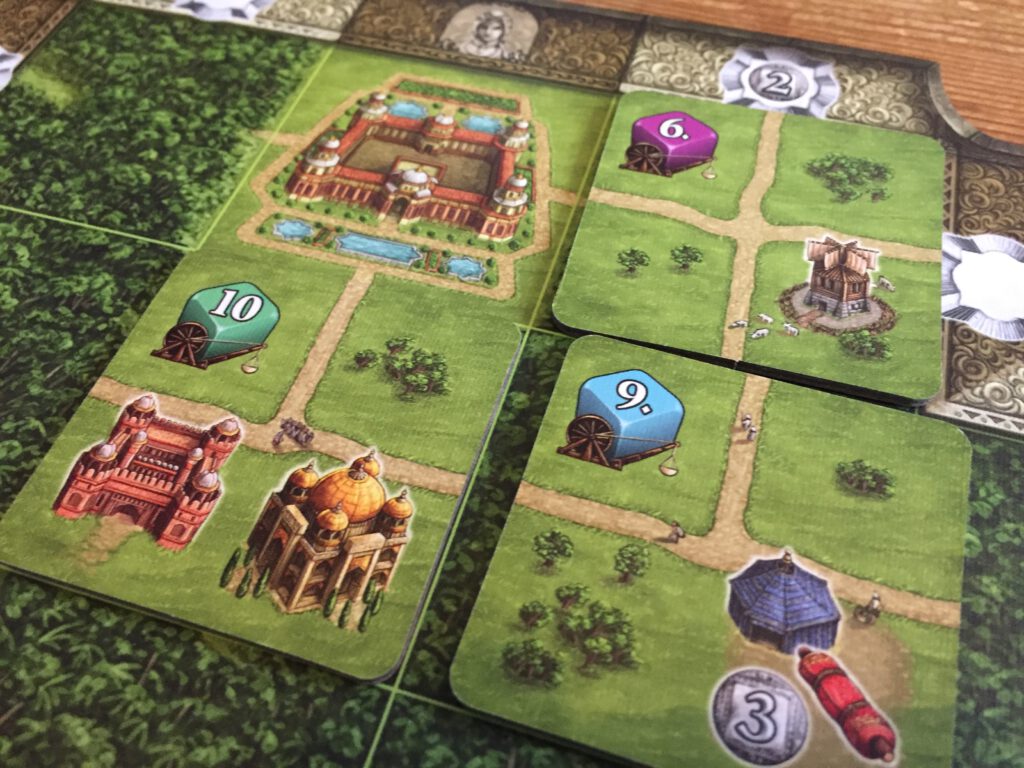
The main board is divided into several areas: perhaps most important is the quarry, where you can place a worker and pay dice to develop your own personal province board, which will define your success in the game: taking a province tile and using it to expand outwards from your residence at the top of the board. The tiles contain markets and buildings, and when you add them to your board they earn you money (markets) or fame (buildings). This is the nub of the game, as your goal is to improve your standing on both counts.
The rest of the main board itself is the various cogs you can turn to help yourself achieve these goals. Move your boat along the river for bonuses wherever you stop. Claim money for the markets on your province board at market place. Grab more dice, or take one of the six special actions at the palace. Dotted around the board are ways to increase the glory earned for buildings, and even a way to improve your karma: in Rajas of the Ganges karma is used to manipulate your dice – which can come in very handy when you need a particular number.
Certain points on the money and glory track (and the river) trigger extra bonuses such as more dice, boat movement, or even extra workers. The box also comes with options to play slightly different versions for even more powerful bonuses or special river tiles for when you’re familiar with the basic game.
Sam says
The busy board almost makes it look like you’ve fallen into somebody’s delirious dream, but – outside of the fact that Rajas probably didn’t utilise dice to this extent – there is a kind of loose thematic sense here, at least in the grand scheme of things. To be the best Raja you want the income of the markets and the fame of the buildings, and although it’s easier to make money, fame moves you twice as fast toward your destiny. If you behave well (i.e. get some karma) the Gods will smile on you and you can use that deistic warmth to change your fortune (i.e. flip dice over). Admittedly the economics of spending dice isn’t so thematic, but mechanically it’s very clever and the whole thing is quite the visual spectacle, with every turn having a sense of reward to it whilst the advancing markers around the edge of the board giving it a palpable tension.
-

Take That!
Players can block spaces opponents want, or take province tiles that someone else was eyeing up. But really the interaction here is fairly minimal.
-

Fidget Factor!
High on a first play, dropping substantially with familiarity.
-

Brain Burn!
The whole thing looks enormously busy and complicated, but really, you're just trying to generate money and glory. Once you see that everything else are ways and means to do that, it's not a massively testing game on the brain: there are a lot of options (more so with less players) but everything gives you something back: there are no 'wrong' moves.
-

Again Again!
Lots of variety in Rajas: not only do the dice and province tiles supply random elements, there are also different strategies to pursue on the board.


