
A Gest of Robin Hood
Designed by: Fred Serval
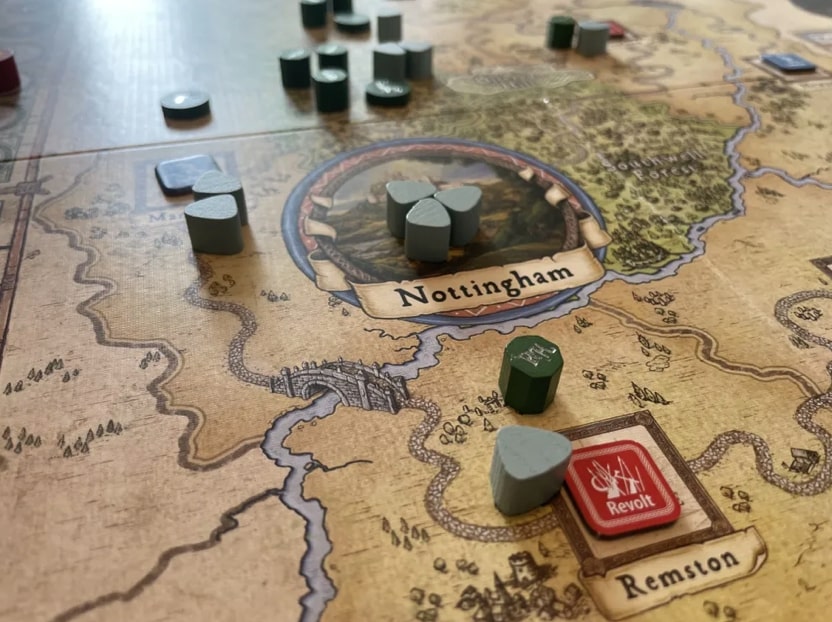
Inspired by the mythical figure of Robin Hood, A Gest of Robin Hood (-pronounced jest, meaning story rather than joke) is a two-player game of Robin’s guerrilla warfare versus the Sheriff of Nottingham’s brute force and extortionate tax-collecting.
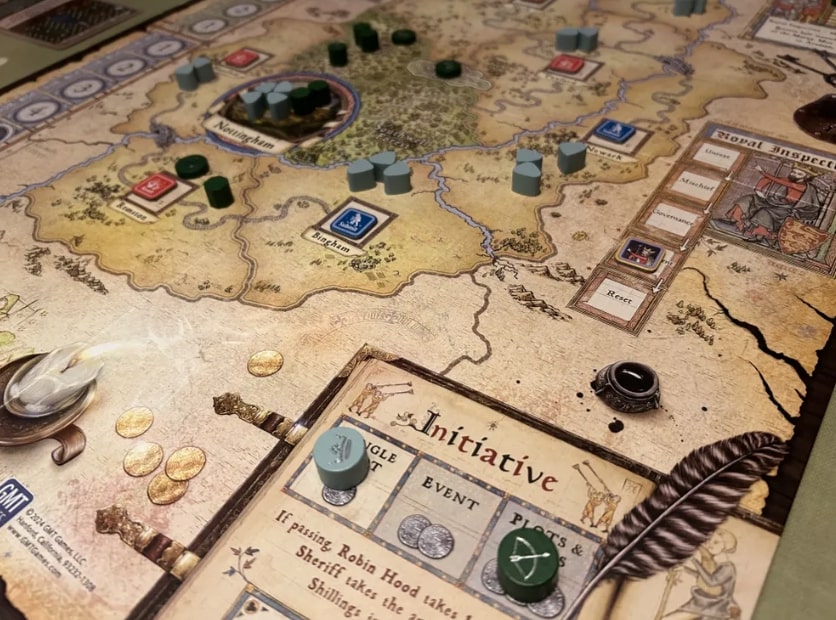
The game progresses through a series of card flips from an Event deck, which is carefully constructed before play begins. After each card is flipped, both ‘the Sheriff’ player and ‘Robin’ get to take actions, in order of eligibility. First eligible means you go first: you can activate one of the available events on the card – simply following the text for instructions – do a single Plot, or the more powerful Plots and Deeds action. Whichever of the three you take will not be available to your opponent – and the catch is that the more powerful actions are more likely to make you Second eligible in the next round, giving your opponent first choice.
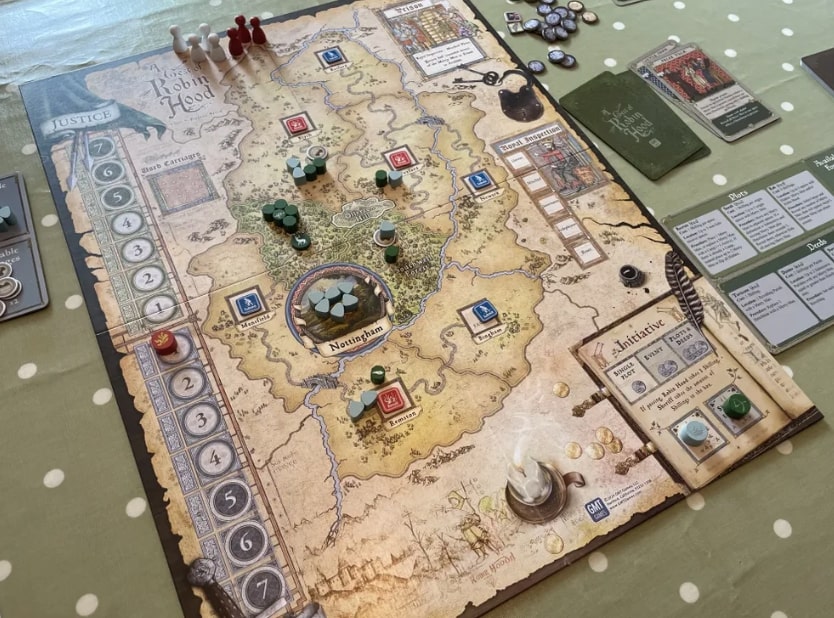
But we’re throwing around terms like Plots and Deeds, so what are they? Without getting into an exhaustive list, Plots and Deeds allow you to get up to all kinds of business on the board – adding more of your Merry Men (Robin) or Henchmen (Sheriff), moving them around the parishes of the board, robbing travellers (Robin) or taxing (Sheriff) and basically advancing your ideology: the Sheriff pursues lawful Order, whilst Robin is interested in moral Justice. The game tracks the swinging momentum between these two credos with a Royal Favour marker that moves up and down on the board between these apparently incompatible positions.
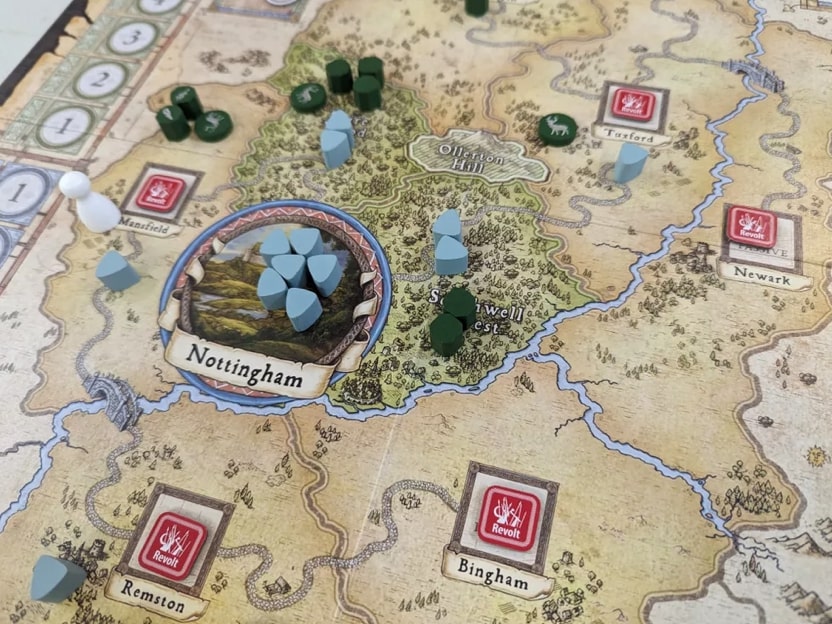
The Event cards also have a number that prompts carriage movement for the Sheriff player. One of the Sheriff’s plots is to Confiscate: taxing a local region and sending the ill-gotten gains to Nottingham along the roads of medieval England. Assuming the carriages make it to the city, the Sheriff will collect income, and potentially move the game marker towards Order… but at the same time, this causes unrest in the suburbs, as parishes previously submissive to the Sheriff break into Revolt. But of course, Robin and his Merry Men may try to rob the Sheriff’s carriages en route – a gamble the Sheriff can counter by sending ‘Trap’ carriages that, essentially, function as booby-traps for Robin and company.
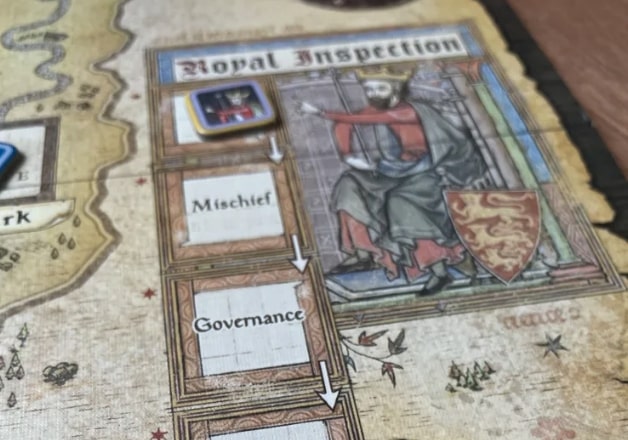
Every six Event cards or so, there is a Royal Inspection card. This is like the King popping by to check on things, and being potentially displeased by the numerous parishes in open revolt. They also function as a kind of mini-reset, as Henchmen evacuate revolting parishes and the Merry Men scurry back to Sherwood Forest. In fact it’s worth noting the geography of the board is important: the Merry Men are more effective in the forest than out in the open; the carriages move along the roads in order to reach Nottingham, and some neighbouring parishes do not actually count as adjacent for movement if they are separated by a river. When the Event deck runs out – the final Royal Inspection – the position of the Royal Favour marker determines who wins: Order for the Sheriff, Justice for Robin.
Sam says
Mechanically the game is inspired by the ‘COIN’ (counter-insurgency) game system used in Cuba Libre (and others). Publisher GMT has several games with the same ‘Event card’ sequence of progression, though they tend to skew towards a heavier set of rules than GNG generally go for. But this iteration, the Irregular Conflict Series, is simpler. There’s less forward planning, and so less cognitive load: the juggling of ifs and buts is confined to what is happening now: what are my opportunities, how can I hamper my opponent. Despite the plethora of text in the box, it’s relatively easy to learn (use the Learn to Play book rather than wading through the rules). Like most heavy games it’s best learnt by playing, and doing that yourself before attempting to teach it. But so much of the game’s narrative is tied up in the Plots and Deeds (and the Events that often refer to them) that once you know what they are, you kind of know the game too. And it’s an intriguing game! Using a fictional setting to explore themes of control, morality, capitalism and basic human fairness, it’s not perhaps the Errol Flynn of boardgames: more the arthouse version. But there is drama, and tension, and surprises, and plenty enough here to portray a Loachian version of Lincolnshire’s famous bandit – and his hard-nosed nemesis.
-

Take That!
The Sheriff can be robbed, Robin can end up in prison (although he will escape). Both sides struggle to bend the parishes to their will.
-

Fidget Factor!
Considering the subject matter, the game does not move like an arrow in flight – it’s a more inscrutable story than just men in tights v the baddies. But it’s not exactly glacial either, as the first eligible basically has three options, and second eligible just two. Within those options are further choices, of course, but once you’re familiar with your choices they become easier to determine.
-

Brain Burn!
For Robin, cash – which pays for certain plots or deeds - can be hard to come by, and the risk involved in robbing means it can backfire. For the Sheriff, income is more easily found, but the favour of the people is far more fragile. Managing each side’s weakness is as critical as utilising their strength.
-

Again Again!
You can play as Robin or the Sheriff, of course, but the game’s constructed deck contains elements of randomness, and Robin relies on dice going his way when he tries to renew the kitty with some illegal Robberies. Mainly though the difference between plays is the tactical manoeuvring in the parishes, and the semi-gambles that an imminent event isn’t about to undo your good work…


