
A Wild Venture
Designed by: Iain Everett
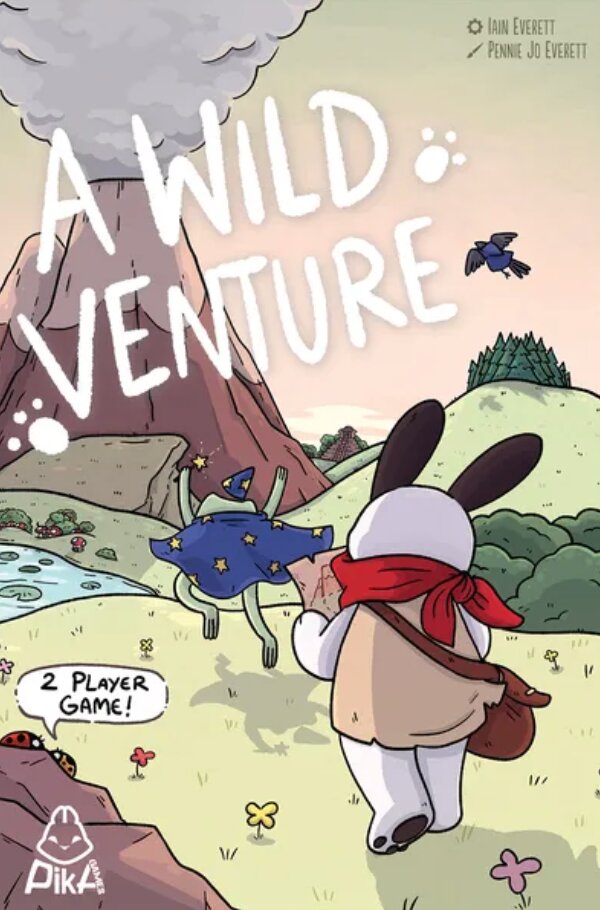


A Wild Venture is a two-player card game – that is, it comes with a (small) board, but the juice is most definitely in the cards, which give you various returns in the short term – and points later. The theme is a little opaque – a yearly competition, contributing to the village, winning the most votes… but what matters is who has the most points at the end of the game.
Your primary goal is to tuck cards, which means flipping them face-down. The cards come in three suits – Crow, Frog, Rabbit – and at the end of the game you’ll score your least-tucked suit multiplied by your most-tucked suit. Let’s say you finish with 8 crow, 5 frog and 4 rabbit cards: you ignore the frogs and score 8×4, giving you 32 points.
How do you go about tucking cards? Well, there are three kinds of cards as well, across all the suits: Buildings, Villagers and Gear. You begin the game with three buildings already in a row on the table (Nest, Lilypad, Warren) and can pay cash to add more buildings to the row. Or you can play Villagers or Gear into separate rows, each of which function in slightly different ways.
When either card is played they will have a number of Supplies added to them. You can activate the action on a Villager card by removing a supply from it, and when all supplies are removed that card will be tucked. Gear cards are not actioned, but triggered by a particular circumstance. When any player triggers anyone’s Gear, they get to take a supply from the card and turn it into cash (the game uses the same tokens for both). The benefit for the triggering player is the instant money; the benefit for the player whose Gear it is is that when the card is emptied of supplies, it gets tucked.
The actions themselves are largely facilitating this turnover of events (-get more cards, or more money to play them) or moving your piece on the board, which has several paths to travel along. The board largely syncs with the above: you take the benefit of wherever you piece stops on the path, and most of them simply give you money or more cards. Some, however, give special one-off powers, like tucking cards from your hand or flipping your starting buildings to their other side.
That’s mostly it – this rhythm of paying cash to play cards, and then emptying them of supplies to tuck them continues until the deck is emptied, and then there is a little end-game scoring where your largest haul of points will always be your tucked cards.
Sam says
Although it’s not that complicated, it’s quite a tricky one to explain and I’m rather mixed on this. I love the presentation and, once you get your head around the slightly oddball way things work, how quickly the game moves along. I also like the idea of anyone activating any Gear card – but in practice it does mean that there’s a lot of looking around checking text on cards, and that in turn suggests the game is best played side by side, rather than face to face – it’s just make it easier to reference everything. But my gripe is the overall length. It feels like it should last 30 minutes rather than the hour or so it takes: because there is no interaction at all on the board, and barely any in the cards, it’s a long time to spend on this build-it-up/burn-it-down pattern. I’d be tempted to shorten the deck, even though that might have downsides for balance. But it’s a moreish flavour, for sure, and I wouldn’t protest at playing it.
-

Take That!
Not a concern. There are Gear cards that your opponent can claim rewards from, but in doing so they're helping you towards tucking it, so there is a balance of sorts
-

Fidget Factor!
It moves along at a reasonable rate once you know what you're doing. But there are a lot of turns (see Sam Says)
-

Brain Burn!
A Wild Venture is constantly giving you more: more options, more rewards. But it's also taking away, as when those Gears and Villagers are emptied they get tucked.
-

Again Again!
The cards combine in different ways, and if the overall experience is samey, there's enough going on in the smaller beats of the game to make it feel engaging


