
Ape Town
Designed by: Reiner Knizia

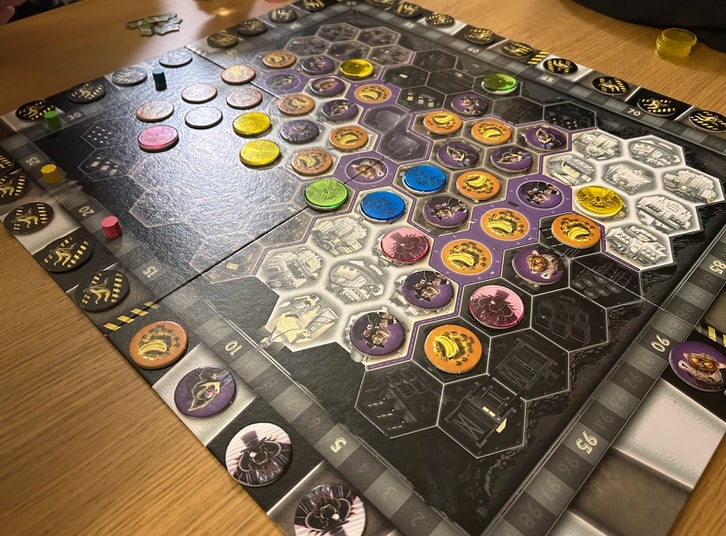
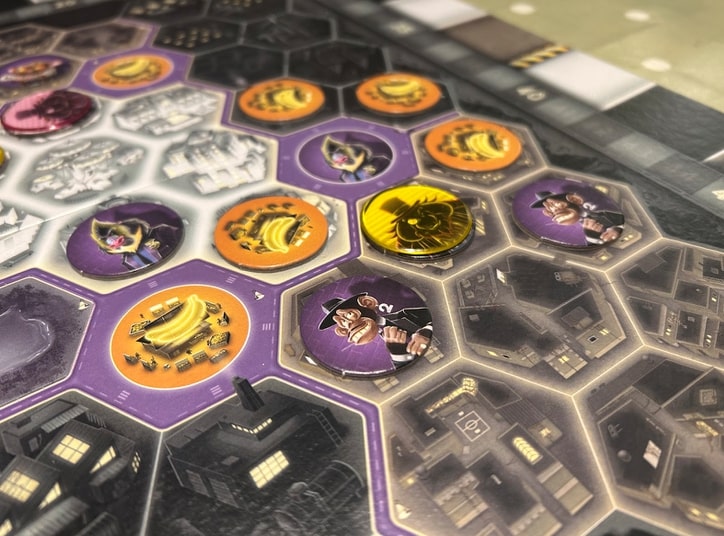
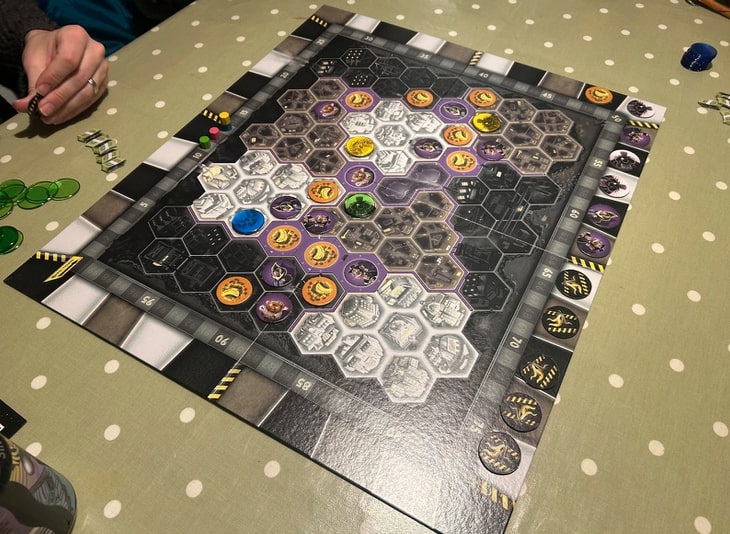
In Ape Town, players are simian gangsters intent on controlling a bunch of neighbourhoods. Each turn, players place an available tile onto any empty space on the board, potentially scoring points for it either now or later. When the board fills up and the neighbourhoods are complete, the game is over.
There are four different kinds of tile: apes, bananas, orangutans and lemurs. The tiles are placed around the edge of the board and the next one in line is always free to take: if you want another further along, you pay cash to every tile you jump past to reach it. Once you’ve chosen, you place the tile on the board… although there’s a crucial catch: the spot the tile was taken from always has a colour (black/white/grey) and the neighbourhood you place it in must match that colour.
Apes and bananas score you points immediately, simply by being next to each other: the more adjacencies, the better. Orangutans score for the apes in its neighbourhood the moment the neighbourhood is completed (ie no more room for tiles) and Lemurs act as a tie-breaker if two or more players have the same number of orangutans, and, crucially, will score points for apes in every adjacent neighbourhood where they outnumber the lemurs in it.
That is pretty much the game! If you take a tile with cash deposited on it, you get the cash as well and everyone’s leftover cash is worth a point at the end of the game, and the player with the most points wins.
Sam says
It’s a bit of a shame Ape Town’s presentation is – to me – rather uninviting: the monochromatic board, the tiny numbers on the ape tiles. They’re not dealbreakers, but I think it’s such a good game that the visual design doesn’t match up to it. I’m a big fan of this designer Reiner Knizia and I like his relatively simple rules + high levels of interaction. I wouldn’t argue you feel like an ape gangster – whatever that is – or that Ape Town is a bundle of laughs. Like Knizia’s Babylonia and others, the joy to be had here is in the tactical battle: the spotting of opportunities to cannonball yourself from a narrow last place to a narrow lead. The dynamic scoring – it happens as you play, not at the end of the game – is a key part of this too. It’s probably a little too abstract to resonate with theme, but as a feisty battle for dominance, it definitely ticks the boxes.
-

Take That!
Players are trying to control neighbourhoods, so it’s unlikely the entire game will play out without someone getting ousted as the current alpha.
-

Fidget Factor!
Because of how the tiles are revealed, and the fact only one of them is ever free, the game tends to rattle along at a reasonable clip.
-

Brain Burn!
Ape Town offers opportunities: definite points now, the possibility of more later? Take the free tile or spend cash – worth points – to skip past it? But it sensibly keeps the game largely confined to those two questions, along with the geography of the board itself.
-

Again Again!
The tiles always come out randomly, and player input determines everything else. It’s enough to sustain you over numerous plays!


