
Cascadero
Designed by: Reiner Knizia
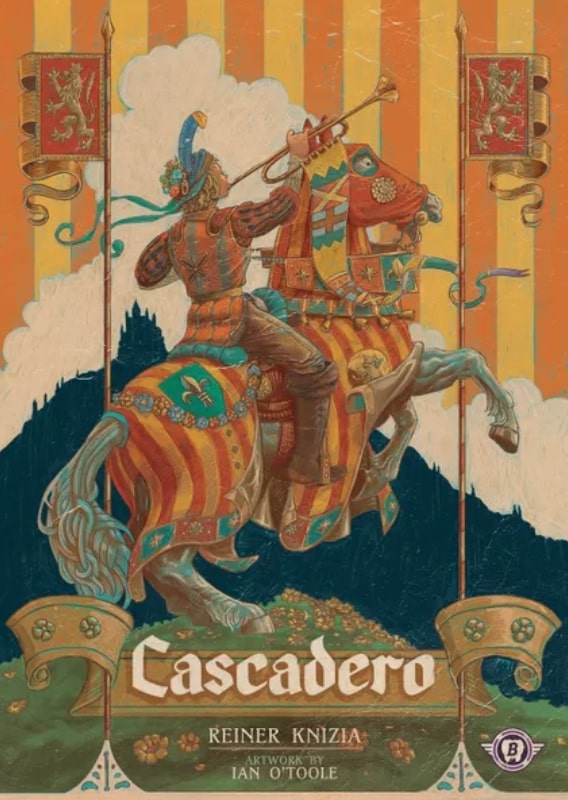


The story of Cascadero is that of a Kingdom broken, and the players sent out by the king to reunite the people. But although this isn’t an abstract game in the checkers tradition, that story largely falls away once you begin playing – like always from this designer, the focus here is on the mechanics, and the player interaction.
The board is made up of two parts – the geography of the kingdom, broken into hexes, some of which contain towns of different colours. The other part of the board shows four tracks, the colours of which match both the towns of the kingdom, and the player colours. This is an important point to remember: although all players move their cubes (representing progress in your quest to promote the king’s masterplan) up all tracks, you must reach the top of your own track – ie your own colour – before the game ends.
So how do you go about it?
Cascadero isn’t the easiest game to explain. Although the rules aren’t overwhelmingly complex, they can sometimes feel a little counter-intuitive. Basically, on each turn you place one of your Envoys on the board, adding it to an empty hex. A single envoy placed next to a town does nothing – essentially the townsfolk are unimpressed. But if a group of envoys arrive – ie, when you place an envoy next to a town and the envoy also connects to more of your envoys – you’ll push your cube-of-progress one space up the matching coloured track, triggering bonuses, which might include point-scoring, cube-pushing, or even bonus turns. If you ‘arrive’ at a town where there are already other groups of envoys present, you push the matching cube twice! So in short, action on the map fuels progress on the tracks, which in turn fuels progress up the scoring track.
There are some extra considerations. Some towns have Heralds in, who reward you with bonus track movement. Normally moving a cube a number of spaces up the track gets you the reward you land on plus any rewards you passed by. But some spaces need ‘jumping’ over (ie a one-progress push won’t move the cube past it) and some need landing on precisely to claim the seal there. Seals can be extremely helpful – like an oversized rosette and an ermine coat, it can be added to a single envoy to make it function like a group of envoys. But seals can also be saved to claim an Objective: let’s look at those.
There are numerous objectives in the game, many of which can be claimed by multiple players – simplest is having a contiguous set of envoys connect matching towns of the same colour. But some objectives only reward the first player to do it: having three seals is one of them, or getting all your cubes to elevated spaces on the tracks. The biggest points swing – a whopping ten points – is having your envoys make connections between every colour of town.
The game continues until either a player reaches 50 points – instant win! – or someone has no Envoys left to place when their turn arrives. Once you’re familiar with the cogs and wheels of the introductory side of the board, it can be flipped over to add the extra element of Farmers: these are randomly-assign tokens in parts of the map that gain an instant reward when an envoy is placed there. It doesn’t change the rules of the game at all, but adds an extra tactical dynamic of grabbing an instant boost when claiming them.
Sam says
I’m a big fan of most of (there are literally hundreds) designer Reiner Knizia’s output, and at first glance I thought Oh this is like Babylonia (a favourite) but more complicated, thinky, and ponderously-paced. It seemed to layer on additional complexity not so much in the rules – although it is more intricate – but in how much there is to think about. Your success or lack of it is wrapped and folded and intertwined with others’ on the board. The best turns don’t just snag you points, but actively deprive others. While there’s no combat here, and thematically speaking, we are working to the same overall objective, this is a spicy undertaking where shenanigans and chicanery rule.
-

Take That!
Not as Take-That heavy as an out-and-out war game, it can still sometimes feel like the slap in the face with a velvet glove.
-

Fidget Factor!
One cannot deny there’ll be moments where you or others need to figure your options, especially if your plans have just been lanced by a nefarious envoy of an opponent.
-

Brain Burn!
The first play can feel like the worst play, as the possibilities and ramifications seem to spin before you like a tombola of potential wrong moves. Familiarity brings it more into focus, and you can start to incorporate stopping others into your play as well as furthering your own cause
-

Again Again!
Even without the ‘Farmer’ side of the board there’s plenty of variety here, and it doesn’t need a list of scenarios. The super fast set-up is easy but player decisions are what make each game feel different to the last.


