
Arkham Horror: The Card Game
Designed by: MJ Newman, Nate French
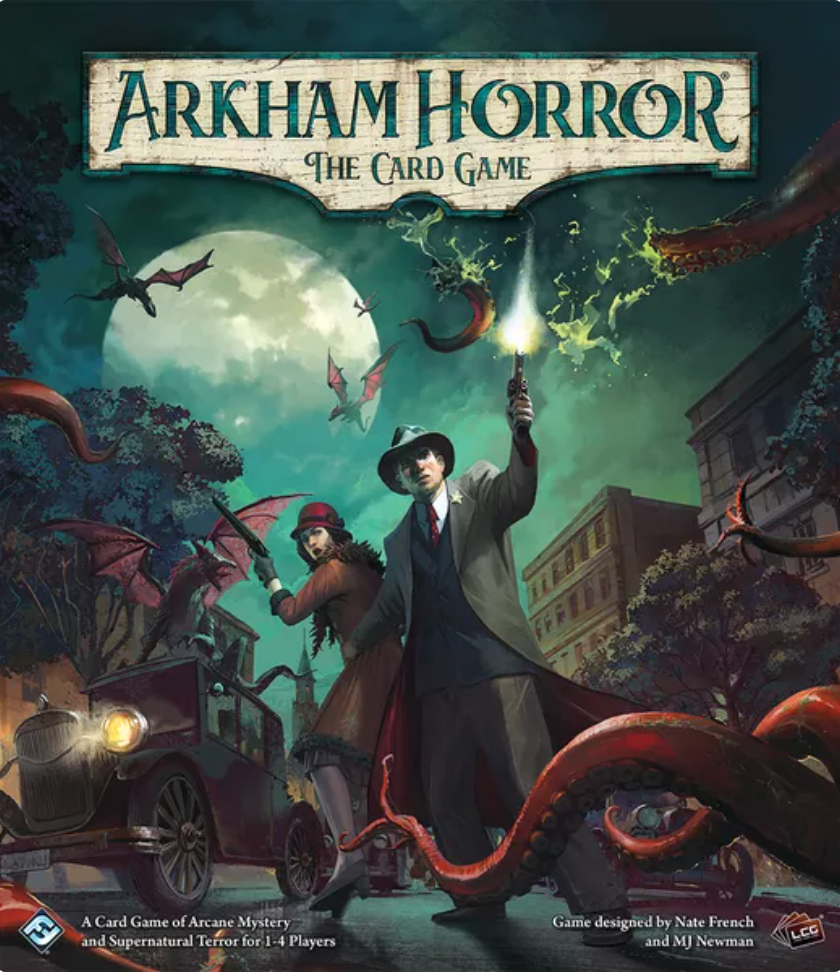
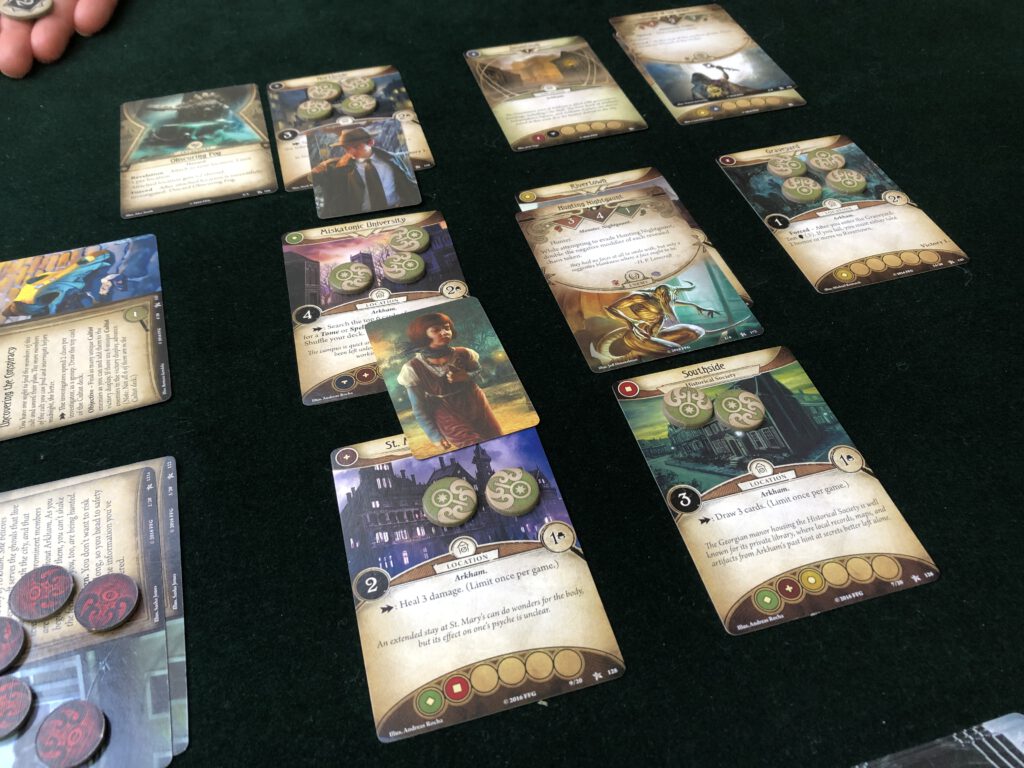
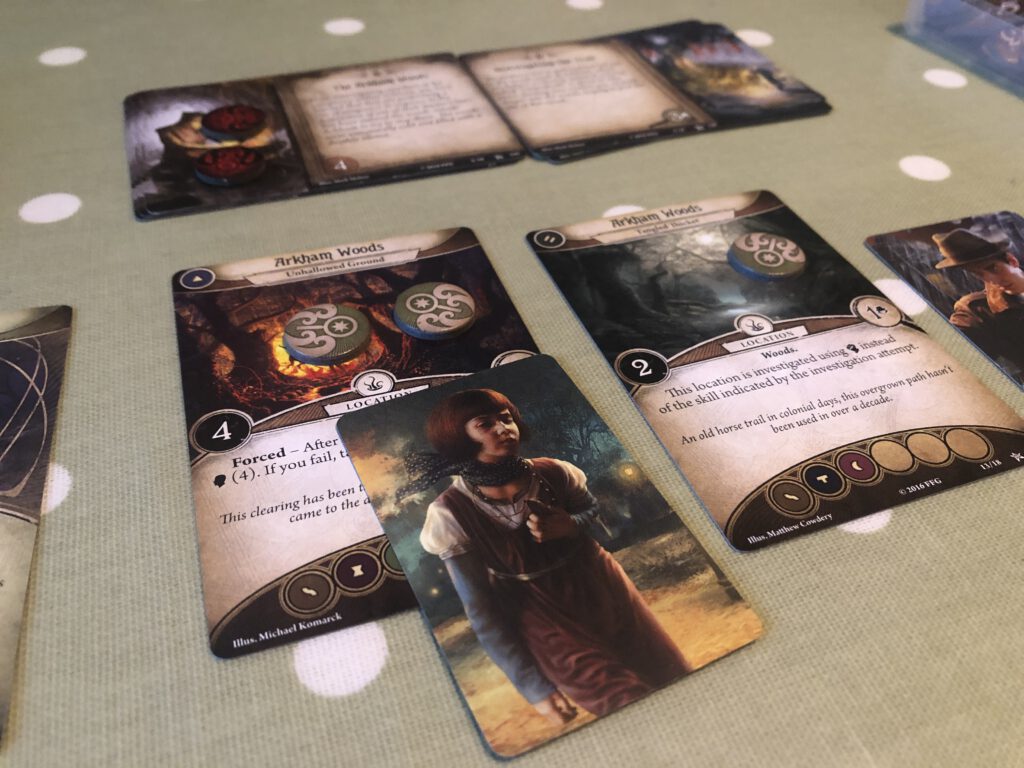
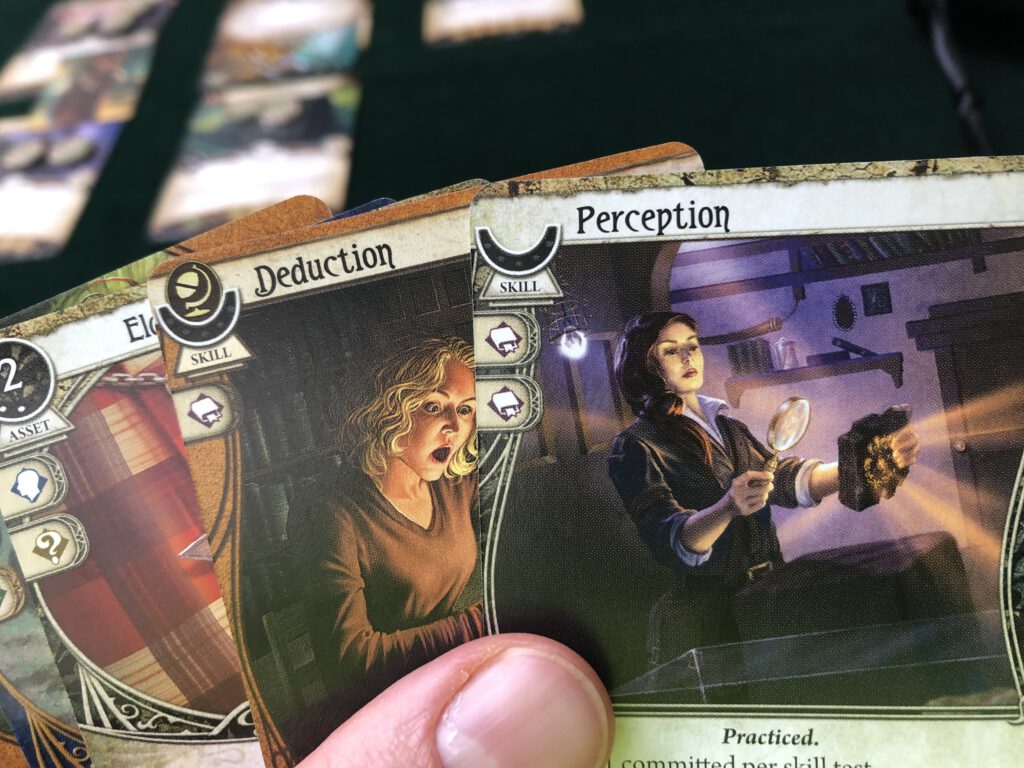
Arkham Horror: The Card Game takes the fictional world of HP Lovecraft and creates a co-operative, deckbuilding adventure, as they navigate the town of Arkham, solving mysteries and battling all manner of evil.
There’s quite a bit going on the game so we won’t start getting into the rules too deeply. The base game – there are several expansions available – comes with a core set of scenarios to explore, each with a specific objective, and several characters they can play in them; with bespoke decks and unique powers. Whether playing solo or with a companion, you begin each scenario in a specific location, represented by a card, and must collect a number of clues to further your investigation: in Arkham Horror, clues are a kind of economy of progress rather than specific things that give you information. The narrative is handled by collecting enough of them to move on to the next part of the story, which – like the locations, objectives and threats – is all handled using cards.
Threats are a near ever-present aspect of Arkham Horror, as each new turn can trigger the arrival of various monsters and bad guys, some of whom will even chase you around town until they’re dealt with. They can be attacked or evaded, and your choice will depend on the character you’re playing and the situation you’re in: just like the monsters can die, you can as well, so if you’ve taken a lot of physical or psychological damage already, you might choose to evade and keep your powder dry, for now.
Searching for clues and battling monsters both involve comparing a score from your character with the matching score for a threat: as long as you draw or score higher, you succeed and find clues or deal damage. The good news is you can play cards to the table that give you advantages, or even discard cards to bump up your score. The bad news? Each such attempt also involves a bag draw of tokens that affect your score – some are good; most are bad! So everything carries an element of risk, and in a two-player game planning out strategy and tactics to minimise it can be critical to success!
At the end of each scenario, players can take the opportunity to improve their character’s deck of cards by spending experience earned to remove basic cards from their deck and replace them with improved ones before the next scenario begins, meaning the scenarios mount up to form a campaign of games; an ongoing narrative where the tougher, later scenarios are faced by tougher, wiser characters!
Sam says
This isn’t the sort of game I would have sought out for myself, being as it is comprised of lots of text-laden cards that establish the ever-changing parameters of play. I tend to avoid that as, for whatever irrational reason, I like a ‘big’ game to have a board and a sense of both location and shared core rules. And slightly more rationally, I don’t like the attendant sense of perpetual rules-referencing these games suggest to me. But a friend cajoled me to sit down and play it, and while it doesn’t change my personal preferences I’ll happily concede it’s a really well-constructed design that conjures narrative and escalating drama. The story comes through, but not at the expense of play, which is kind of a series of puzzles that can’t be predicted from game to game due to the many variables involved: the order of events, where monsters appear, what players hold in their hands, what they’ve played to the table and what token gets drawn from the bag of doom. I’m impressed; and if the iconography can be initially a little overwhelming for the various actions, familiarity speeds things up considerably. In fact with a helping hand it could probably be played by kids younger than 14: if they’re okay with the dread, doom and death quotient.
-

Take That!
None from any gaming partner you might conscript, but plenty from the game itself, which is very much out to get you.
-

Fidget Factor!
Extremely low (with 2) to non-existent solo.
-

Brain Burn!
The game is more tactical than strategic, as the inhabitants of each scenario shuttle and shift around and fogs, mists, doors, pianos from the sky et cetera all loom out at you, presenting round by round shenanigans to be overcome.
-

Again Again!
Although the game is a campaign style, it's not a 'legacy' game where one play means done: you can play the entire thing from scratch once finished, and have a completely different experience, on a micro level at least. Obviously, the experience of being up against a bunch of psychotic lunatics from another dimension will probably be intact from game to game!


