
Aspens
Designed by: Luke Roberts, Neil Edwards
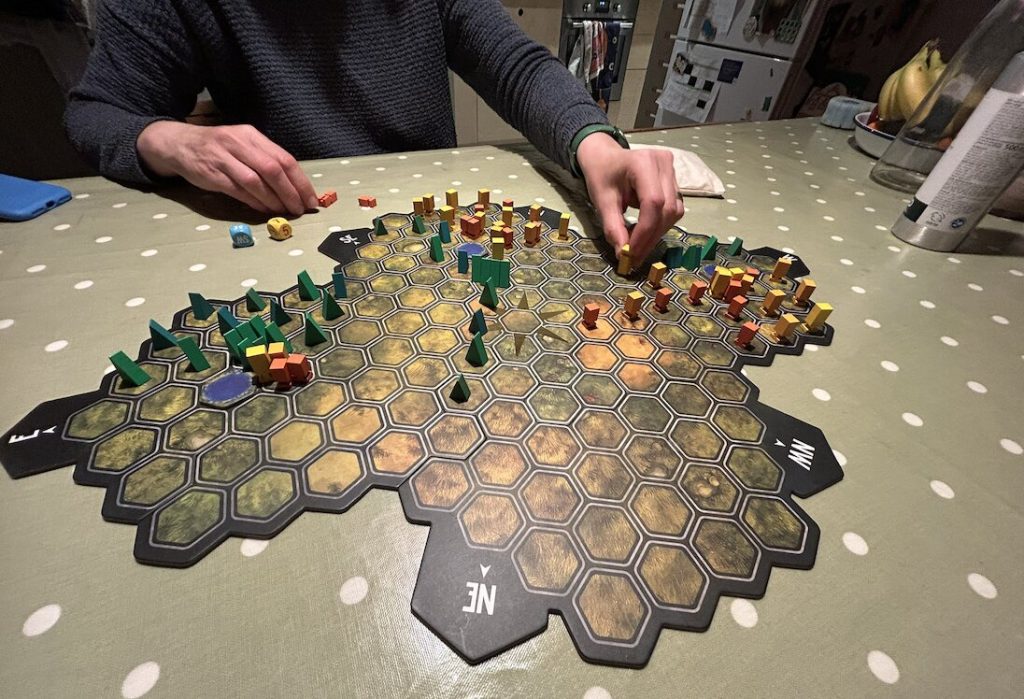
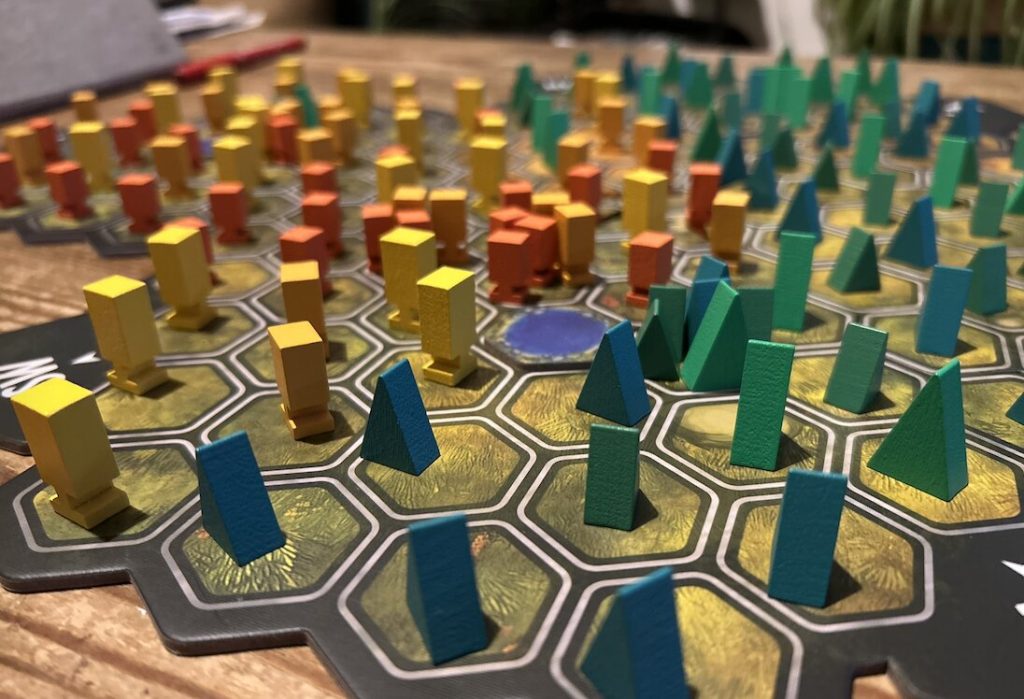
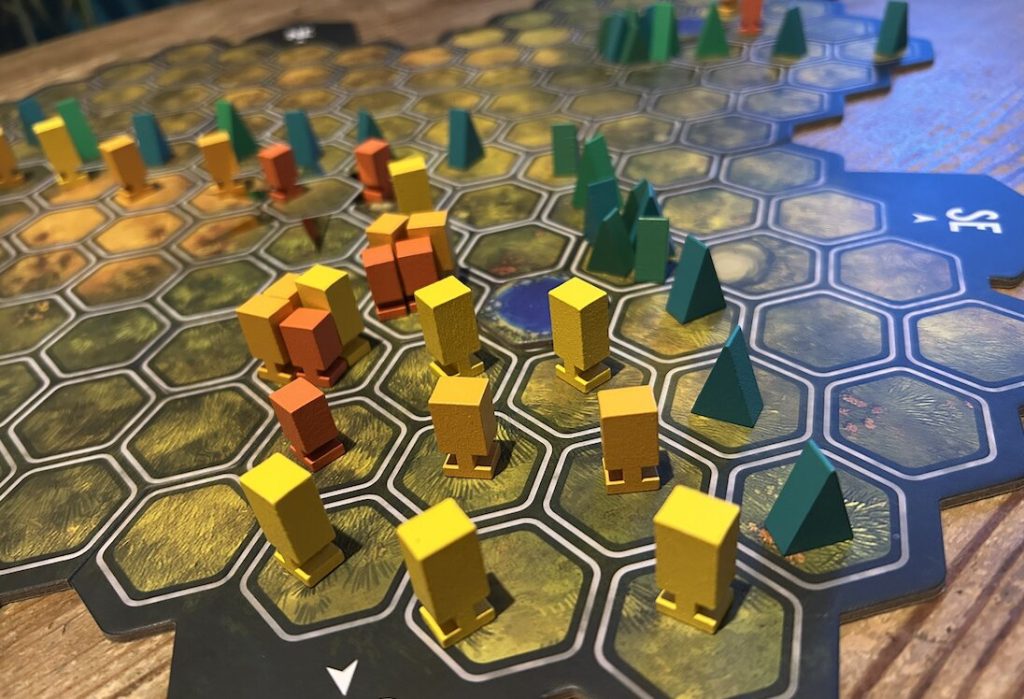
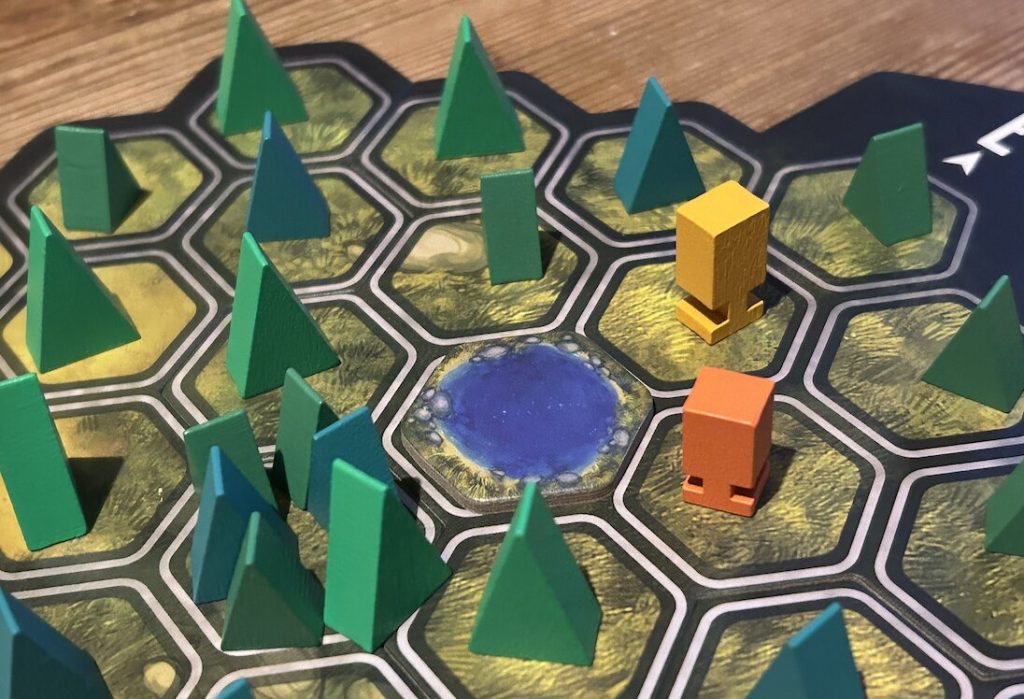
Aspens is a two-player game of competitive tree-growing. You’ll want to spread your trees – aspens or firs – as far as possible across the board. But you’ll also want to cluster them together, for treasons that we’ll now attempt to explain…
The board is broken into hexes, and during set-up you’ll add 3-4 waterhole tiles and a few starting trees beside them for both players: the aspen player’s yellow and the fir player’s green. The trees are different sizes and shades, but for the purposes of play they are all the same. Other than set-up, all the trees remain in their respective bags for now.
On your turn you roll the two dice representing Sun (yellow) and Wind (blue). Then both players potentially gain trees from their bags, depending on your tree clusters: each hex on the board can hold up to seven trees (all of the same colour – players never share hexes) so if, for example, you roll a 4 on the sun die, you get a tree from the bag for every hex where you have 4 or more trees. The active player always gets one tree for free, as well.
Then you can place all your trees. It’s tempting to make lots of clusters, because that is after all the surest way to more trees in the future: but to win the game, you also need to spread, and this is where the wind die comes in. You spread by adding tree (or trees) adjacent to any current hex your trees occupy, but only in one of three directions each turn. If the wind die says east, for example, you can spread eastwards but also northeast and southeast. If it says southwest, you can spread southwest but also south and west: basically, the wind is billowing enough to give you a bit of geographical flex. If you ever cut off a section of the board from your opponent – they can’t reach it by spreading – then you instantly fill all of it with trees from your bag. This is called cascading and it’s a vitally important rule – you can cede a lot of ground as long as you cascade your way into contention later!
If the trick of the game is when to spread – don’t go too early, but not too late either, but then again it depends on what your opponent does too – then it doesn’t hurt to be lucky either. It’s far from a lottery, with a lot of tactical decisions, but there can be crunch points where wind direction is crucial.
When the board is full the player who occupies most hexes is the winner.
Sam says
I enjoy this. A lot of the nature-themed board games out there tend to feel a little vanilla after a while: once you’ve experienced their charms there’s not always a tonne of depth. But whilst I wouldn’t argue this is a deep game, it is at least extremely interactive, and keeps things going at a cracking pace before wrapping up in about 20 minutes or so. Looking as pretty as it does doesn’t hurt either, but for me it’s the passive fight over the board and the dice-rolling flavours that make it appealing.
-

Take That!
Noticeable. You can't interfere with each other's trees, but you can - and should - be as dastardly as possible in cutting off as much of the board as you can
-

Fidget Factor!
Light. Both players (depending on the Sun die) get trees each turn, but only the active player places them. However decisions are pretty quick.
-

Brain Burn!
The core risk/reward is how much you cluster your trees together and how much - and when - you spread. Beyond that it's very easy on the brain.
-

Again Again!
The side-order of dice-driven luck keeps each game different, but the rules also provide you with different set-ups for new challenges.


