
Rebirth
Designed by: Reiner Knizia
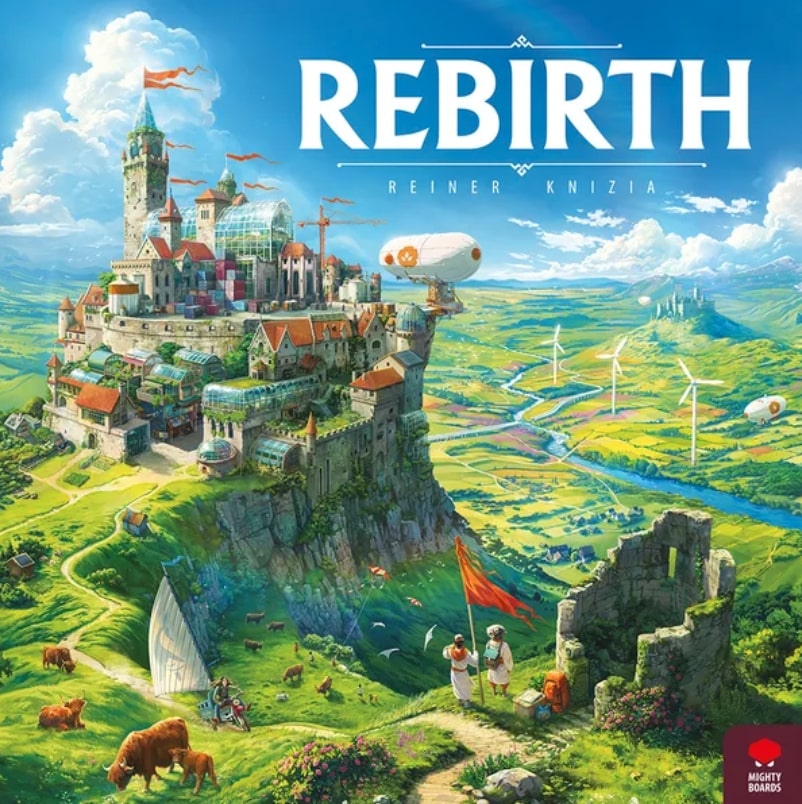
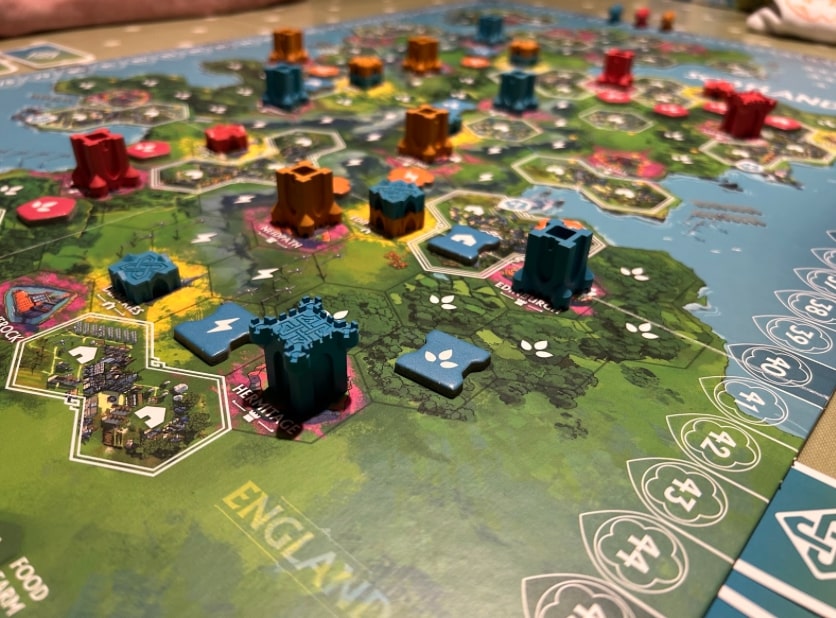
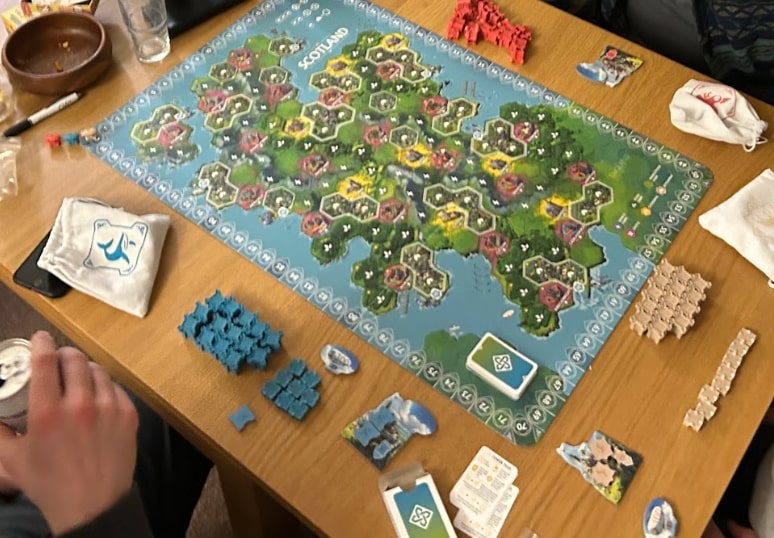
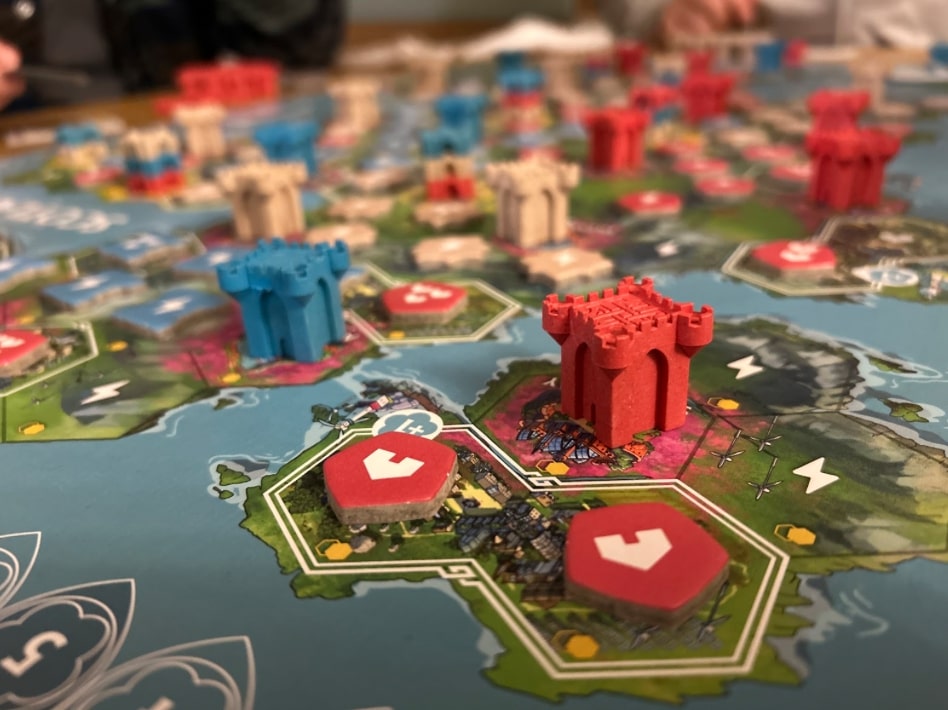
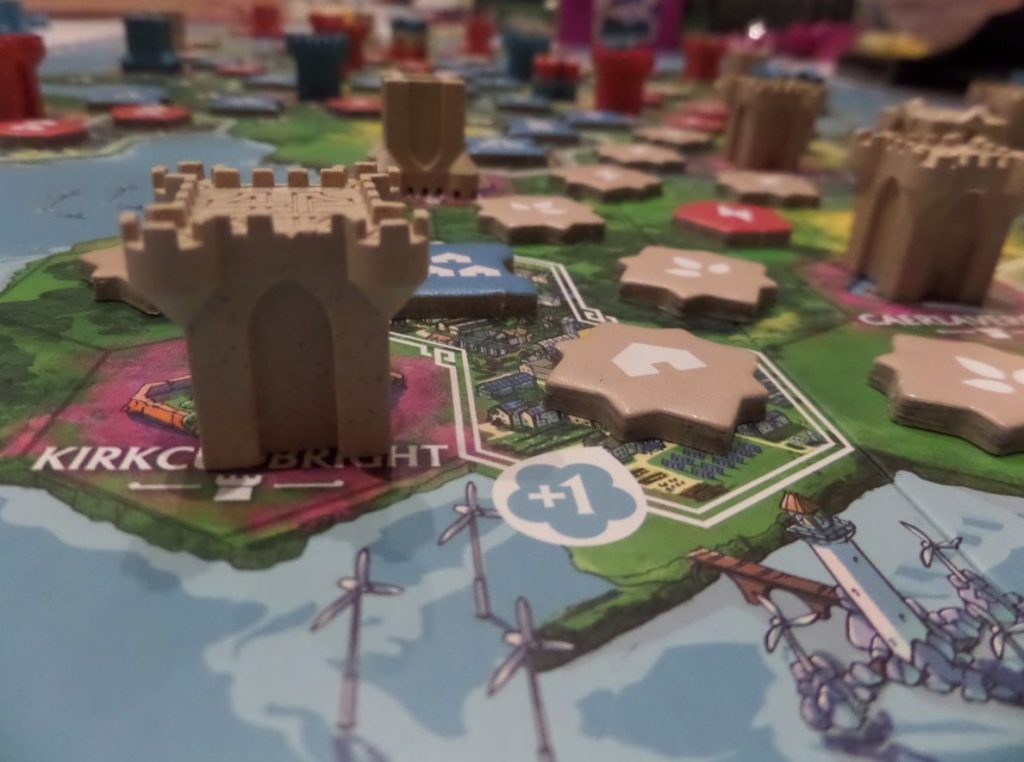
In Rebirth, players are rebuilding a post-apocalyptic Scotland by constructing food farms, energy farms, and settlements. How is simple – on your turn, you simply add a tile to the board. The catch is that as well as advancing your own rebuilding, you ideally need to be stopping others at the same time.
Each player has a bag of tiles, and draws one to play on their turn. The board is broken up into hexes. where your tiles will be placed: most hexes have a matching food farm/energy farm/settlement symbol to show what kind of tile can go there, and a few hexes have no symbol, which means you can play food or energy farms there (but not settlements).
Both kinds of farm score the same way: when you place one, you score a point for the farm you just placed and an extra point for every matching farm (in your own colour) that it connects to. So if I have a cluster of five energy farms, and I add a sixth, that’s six points.
The settlements will only score when a settlement area (1, 2 or 3 hexes) is complete, and then rewards points based on majority: obviously a single hex is completed instantly, and that scores a point for every house symbol on the tile you just played there: each settlement tile has between 1 and 4 house symbols. The 2 and 3-hex settlements reward first and second place only, with ties broken in favour of whomever placed there earlier. As far as the tile-scoring goes, that’s it.
However there are two more considerable considerations. The first is the pink Castle hexes. If you’re the first player to place a tile adjacent to a castle space, you immediately put a castle in there of your colour – this will be worth five points at the end of the game. However, castle hexes can change hands: ownership will go to whoever occupies the most adjacent hexes (ties favouring farms over settlements) so you may find your castle kicked off in favour of someone else’s.
Second are the yellow Cathedral spaces. When you first place a tile next to any cathedral space, you get to take a Mission card: these give you a secret objective (for example, have the most castles, or occupy the most hexes next to Aberdeen), worth five points at the end of the game if completed. After the final tile is placed, players will score any incomplete settlements (a point per house symbol you have in it) and reveal and score Mission cards. Most points wins!
The Ireland side of the board is largely the same game on a different map. However it does add a couple of extra wrinkles: there are now Public Objectives as well as private missions – first person to do one claims and scores it – and in place of cathedrals and Round Towers that give players certain rewards when you place a tile adjacent to them. It’s a slightly more complex and thinky version of the Scotland side.
Sam says
I’m a big fan of Reiner Knizia’s tile-laying games and whilst this probably isn’t going to oust Babylonia as my favourite, it comes in close behind it – and indeed has some advantages. Whilst it sounds pretty math, Rebirth is incredibly easy to teach as every turn is simply a matter of placing a tile. You only ever have one tile in your hand, so the question is merely where to put it. However the game offers you two tempting strategic directions: getting next to all eight cathedrals as soon as possible gives you eight mission cards – and in turn, a direction to go in making them worth up to 40 points. The other thing you can do is start building a big cluster of farms: if you manage to get a seventh down in the same cluster, that’s already got you on 28 points (1 for the first, 2 for the second, 3 for the third and so on). Getting castles on the board is also critical – but most of the learning is the emergent experience of playing, rather than learning excessive rules. It also looks great and only takes about 15 minutes per player. A rock-solid design that I’ll happily be returning to regularly in the future.
-

Take That!
Whilst there’s no direct combat or arbitrary-feeling targeting, players will definitely be getting in each other’s way – and they should.
-

Fidget Factor!
Like most games, if you have a real ponderer playing it then there may be some pondering. Certainly you don’t want to rush decisions here, but cast your eye across the whole board and look for the best opportunity...
-

Brain Burn!
...but thankfully Rebirth sensibly limits your options by giving you just a single tile on each turn, rather than a hand to choose from. The board itself also limits your choices by making only matching (or blank) hexes legal. So the brain-burning is the space between furthering your own cause and hampering others. Ideally both.
-

Again Again!
While some may decide that Rebirth is a little too abstract for them (the theme does fade away somewhat on playing) and want more drama, story, or laughs, as a highly interactive puzzle in a relatively untaxing brain space, this is a game in the classic sense of the word: minimal rules, but engaging decisions.


