
Baltic Empires
Designed by: Brian Asklev
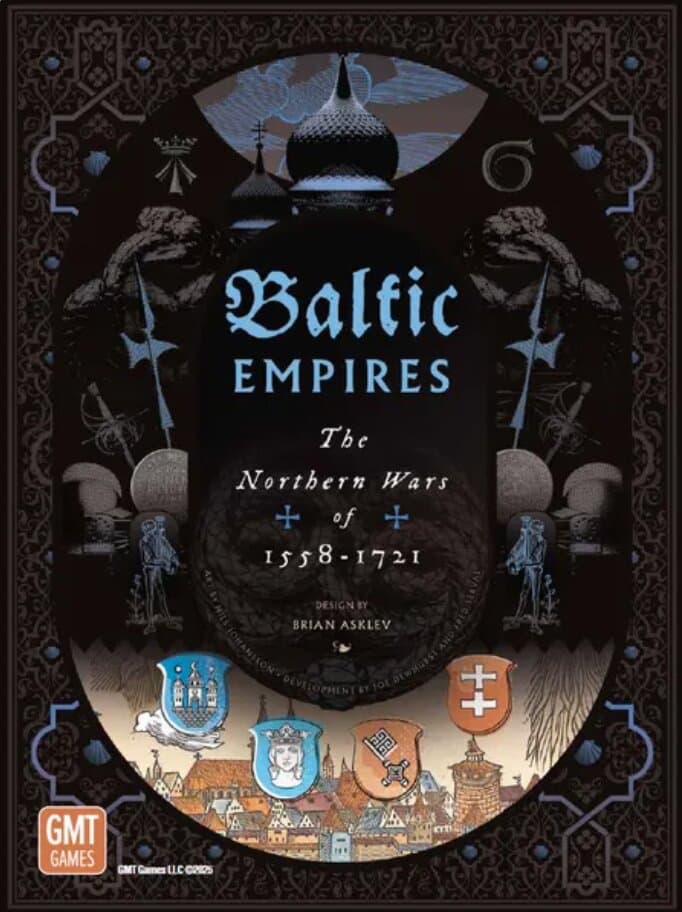
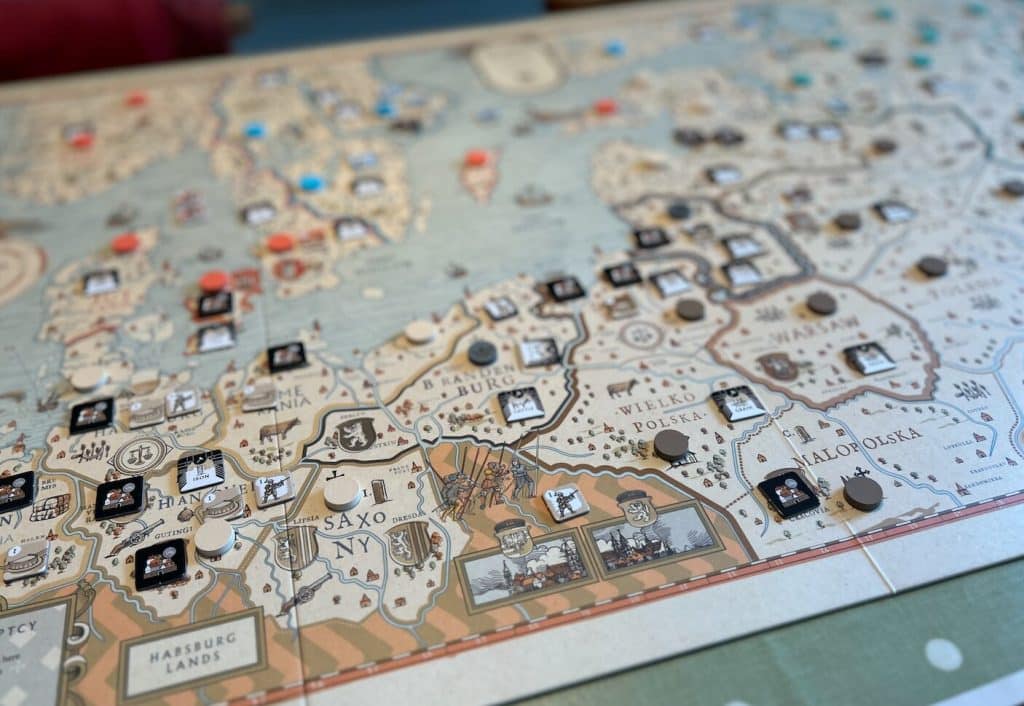
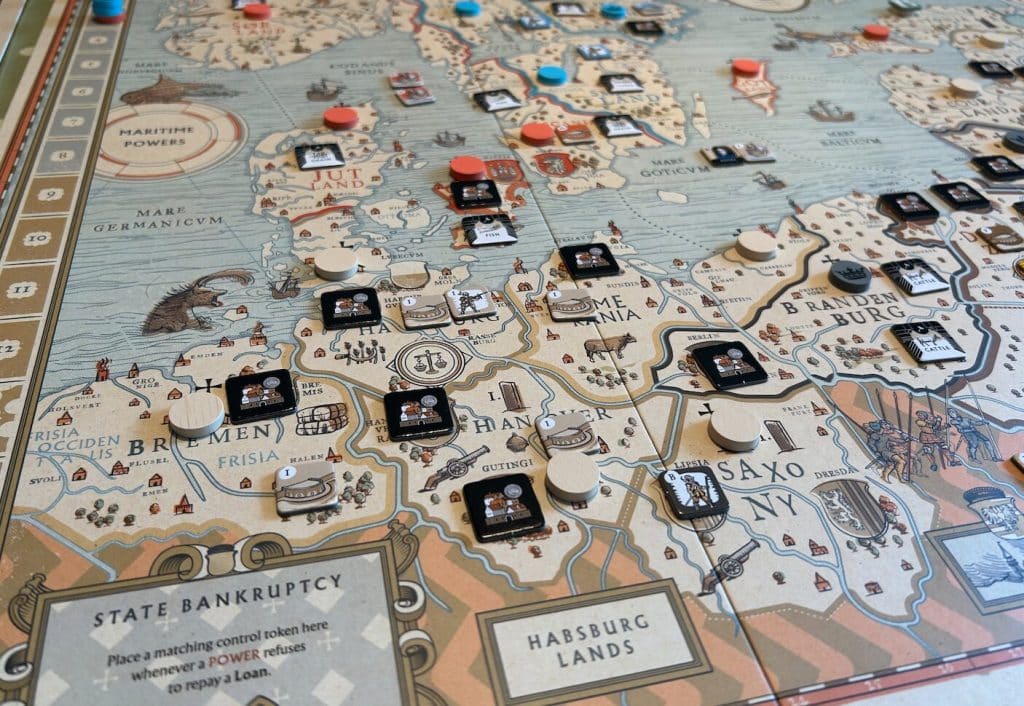


Or to give it its full title: Baltic Empires: The Northern Wars of 1558-1721. A 2-5 player battle for control of northern Europe, when the Teutonic Order had collapsed. Sensing a power vacuum, the five powers of Denmark, Sweden, Russia, Poland and Prussia all attempt to seize the day and take control of the provinces. Players each take control of one such power (or possibly more, with less than five players) and wrestle for their destiny, controlling goods income, military units, and personalities from across the era of history that Baltic Empires sweeps through.
Baltic Empires has a simple enough rhythm to it: each round consists of six phases, and the majority of phases are simple enough that players can play them simultaneously. But there is a fair amount of complexity around that rhythm, so we’ll just give the broadest of overviews here.
The first phase is Income, where each power gains goods from their workshops and money, in the form of thalers, from their cities. Everyone begins with a little of both on the board. In the Maritime Trade phase, players can trade these goods for randomly-drawn shipping goods, which is good, because shipping goods are all unique and you’ll want a diversity of income rather than lots of the same thing later, during the Production Phase.
First up, however, is the Finances phase: where you can potentially take loans from the bank of two thalers, with the caveat that they’ll cost three thalers to pay off later. Money is helpful in the next phase, Production, where you can pay for infrastructure – cities, customs houses and workshops for more future income – and potentially recruit a Dramatis Personae card, each of which provides their own specific advantages to play. All of these costs goods and/or thalers, and when goods are used they must be distinct: you can’t have two or more of anything other than money.
The War Phase is the juice of the game: the player with most military might chooses turn order here, and each power can pay money to – temporarily – ally with the ‘sixth’ power: the independent units that begin around the southwest corner of the map. Naval units move before land units, and both naval and land units resolve battles – using dice – where they encounter opposing forces. If land units end up with no opposing forces, they can ravage, tearing down a workshop, or attempt to assert control. Asserting control is a two-step process, starting in one war phase and finishing – assuming your units haven’t been ousted – at the start of a subsequent one. Controlling provinces is what the game wants you to do: it increases your power across the board, allowing you to gain more income, and build more workshops and cities.
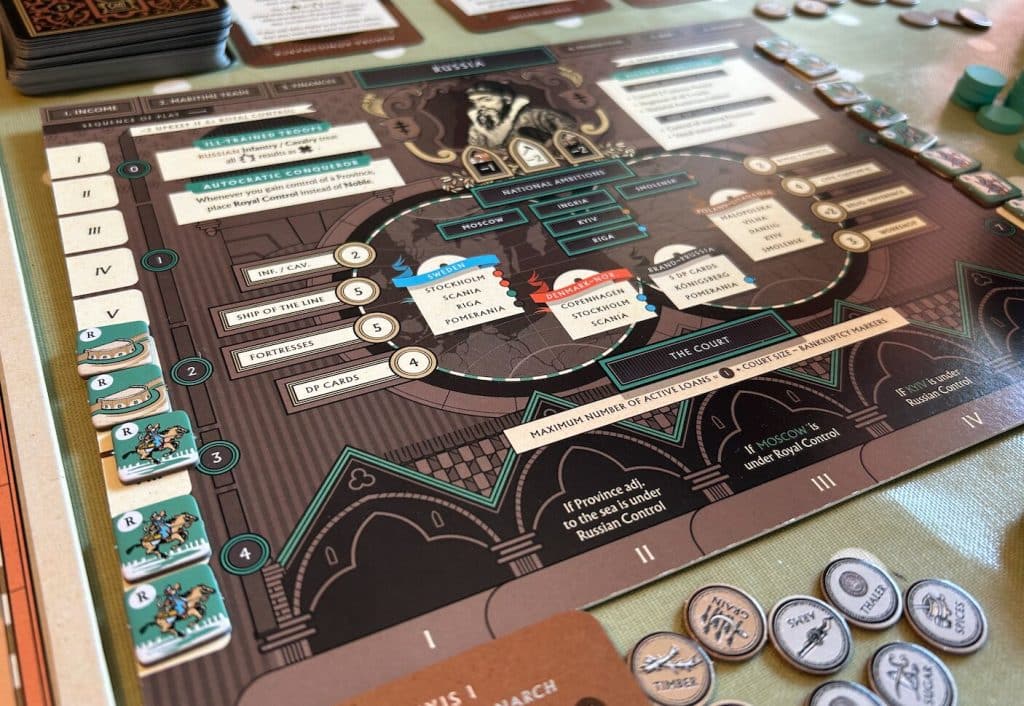
The final phase – Hegemony – needs a little extra explanation, as it involves a separate board that tracks three different strengths of each power: military (-how many units on the board) production (-how many workshops) and mercantile (-cities and customs houses). The lead player in each instance becomes the current Hegemon for the next round: the war hegemon chooses turn order in the war phase, the mercantile chooses turn order in the trade phase, and the production hegemon chooses turn order in the production phase. Whilst the war hegemon is definitely more advantageous during play, the other hegemons can be critical to how and when the game ends.
In the standard game – there are extended and advanced scenarios in the box too – there are four ways to win, which are checked at the end of each hegemony phase. A Trade Monopoly win is attained by controlling two or more Customs houses. A Cultural Hegemony victory is about being hegemon across all three incomes of war, mercantile and trade. A National Ambition win is about gaining control of specific provinces: which ones depends on the power you’re controlling: for example, Denmark want to keep their control of Copenhagen, and gain Stockholm and Scania from the Swedish power, whereas Russia have designs on Kyiv and Riga provinces. And one power only – Prussia – can triumph with a Balance of Power victory. This is about the Prussian player keeping the other powers in check long enough that when the game concludes its final round, no other power has achieved an outright win. If Prussia still controls its starting provinces and has shrugged off its ‘Vassal’ status (it begins in a truce of sorts with Poland, and neither side can attack each other until Prussia chooses to reject the status) they will win. failing that, the final-round victory will go to a series of tie-breakers.
Around the six-phases per round and three economies to manage are a few other things to consider. Firstly, each power has distinct power-specific exceptions and rules. Sweden, for example, have an advantage in battle with superior firepower, translating ‘probable miss’ results on the dice into definite hits. Russia gains Royal control of claimed provinces as opposed to normal control: the usual limit of one workshop production for each province no longer applies, giving a distinct advantage in the Income phase. The previously-mentioned Dramatis Personae are largely easy to understand, furnishing you with in-game advantages. But religion also plays a part too: with Catholic, Protestant and Orthodox beliefs spread across the continent, it will cost powers more to build infrastructure in provinces that hold different religious beliefs to them. The whole thing adds up to quite an undertaking, with a lot of things to consider as you play.
Sam says
At time of writing I’ve only played the game twice, and probably made a few rules goofs, but largely ended in a place where we pretty much knew what was going on. I’m not sure I’ll go back to it though; it is extremely long and for my tastes, edging into a pacing I found slightly ponderous. More plays would fix that, but Baltic Empires is never going to be a short game and for a long one I’d love it if the pacing could move along with a little less referencing – the Hegemony tracks need constant management, and you need to bear each powers abilities and objectives just as much in mind as your own – and a little more well-oiled. But this is a war-game from a war-game publisher, so it’s worth bearing in mind as well that war-games tend to come with a little more cognitive load: for this particular genre, Baltic Empires’ rules are comparatively short.
And there are lots of pluses: not least the asymmetry of the powers and the fact players absolutely need to police each other. It’s a high interaction game where staying at home twiddling your thumbs is not really rewarded – but at the same time, powers shouldn’t overstretch and leave themselves open to bystanders taking advantage of weaknesses, momentary or otherwise. In terms of accuracy it’s a little woolly: the Dramatis Personae can be bought by any power, rather than the one they were historically associated with, and obviously the players military manoeuvrings don’t exactly match what occurred centuries ago. But I don’t mind that: it’s a game, not a reenactment, and the larger picture isn’t too far off: it’s powers at loggerheads, with all that that entails.
In short, it’s a game that asks a lot of you – but it’s also a game that rewards, and will continue to reward, a group who enjoy a punch-up on a map, maybe over a leisurely afternoon. As well as managing economies, pacifying churches, hiring inspirational figures – and chucking dice. We’ve not explained the combat system here but it’s very simple and outlined on the player aids.
-

Take That!
A five-way battle for the Baltics? You'd better believe it
-

Fidget Factor!
Potentially extremely high on a first play, although it will speed up.
-

Brain Burn!
The core is not as crazily complex as the 20+ pages of rules suggest: follow the phases, get income, spend it expanding and building. But there are a few elements to integrate into your thinking.
-

Again Again!
There's masses of variety here: even in the basic game, and publisher GMT have added plenty more in the box.


