
Bella Vista
Designed by: Andrea Mainini, Bruno Cathala

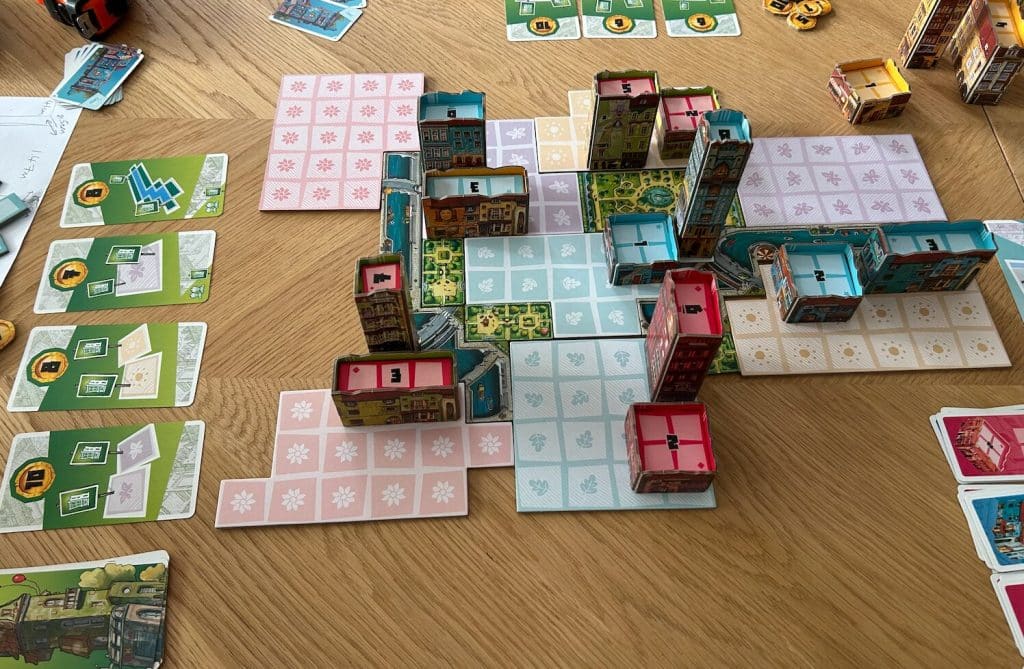
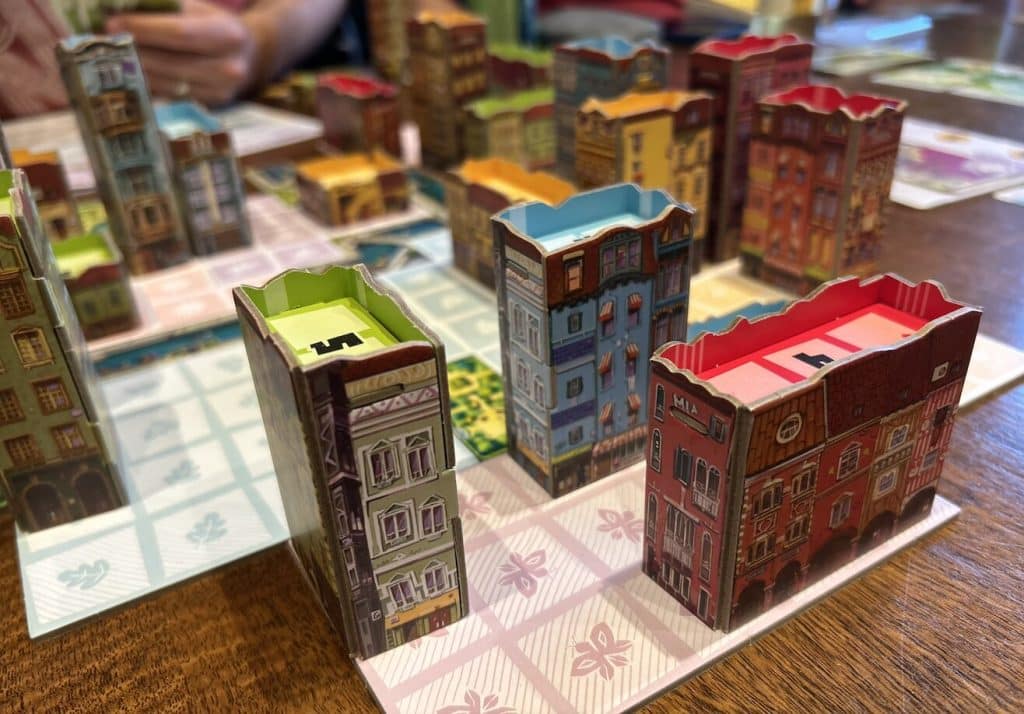
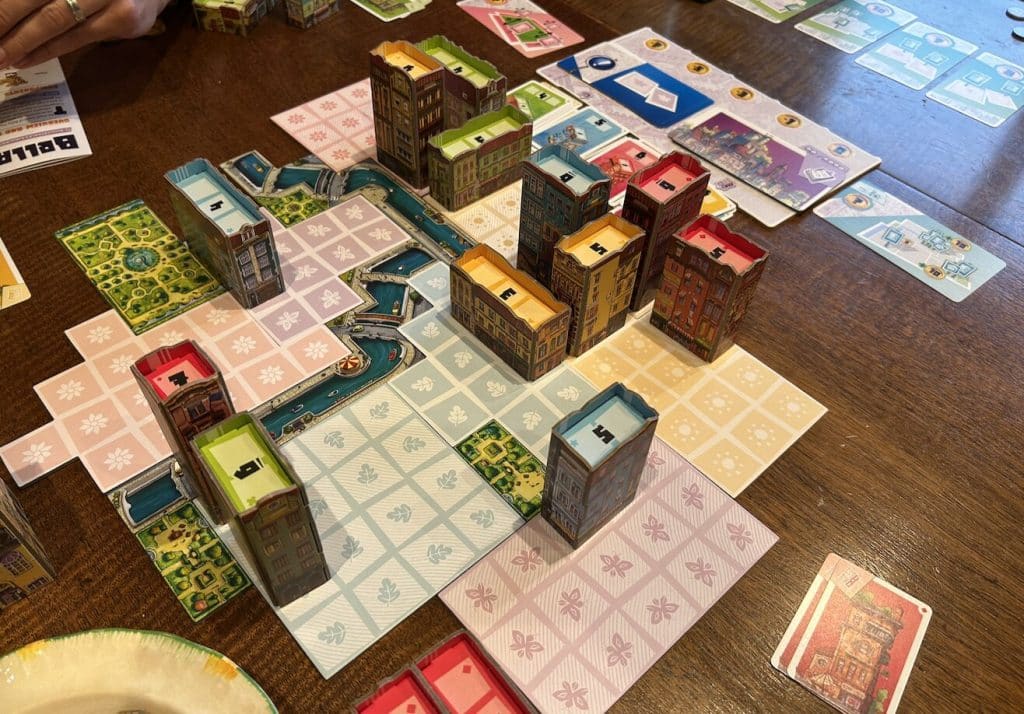
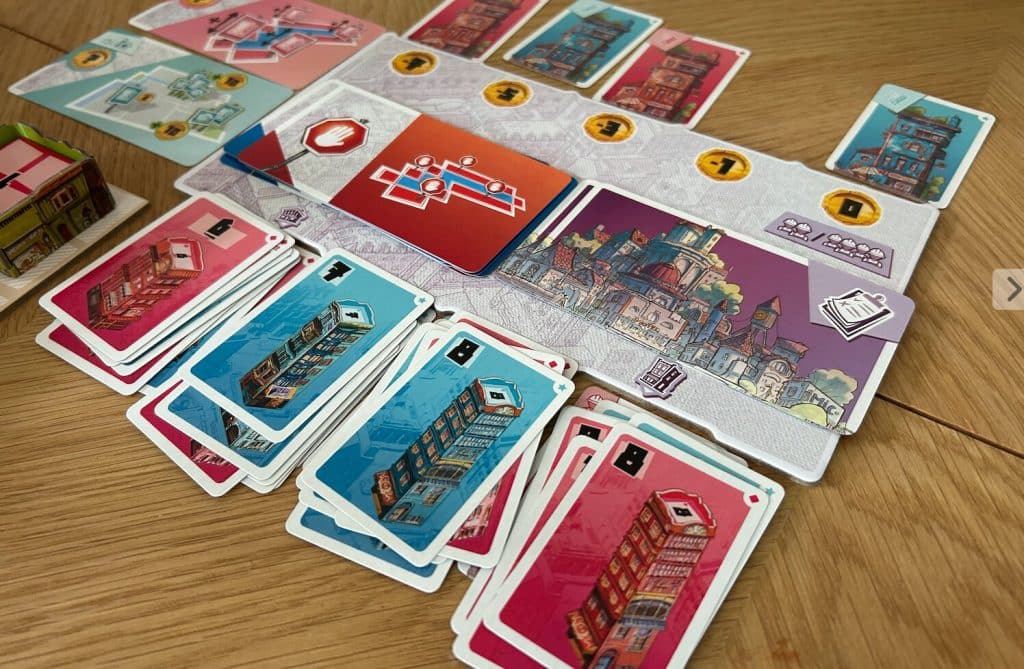
In Bella Vista, players are building a city together, placing the neatly-constructed buildings that come pre-assembled for you in the box. But despite the beautiful view, this is a more combative game than the dainty architecture suggests.
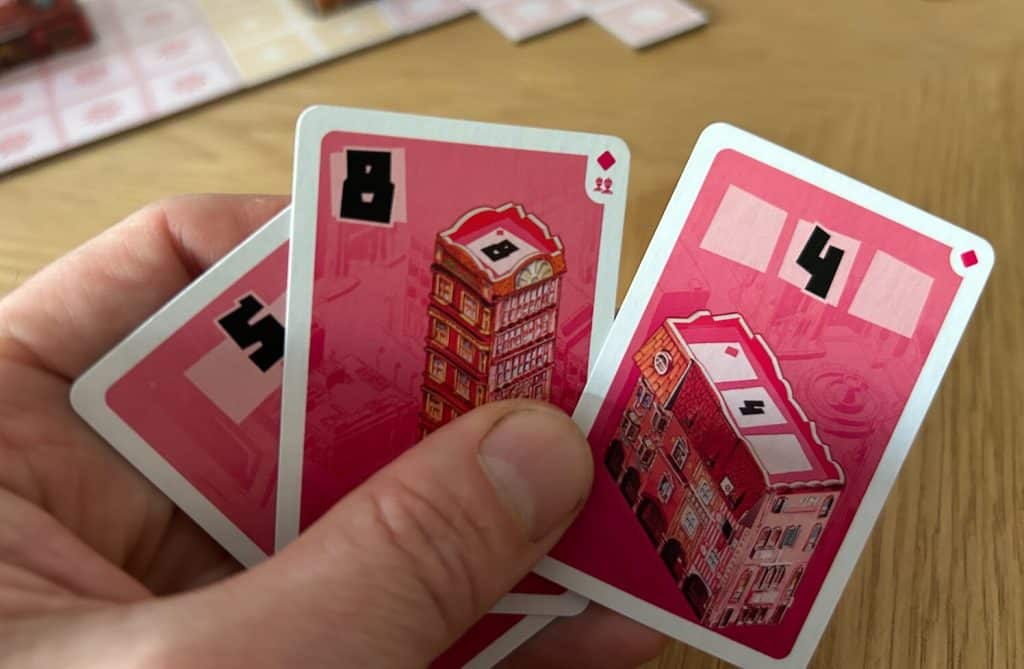
Before play starts, the city’s footprint must be assembled on the table: there are suggested layouts in the rulebook, or you can just connect the elements of river, parks and neighbourhoods randomly: the only rule here is there mustn’t be any gaps. Players take all the buildings of their chosen colour (numbered 1-8, with an equivalent number of storeys), a matching deck of cards (shuffled; deal yourself three) and 20 coins to begin with. The small Offer Board is placed where everyone can see it.
Each round, everyone will place one of their buildings in the city. There are three phases to this: Offers, Construction, and Earn Coins. In the first, everyone will place one of their cards face-down to an empty slot above the offer board. This establishes both which building you’ll construct this round and turn order: going sooner costs money, going later is cheaper (or even free, if you go last). In construction, these cards are flipped one at a time, and each player places their matching building on the board. Earning coins means getting coins for every adjacent building your new construction is taller than (and 3 coins if it’s taller than everything adjacent). As far as the rhythm of the game goes that’s pretty much it. Coins are also points and most coins will win the game.
But!
But there’s more to Bella Vista than that. First of all each round there is a Zoning Card that gives parameters about where you are allowed to build: it might be in specific neighbourhoods (for example, the two blue neighbourhoods), or on the city border. Or it might tell you where not to build; for example not next to parks or the river. Secondly, there are always two Objective cards in that will score for all players at the end of the game. For example, the height of your buildings next to parks, or points for your buildings that are grouped together. And finally there are Contract cards that can be collected during the game: these are highly situational and might ask for two buildings in a particular neighbourhood or two buildings next to the river. If you’ve completed a contract at the end of your turn, you simply pick it up (-you can only collect one contract per turn, even if you’ve completed multiple) and cash it in as points at game-end. The contracts are replenished at the end of each round.
A new round begins with the Offers order decided by building heights of the previous round: the player who built the smallest building gets to choose first, and the tallest building last.
Sam says
Bella Vista doesn’t really need the miniature buildings to function as a game: tiles would do just as easily, and – beyond the Earn Coins phase – might actually speed things up a little in terms of legibility. But one cannot deny that it does give the game a rather striking appearance, so I am happy with the production here, especially as it’s all done with no plastic. Of the gameplay itself: I really enjoy it. Essentially it’s an abstract: maybe somewhere, once upon a time, cities were built this way, but Bella Vista hangs onto its theme largely by dint of its appearance. The play itself is more a puzzle of diverging rewards: I want to be next to a park, so I can claim that contract. But if I can also be on the border at the same time, that’s good for the objectives. But if I can block off player A from the river, that’s good too. But I can only play in the blue neighbourhoods this round because of the zoning controls! If the construction appeals, but managing those different parameters sounds like a nightmare, then maybe something like Dorf Romantik would be better. But we’ve found that this is a lot of fun, and one that will stay in the library.
-

Take That!
Whilst there's nothing destructive in the how the interaction manifests, there is definitely a sense of jostling for position, and players can build to foil each other
-

Fidget Factor!
Fiarly low, although potentially climbing to moderate as the city fills up
-

Brain Burn!
It's largely a spatial puzzle, trying to fulfil objectives both short and long(the contracts) and long-term. With a side-order of managing your money, which doubles as your score!
-

Again Again!
There's lots of variety in the set-up and the end-game objectives, whilst being confined to a total of six, can combine in nine different ways


