
Santiago
Designed by: Claudia Hely, Roman Pelek

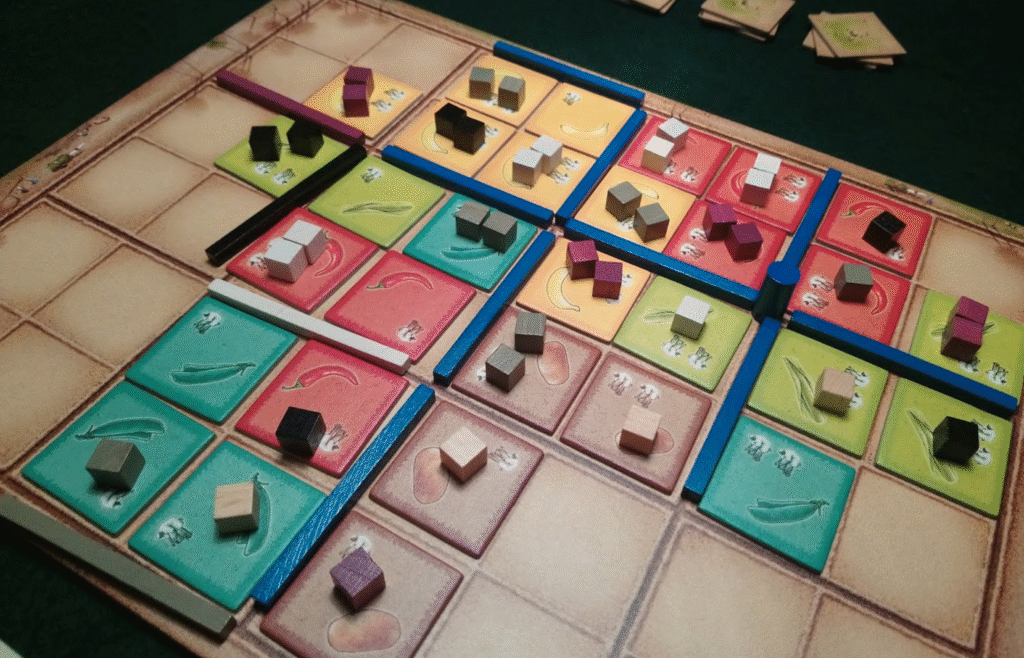


Santiago is a game in which the players plant crops on an arid landscape (the board), whilst trying to ensure that the water source, from a single well, reaches them. After a set number of rounds, the players will get points for all the groups of crops they’ve planted; the person with the most points and money wins.
In each round, a number of crop tiles equal to the number of players are revealed, and players bid cash to get first pick of them. Having won a bid, you place your tile on the shared board, adding your own workers (cubes) to the tile. It’s likely that when placed, the crop tile will not be irrigated (see below) – if the tile stays that way, it won’t last more than a couple of rounds before being flipped over: this will earn you no points at the end of the game!
Then one player (the player who bid lowest) is designated the ‘canal overseer’, and will get to place a single canal, which will extend the reach of the precious water. If a tile is adjacent to a canal, it’s considered irrigated. However, before the canal is placed all the players get to offer bribes to the overseer, to persuade them to steer the water their way. Players can even collaborate on bribes, if they choose. Then the overseer can either accept a bribe, or, if they wish to ignore all the bribes and go their own way, they will have to pay cash bigger than the biggest bribe to do so.
Once the canal is placed, all the tiles are checked, any that aren’t irrigated will dry, and may dry out completely. At that point those tiles become useless. Everyone gets some cash income, and the next round begins. The game continues for a set number of rounds, and at the end everyone scores any cash in hand along with points on the board: workers x number of matching adjacent tiles (no matter who they belong to!) equals a cash reward: and the richest player wins.
One extra thing to bear in mind: each player has a single ’emergency canal’ they can place themselves – shrewd timing is called for on when this is placed, as later in the game it’s more likely bigger points will be at stake.
The rules themselves are simple, and the game quickly becomes all to do with the player interaction. Money is scarce, and accepting a bribe as the overseer is the only way to ensure getting more than everyone else; but will you be able to ensure a bidding war, to make the bribery worth your while?
The money spent versus points gained is fairly easy to track, so it never feels overwhelming – the only unpredictability is in the bidding for crop tiles and bribery, so there will be many tense moments between the players as they weigh up the benefits of temporary alliances. If you pine for the back-stabbing delights of an old-school game like Diplomacy without the seven hour play time, and can accept watering bananas as a substitute for explosive world domination, you can’t go far wrong with Santiago.
Sam says
If you want a game where table talk is what moves things forward, then Santiago is a great option. Like Genoa and to a lesser degree, Catan, the interaction between players drives things here – it’s one of those that contains a substantially interactive experience inside a simple set of rules, and perhaps surprisingly doesn’t feel completely abstract. The bidding is delicious: go high for the best offering or low to be the overseer? Navigating those two options successfully is really the key to success. An excellent game, belying its bland-looking box art.
-

Take That!
There's plenty of player interaction here, and it will be hard-fought. It's also not a game that can be toned down effectively, as the game really is all about the players, so best avoided if confrontational games aren't your thing. It's not unnecessarily nasty though - it's a subtle, well structured game.
-

Fidget Factor!
Turns are long, but within each one all players will have lots to think about and do, so downtime isn't a big problem.
-

Brain Burn!
Towards the end of the game, scores are calculable - this can make decisions easier, but puts off some players who prefer more of a surprise ending.
-

Again Again!
Despite the lack of variability in set-up, Santiago will be a good game to pull out whenever you feel like a full-on four or five player battle of wits - it's only ever going to be as predictable as human nature.


