
Caldera Park
Designed by: Michael Kiesling, Wolfgang Kramer
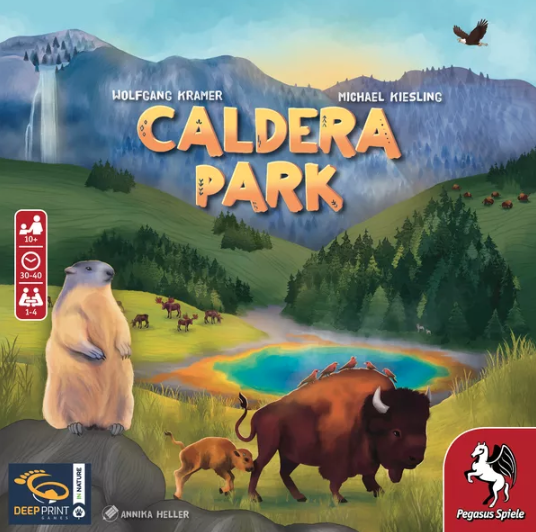
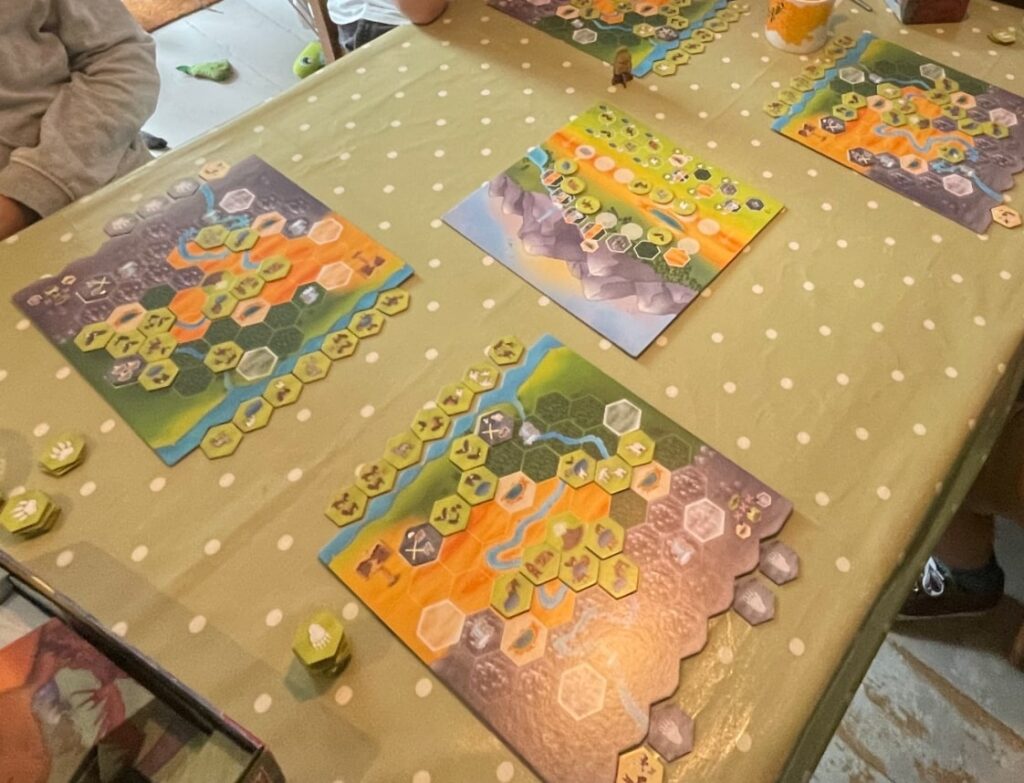
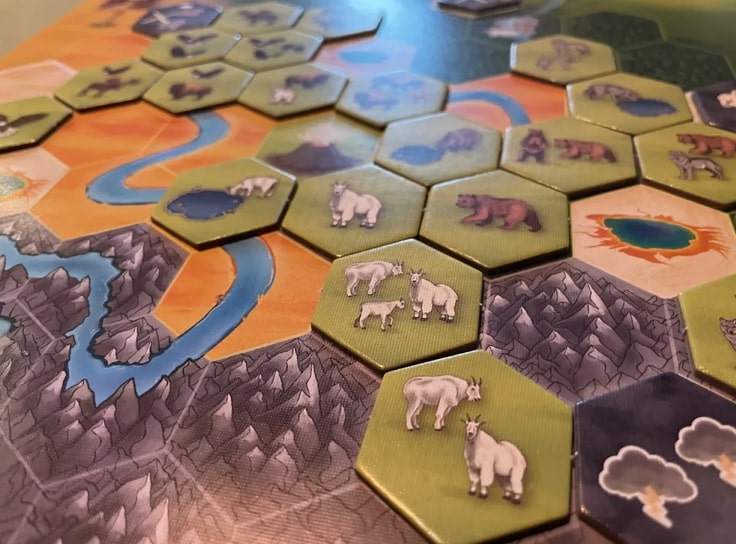
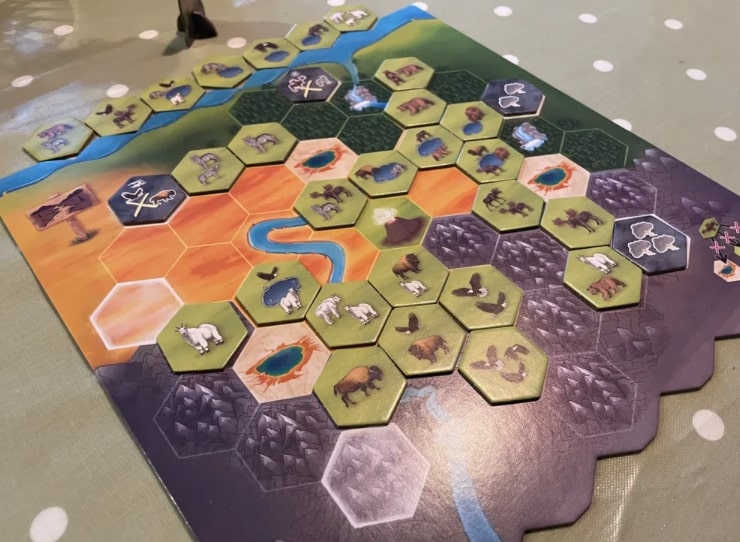
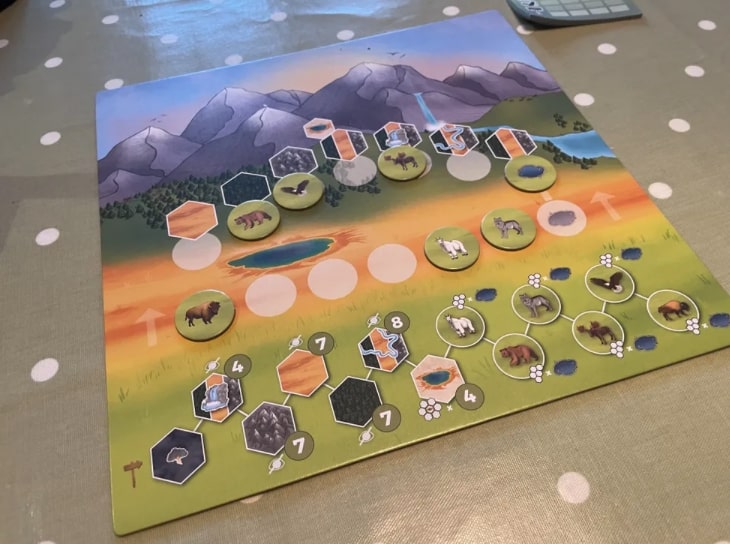
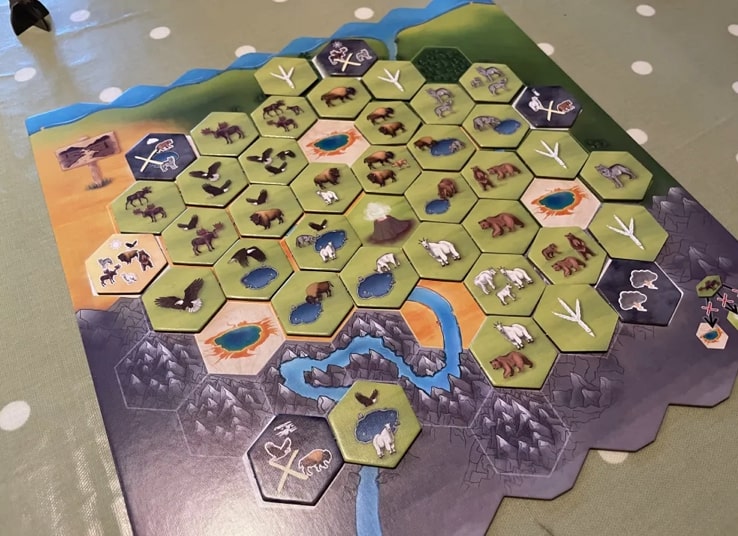
In Caldera Park (loosely based on the designer’s previous Savannah Park) each player will be populating their own board with animal tiles, and then scoring their largest group of each animal multiplied by the number of watering holes in that group. The catch? Well, there are three catches really. One is that many tiles have more than one type of animal on them. Then there are weather tiles that may eliminate animals. And finally you won’t always be choosing which tile to place, or where to put it!
Before play begins everyone places their first weather tile in one of the ‘weather spots’ on their board. The weather tiles are, in all but one case, destructive. At the end of the game they will kill off certain animals adjacent to them, so managing the placement as best you can is critical to success!
On your turn, you choose an available animal and announce which terrain it’s going on: forest, plain, mountains, river, waterfall, or adjacent to a geyser. In each round each animal can only be selected once, so there’s a shared central board that tracks which animals and which terrains have already been selected. Once you’ve made your selection, you announce it aloud to the other players and then everyone takes the matching animal tile – if they have one available – and places it in the matching terrain – if they have space to. For example, if I call out ‘Bison in the plains’ you take a tile containing at least one bison, and place it in the terrains. Where terrains overlap – eg a tile space is river but also forest – you have flexibility: you can place a tile ‘on the river’ or a tile ‘on the forest’.
But you may not have a bison tile available, in which case you can take any tile you like. And you may have covered all your forest spaces, in which case you can place a tile anywhere you like. As the game closes out, there are less spaces available but more freedom in placement – usually. After a round ends the starting player moves on, and everyone places their next weather tile.
When all tiles have been placed you add up the total value of your animals plus bonus points for covering all terrain of the same type: river 8 points, forest plains and mountains 7 points each, all waterfalls covered 4 points, each geyser surrounded 4 points. But remember before scoring to flip any tiles face-down that have been eliminated by bad weather… this may have a small effect or even none at all, but if you’re unlucky it can split your biggest group of animals apart! Most points wins.
Sam says
A game perhaps best with 2 or 3 players not given to agonising at huge lengths. Because all but one weather tile (the only good one, which doesn’t eliminate anything but actually adds an animal to any adjacent groups) are face-down until placed, you can end up gambling that the bad weather won’t be bad for wolves (or something equally silly) and either pulling off a huge score or finding you’re harpooned by fate. I don’t think the boards look amazing but as they get filled up with tiles it doesn’t seem a big deal. It’s a fun undertaking that calls to mind the options-dwindling-fast of Take it Easy and the area-scoring of Kingdomino: a nice combination of two solid games.
-

Take That!
There’s no direct interaction at all, but players can – if they choose – certainly scrutinise other’s boards to see what they don’t want chosen. However you’re largely focused on what’s best for you.
-

Fidget Factor!
As players are all tile-laying at the same time, it can be very low. But equally the game does present a thinky puzzle, so it’ll creep up during play, and down-time can vary depending on who’s playing.
-

Brain Burn!
It’s a relatively simple game but there is certainly some spatial-patterning going on in trying to negotiate spaces for overlapping animal types.
-

Again Again!
We’ve found it quite moreish. There’s not much variety of the dramatic kind (though the reverse sides of the board offer a harder weather-related challenge), but the built-in random elements are enough to keep it feeling fresh.


