
Tipperary
Designed by: Günter Burkhardt
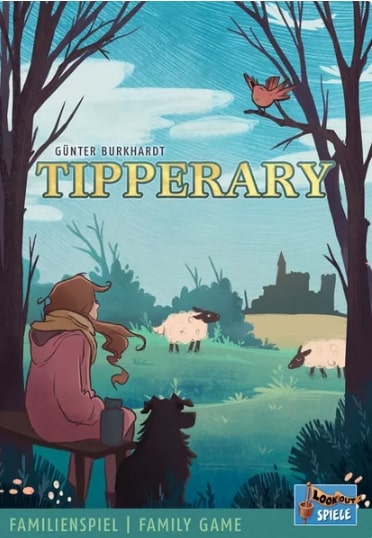
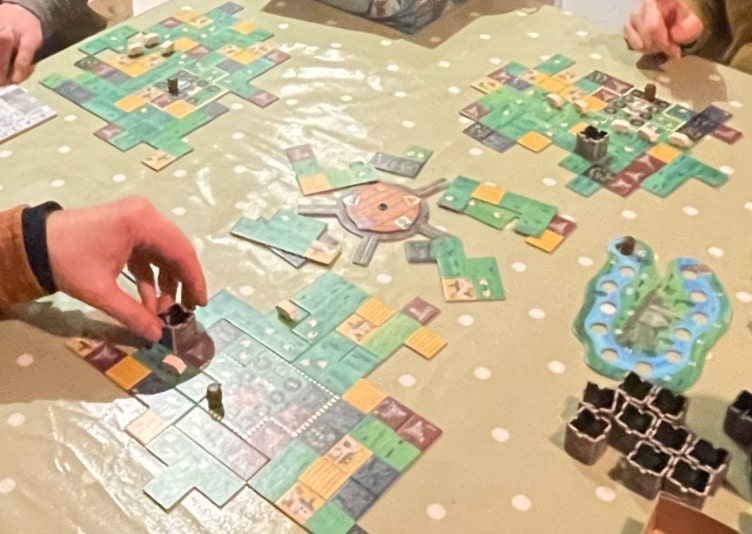
Tipperary is a game of building a bucolic Irish valley, replete with sheep, bogs, ancient ruins, and very possibly numerous whisky distilleries. Also, try to make it rectangular.
Over 10 or 12 rounds (depending on player-count) players will each add a Tetris-style tile to their growing landscape, and at the end you’ll score for the largest unbroken rectangle you can make – (each tile being made up squares which are multiplied width by height for points) and your largest flock of sheep (number of connected squares with sheep on!) You’ll also pick up 5 points for surrounding your starting tile, x points for your stone circles and x points for however far you’ve gotten up the distillery track. It already sounds pretty complex, but as the game takes about 20 minutes it can’t be that crazy! Let’s see how it works.
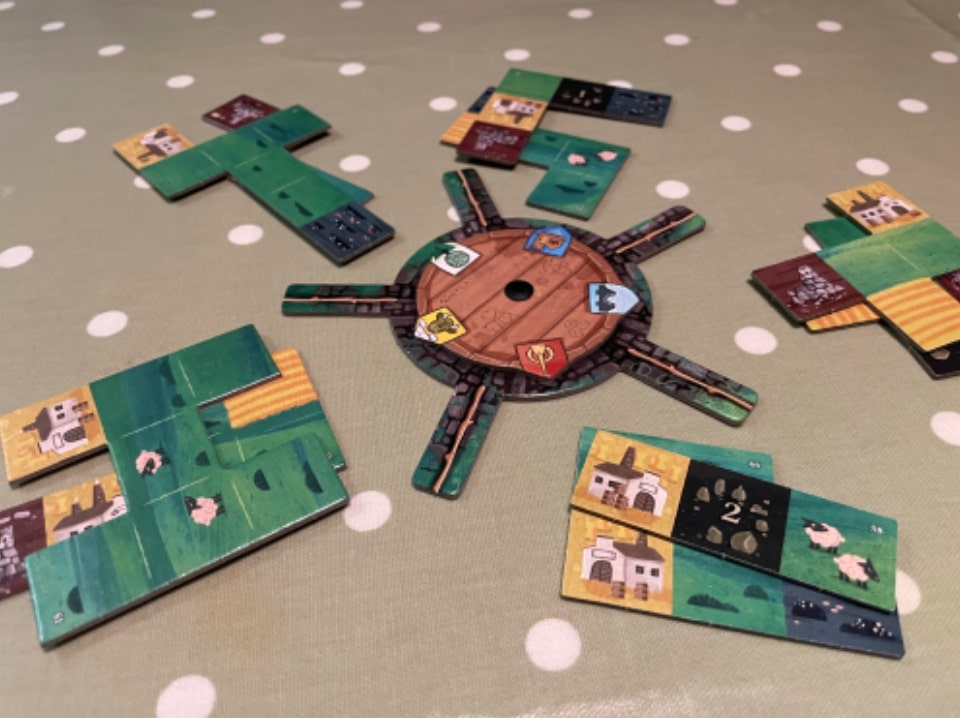
The game comes with a spinner divided into five sections. Each section has two random tiles assigned to it and at the start of each round the spinner randomly determines which tiles are available to which player: so you always have a choice of two, but you only get to take one, adding it wherever you like to your ‘valley’ in hopefully constructive, point-scoring fashion. The spinner is refilled to two tiles in each section and we go again.
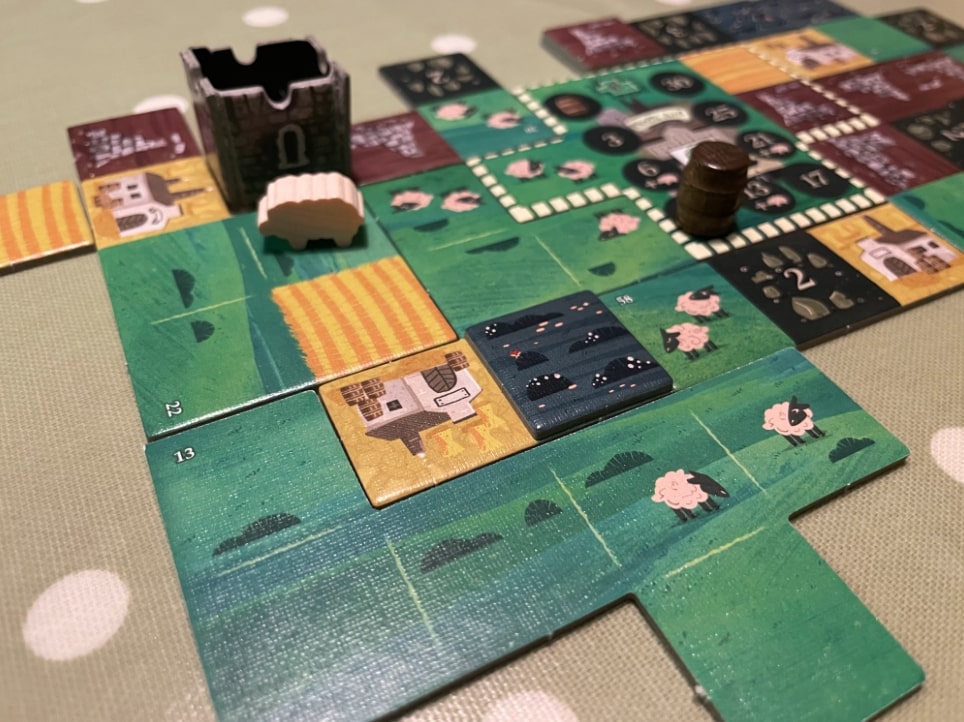
As the rounds continue, you are trying to group sheep together and keep the ‘big rectangle’ in mind, but there are other temptations as well. Any time you connect a distillery to a grain field, you move up the distillery track. This may occasionally give you an additional sheep you can use to grow your flock, possibly connecting two flocks into one! (Note that some tiles also give bonus sheep when you add them to your valley: there is a tiny sheep symbol on them; easy to miss!).
If you establish three ruins in a row you get to take a tower, which you can place at the end of the game: these are helpful for filling ‘holes’ in your board which might otherwise sabotage your biggest rectangle. If you connect two bogs you get to take a random bonus tile! These are the only tiles you’re allowed to place on top of another tile: they can be placed adjacent or on top of an empty (no sheep) green space.
So as the game continues your are managing the spatial challenge of the tile-laying but also the overlapping temptations that may pull you away from the default big-rectangle-with-sheep-in objective the game starts you off on. You might even neglect your sheep in favour of multiple distilleries, or focus all your energy on building the biggest rectangular valley ever! (Biggest flock gets five bonus points too!)
Sam says
I’m not sure the game itself every mentions the word ‘valley’ but that’s how I think of them: you’re farmers, but you’re also distillers, and archeologists, and geometrically-obsessed deities. I have friends who jokingly despair at the dearth of interaction in Tipperary, but – while I am a big fan of interaction as well – I love it for it’s simple brevity and the various itches it scratches in – with two players – literally ten minutes of satisfying polyomino-play. Kids can learn and play it easily, adults can enjoy it just as much if not more. There are a lot of polymino-placing games out there, but for my money none of them condense the experience down into such a compact, moreish package.
-

Take That!
None
-

Fidget Factor!
ery low. There may be the odd lull as someone figures out their best option, but you only ever have two tiles to choose from. It shouldn’t drag to a halt.
-

Brain Burn!
A nice low heat, occasionally crackling
-

Again Again!
For those who like these kind of spatial puzzles, delivered in a light, accessible package, this is a winner. If you desire feisty interplay, drama and theme, maybe avoid.


