
Chocolates
Designed by: Jean Paul Monnet, Ségolène Monnet
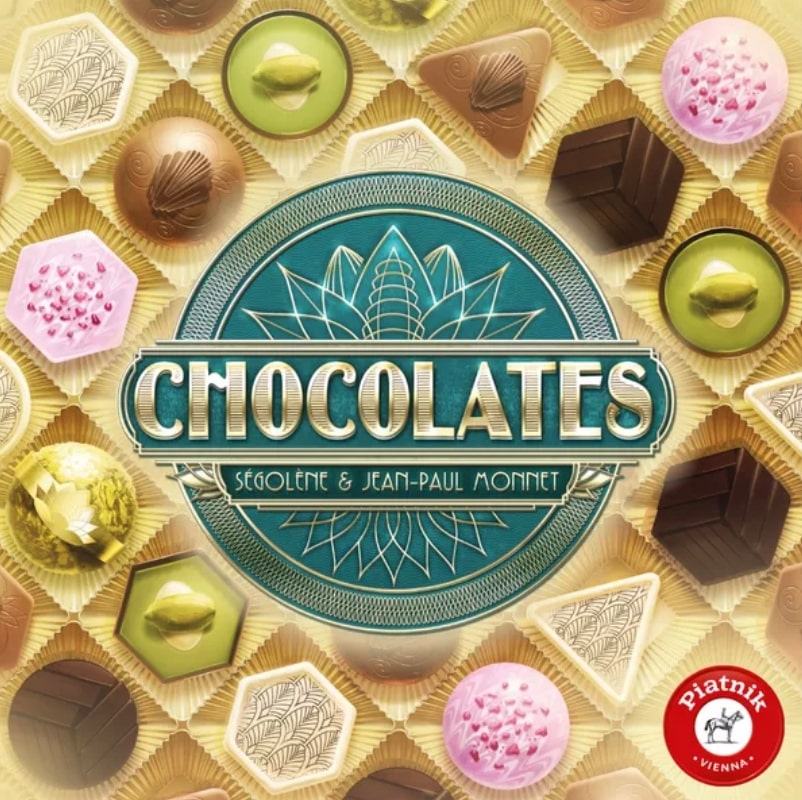
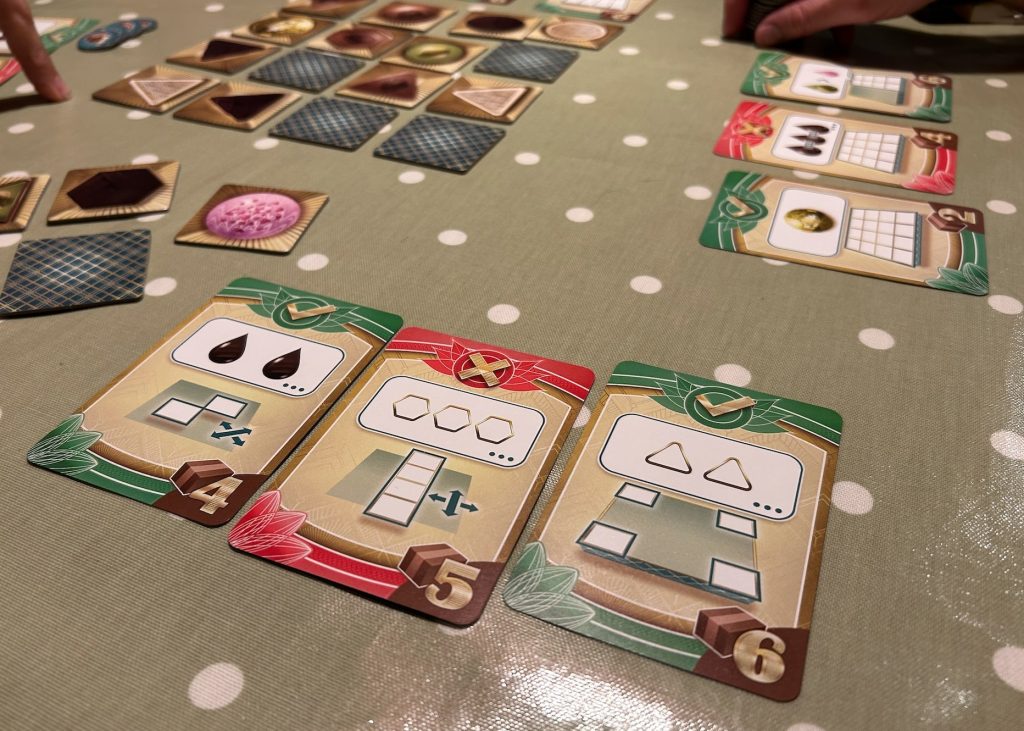
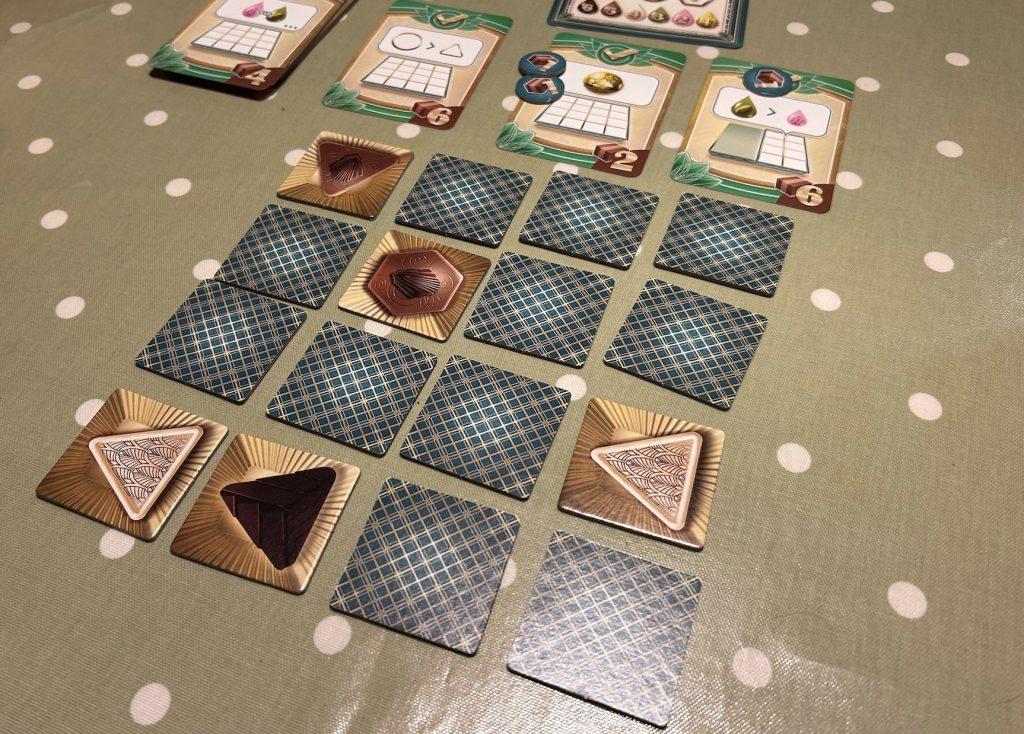
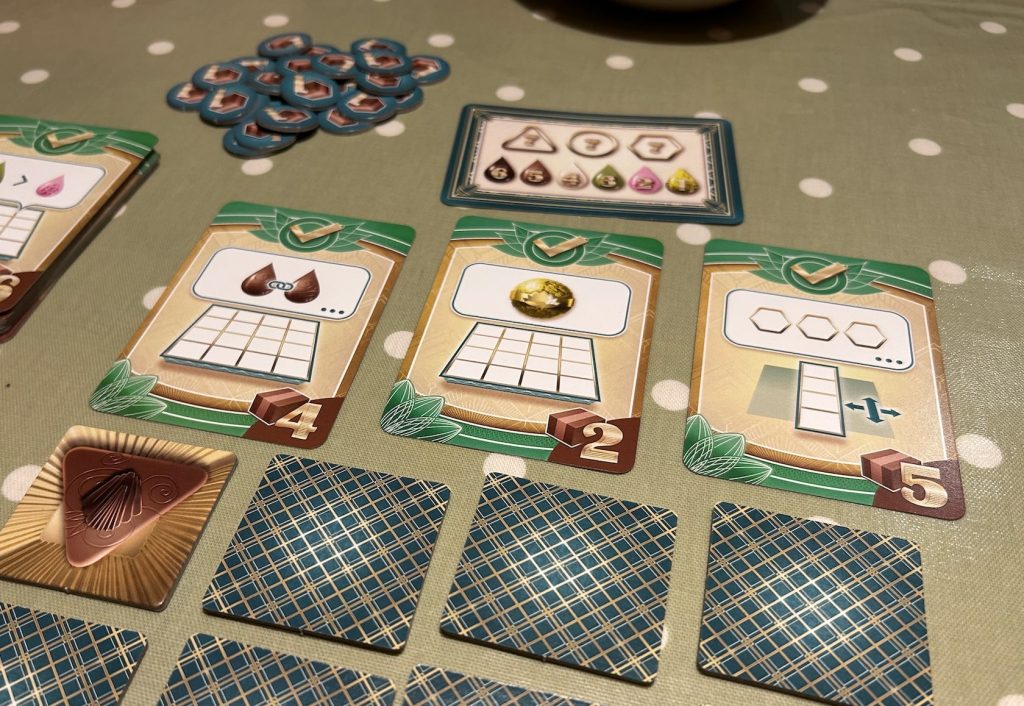
In Chocolates, we are taking turns to reveal chocolates from a lavish box. Nobody knows what flavours they’ll be until they’re revealed, and winning or losing the game relies on making the best predictions.
The game comes with a bunch of chocolate tiles, each having a particular shape (seven each triangular, hexagonal, circular) and flavour ( seven dark, six milk, four white, three pistachio, two raspberry and the one ‘golden’ chocolate). These are shuffled face-down and 16 are laid out in a 4×4 grid representing the box, with the remaining tiles placed off to the side. A deck of Prediction cards are placed face-up beside the chocolates, with three of them placed in a tableau, available to take.
The game proceeds simply. At the start of your turn you can optionally take a prediction card, and then you must reveal a chocolate: either in the box, or one of the tiles off to the side.
The prediction cards basically offer your bets of a sort on what’s in the box. Will there be the same amount of triangles and circles? Will there be more pistachio than raspberry? Will the golden chocolate be in the box? The prediction cards are double-sided: leave it face-up if you think the prediction will come true, or flip it face-down if you think it won’t. And because the prediction cards are about the contents of the box, the longer the game goes on the more information you have about whether they’ll be true.
Whenever someone takes a prediction card, Nougat tokens are added to the remaining pair, making them slightly more alluring (-one nougat is one point at the end of the game) and the top card from the deck takes its place. When someone takes a third prediction card, the endgame it triggered: everyone gets one final turn and then the last chocolates are revealed! Everyone scores their predictions – you lose points if they are incorrect – and their nougat, and the player with the most points is the winner.
Sam says
It’s – no pun intended – a sweet little game, especially for two or three: I feel the pace and game-length suits that number better than the full complement of four. Situations can arise where a Prediction card has already been proved when nobody has taken it, which feels like a free hit for the lucky player who picks it up – we’ve house-ruled that these get discarded instead, but either way it’s hardly a dealbreaker for what’s a quirky little abstract: tangible enough on theme to draw in kids and light enough on rules to keep them there.
-

Take That!
None
-

Fidget Factor!
Whilst it's an abstract game, it's more about speculation than optimal number-crunching
-

Brain Burn!
It's largely about seeing what the probabilities are and hoping your predictions don't stray too far from them
-

Again Again!
It's very abstract, but the game is nice and speedy and the random set-up means it's never solved


