
Cities
Designed by: Phil Walker-Harding
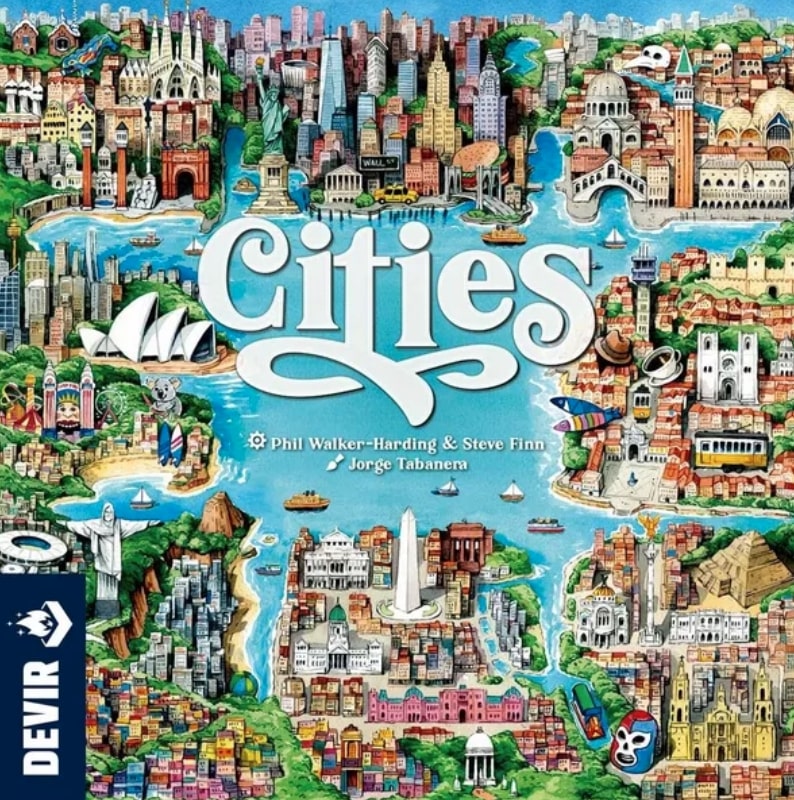


In the game Cities, each player is busily constructing their own city in miniature, comprised of a 3×3 grid of tiles. You begin with one such tile, and over several rounds will add another, and also three other elements: buildings that are placed on the tiles, features that go in parks or lakes, and cards that provide scoring objectives.
The shared board is filled at the start of each round with the aforementioned components: the tiles, features, buildings, cards. These things are placed in four rows, and in turn, players send their ‘workers’ out to collect them. The catch is that you can only place one worker per row (or two in a 2-player game), so in each round you’ll gather exactly one of each. The tiles expand your city’s footprint, the buildings and features are placed on the tiles (note that buildings must go on a foundation of their own colour, and can be stacked 4 storeys high), and the cards are kept handily nearby: each scoring objective is simple: for example, a point for each lake, two points for each 2-storey building of a certain colour, six points for each blue 4-storey building, and so on.
The game continues until everyone has completed their 3×3 city (four rounds with 2 players; eight rounds with 3 or 4) and points are scored for your card objectives, features in the parks and lakes, and the three objectives shown on the shared board itself, which are claimed during play in order, as players complete them (doing so sooner scores more points than later). The player with the most points is the winner.
Sam says
Cities is a fun little game that packs a decent amount of decision-making into it. Whilst there’s no direct interaction, there’s a little tension in each round: you might really be after some specific buildings to hit an objective, only to find someone nabs it before your turn – now you must pivot to Plan B. The fact each row has a face-down option is also, to me, a fun aspect: do you ignore a couple of guaranteed points and hope you flip something better? It’s not the most elegant game and for some ending up with 8 scoring cards each may feel too many – but focusing in on a few is a better bet for both the scoring and your sense of zen. It’s easy to teach, it has a nice tactile and visual presence, and probably plays at around 10-15 minutes per player, even on a first blush. It’s a game that knows what it wants to do, and does it very capably.
-

Take That!
The city-specific objectives on the board are a race of sorts: only the first three players will score anything, and the first to do so will get a bigger reward than the second (and the second more than the third). You can certainly be harpooned when something you want is taken by another player as well, but it’s a fairly light, non-aggressive sense of interaction.
-

Fidget Factor!
The opening rounds are a fairly broad brushstroke vibe of seeing where things take you. As the game proceeds, decisions get more meaningful. But it’s not going to be a game where there’s an age between turns.
-

Brain Burn!
There’s a nice combo of developing strategy (hitting those goals) tactics (reacting to the round-by-round situations) and even some low-level passive-aggression, if players want to go that way. Largely however you’ll be preoccupied with your own needs, which is good, because studying everyone’s score cards in round 8 wouldn’t be much fun for anyone.
-

Again Again!
Cities has several options in the box for which city you are ‘building’ – giving different objectives – but other than that the game plays out similarly. Fortunately there’s fun to be had in what is available when, and how you can <hopefully> maximise your opportunities.


