
Looot
Designed by: Charles Chevallier, Laurent Escoffier
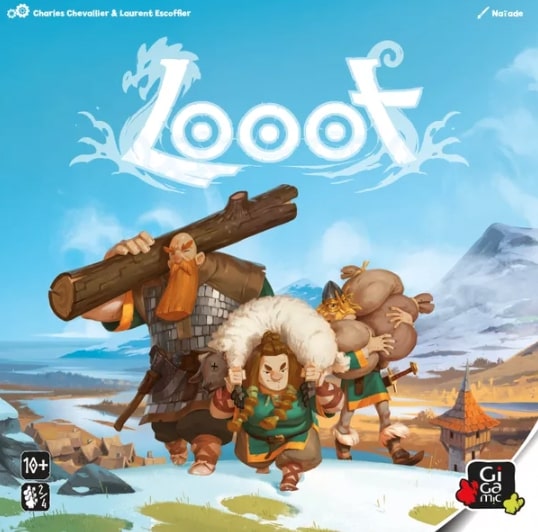
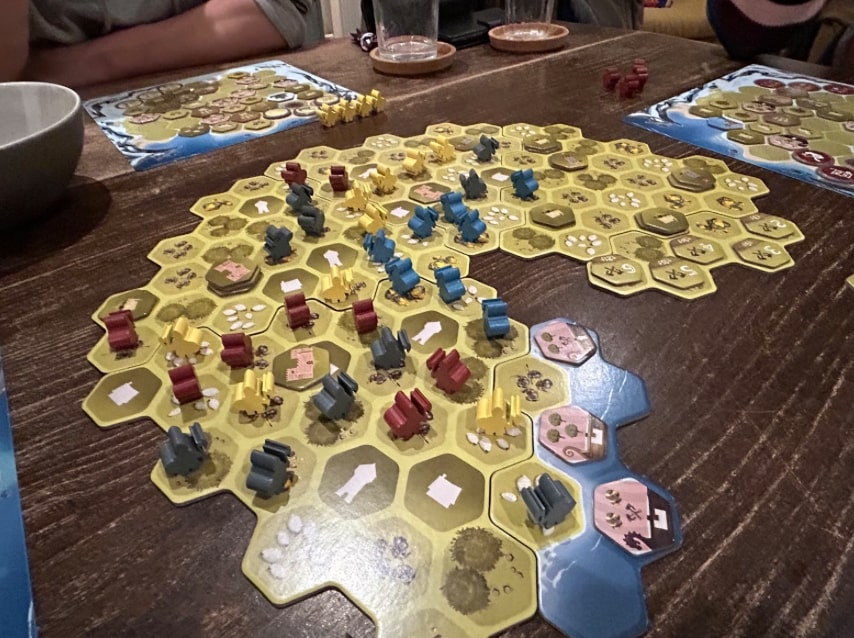
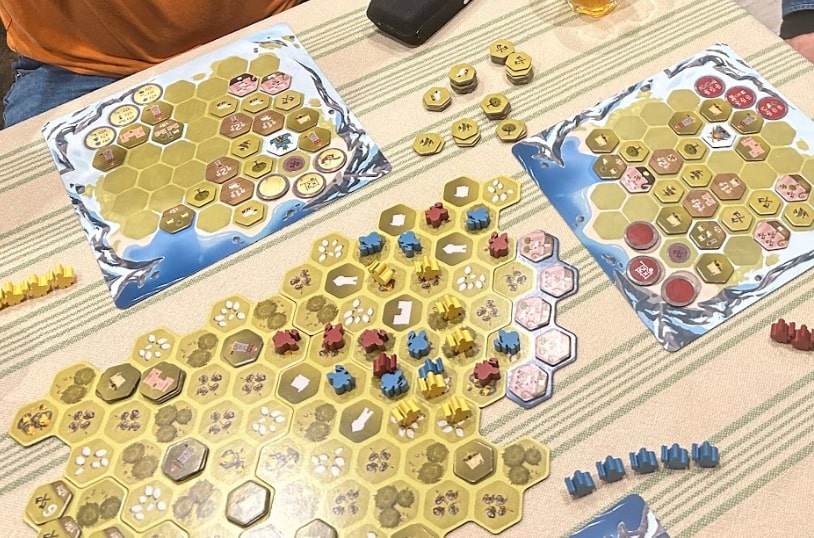
In Looot, you are vikings, arriving in new lands and plundering resources for your own reward. Players have a shared board where booty is found and claimed, but each have their own individual board to puzzle over back home: where your ill-gotten gains get transformed: into points!
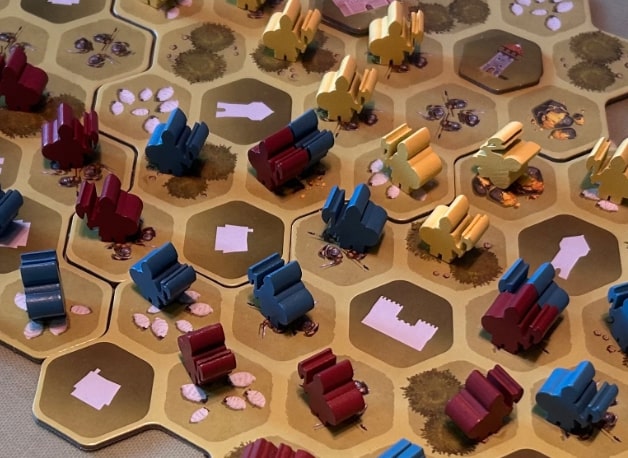
The shared board is a different size depending on the number of players, but basically shows the resources you can claim by putting one of your vikings into a hex (wood, sheep, axes, gold) and the buildings you can claim by either placing next to them (the easily-taken houses) or linking them together with your vikings (watchtowers) or simply having at least 4 of your vikings connected to them (the alluring castles). Why are you doing this, and what do you hope to achieve? – Let’s go through a sample turn.
You must always place a viking in a free hex, and it must either go next to another viking (-any colour) or the longship tiles perched on the coast. When you place a viking, you get the resource there and, depending on context, possibly claim buildings too. Whatever you take is placed onto your player board, wherever you like – but, the location is important, as we’ll see.
Then you have the option of claiming a longship tile, and adding this to your board as well. The longships will increase your score, but you need to surround them with certain resources, as printed on the tile itself. Once that is done you can flip the longship over to its reward side. For example, each castle has a base value 4 points and so three castles would be 12 points. But if you ‘complete’ a longship that gives each castle +3, now your three castles are worth 21 points instead. All the longships have this value-boosting ability, while the three buildings you start with already on your player board – which also need x resources to be flipped over – simply score points. And these longship bonuses basically apply to all the things you can claim – buildings and resources – so the challenge is to synchronise them in the best possible way.
There are a couple of other wrinkles but that is largely the game: a conflict of interest on the shared board, and a solo puzzle on your own where the player who best combines the tiles they take with the bonuses they have will win!
Sam says
Looot is one of those games where the back of the box has a 1-2-3 set of at-a-glance instructions that make it look like a light family undertaking – but it’s far more thinky than the box suggests, and that’s without even mentioning the Shields (three one-use-only boosters: use wisely!) and trophies (claim a trophy for points: having a lot of axes helps!). Every resource on your own board can count towards every hex around it, so while there’s a slightly combative vibe on the main board, here it’s more of a spatial puzzle where adjacency is a far more powerful word than you’d normally expect, and the fun of ‘loooting’ is replaced by the challenge of a stay-at-home viking trying to multi-task several overlapping jigsaws.
-

Take That!
It’s more passive than brutish, but you can find yourself blocked out of spaces you need.
-

Fidget Factor!
It’s a game where rushing decisions makes little sense, so while the rules aren’t too heavy you definitely need a little thinking time particularly on Longship placement. Maybe best with 2 or 3 players in that regard?
-

Brain Burn!
A puzzly undertaking where you’re mainly focused on maximising points from your board, whilst also keeping an eye on opportunities (and closing doors) on the shared board.
-

Again Again!
Lots of random factors mean that the puzzle aspect remains fresh for numerous visits.


