
dnup
Designed by: Kei Kajino
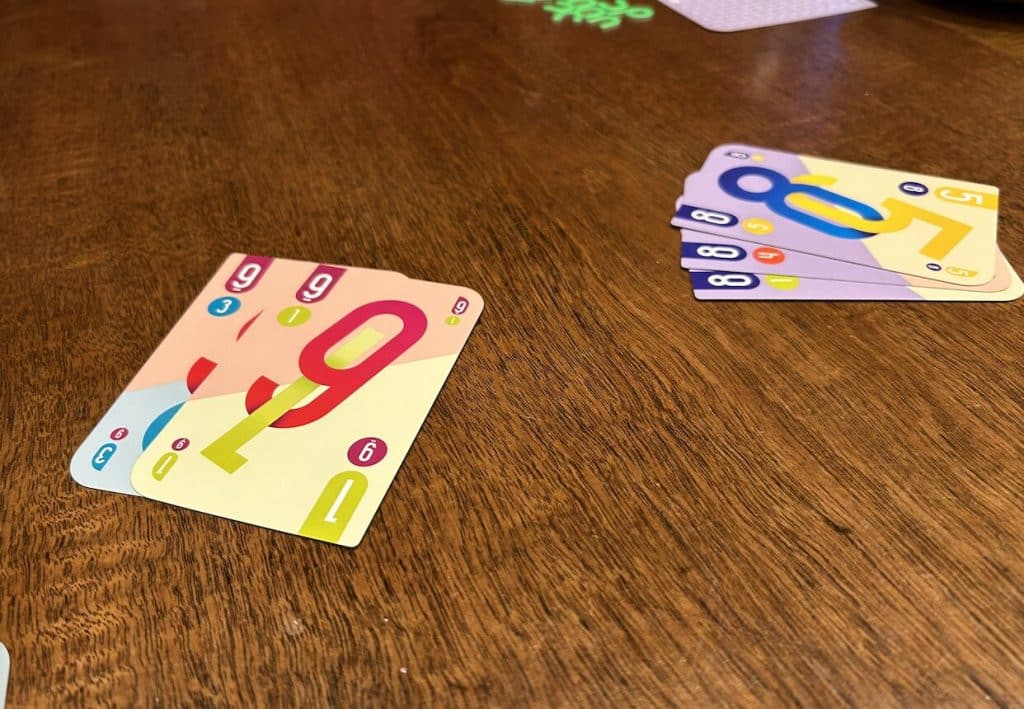
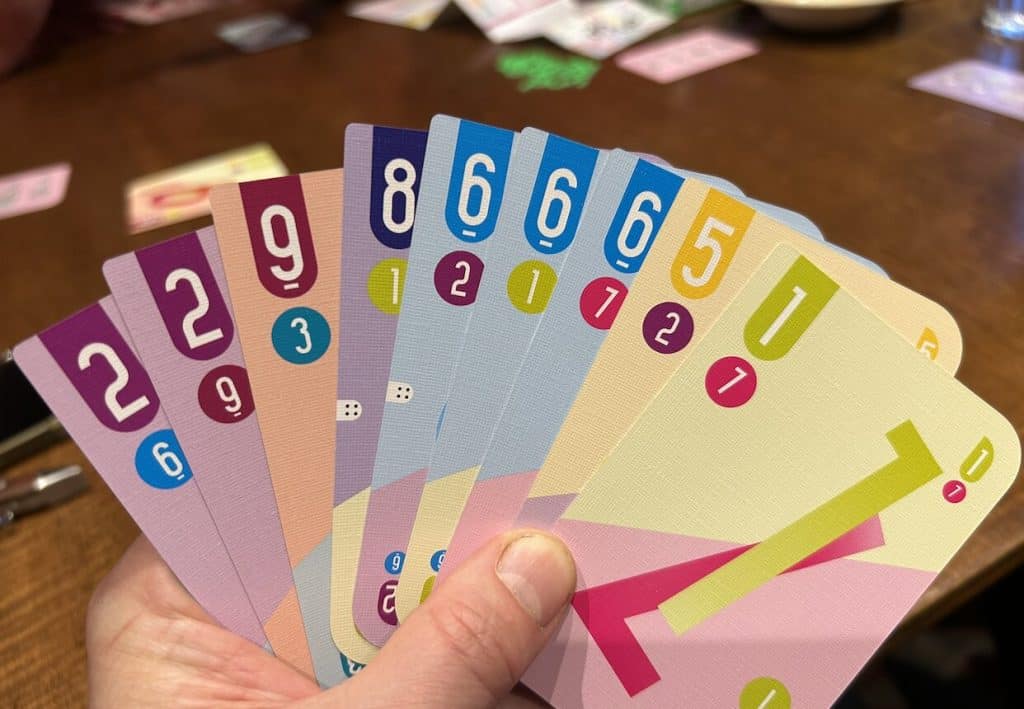
The peculiarly-named dnup is a card game with a difference – each card has two numbers: one at either end. Your goal is to get rid of all your cards before anyone else does – but it’s easier said than done when they keep flipping over…
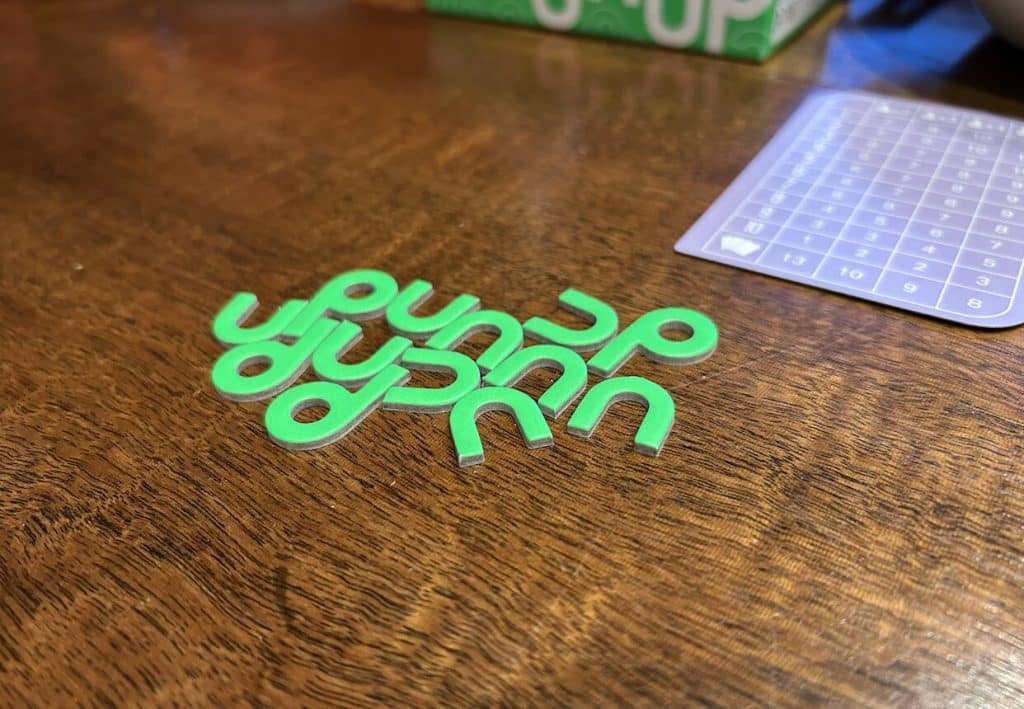
Apart from the scoring tokens, the game is entirely in the cards, which are numbered from 1-10. There are lots of the lower numbered cards, and fewer of the higher ones, up to the rarely-sighted 10. All the cards are dealt out and the player with the 1/5 (ie a 1 at one end, a 5 at the other!) goes first. Note that whilst you can arrange your hand how you like, this is only laterally: no cards can be flipped over!
On your turn you’ve four possible actions. You can play a set from your hand to the table – this can be a single card or multiples of the same number. If there’s another set on the table of the same number of cards, your set must be higher. So for example because you played your three 5s, I cannot currently play my three 2s. But three 6s or anything higher would be fine. But you only have to beat any set of the same number of cards, so I could play my single 4 if there’s no higher single out there. If your turn arrives and you still have cards in front of you you played on your last turn, then you can safely discard them before this turn. Whew!
There are three other actions you can do on your turn instead (a turn is always a single action). One is you can add a single card to another player’s set, anywhere on the table – a handy way of getting shot of pesky singles. Another is you can take another player’s set into your hand; the caveat being that when you do so you must – of course!v – flip the cards around. The last possible action is that you can flip your entire hand, which – if you’re able to plan like Rube Goldberg does – can be a fantastic moment of turning a bunch of rubbish into one or two big sets.
The goal is to shed your cards, and a round ends when two players have done so. First out gets two points and second out gets one. The first player to reach four points is the winner.
Sam says
I’m a bit fan of designer Kei Kajino’s Scout and dnup is not a million miles away from that experience: in both games you’re trying to shed your cards, and in both games there are restrictions as to their orientation. dnup feels a little more chaotic to me, despite the (slightly) simpler rules. In our first game everyone was bamboozled by it – but by the end at least one person (-not me) was getting to grips with the roiling ramifications, and starting to manage their hand rather well. It’s an interesting game in that the rules are pretty straightforward but their implications and consequences are incredibly opaque – at least at the start of the round. If you’re able to keep track of what people are picking up certainly doesn’t hurt, but I don’t think it’s necessary to play – I wouldn’t call this a memory game. It’s an odd one, but I don’t mean that pejoratively. For some it will be a little too foggy and/or chaotic. For others, the curious swings and labyrinthian routes to ‘building’ a good hand will be excellent, oddball fun.
-

Take That!
It's a fairly chaotic game, but whilst you might be continuously picking up cards you're trying to get rid of, it would take a leap to interpret it as personal
-

Fidget Factor!
Low, occasionally staying to moderate depending on how many players, and how determined they are to exert some control!
-

Brain Burn!
There is some agency to be had amidst the madness of card flipping and swapping and dumping, and we suspect that finding those thin margins are where the juice of the game is
-

Again Again!
It depends how you feel about the bubbling manifestation of possibilities, but it's never predictable


