
Eldritch Horror
Designed by: Corey Konieczka, Nikki Valens
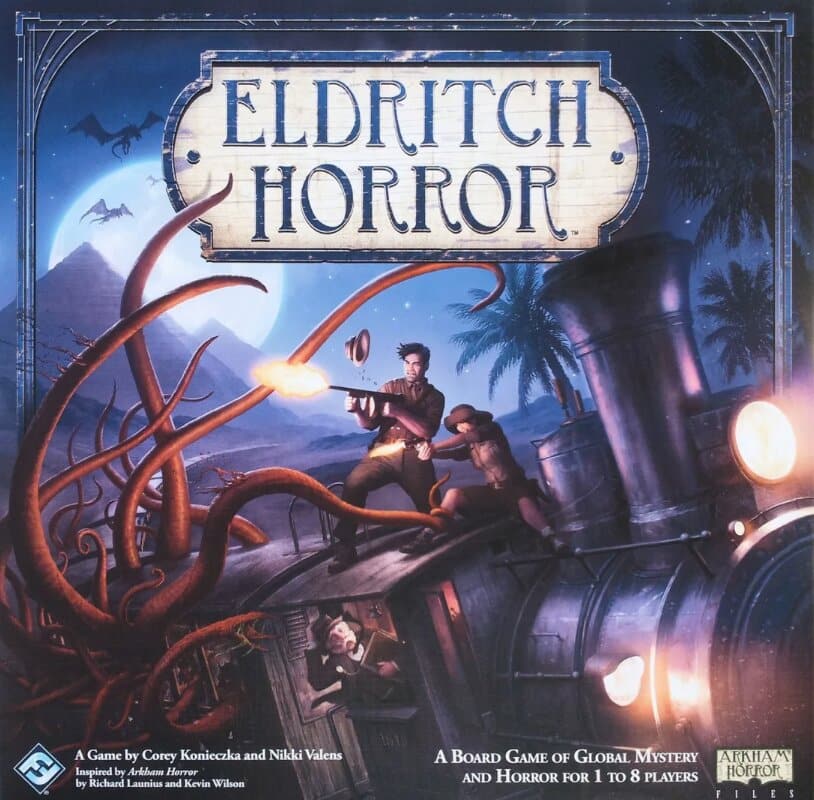

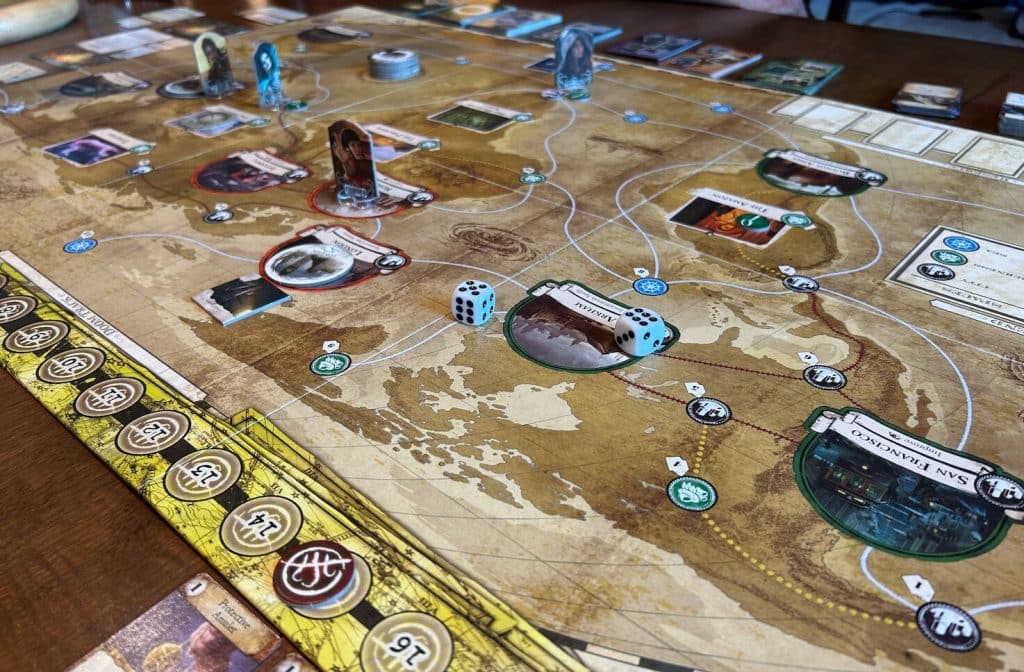
Inspired by HP Lovecraft’s stories of the occult, Eldritch Horror is a game that pitches the players co-operatively against the horrors of the Ancient One and its evil disciples, set on destroying the world as we know it.
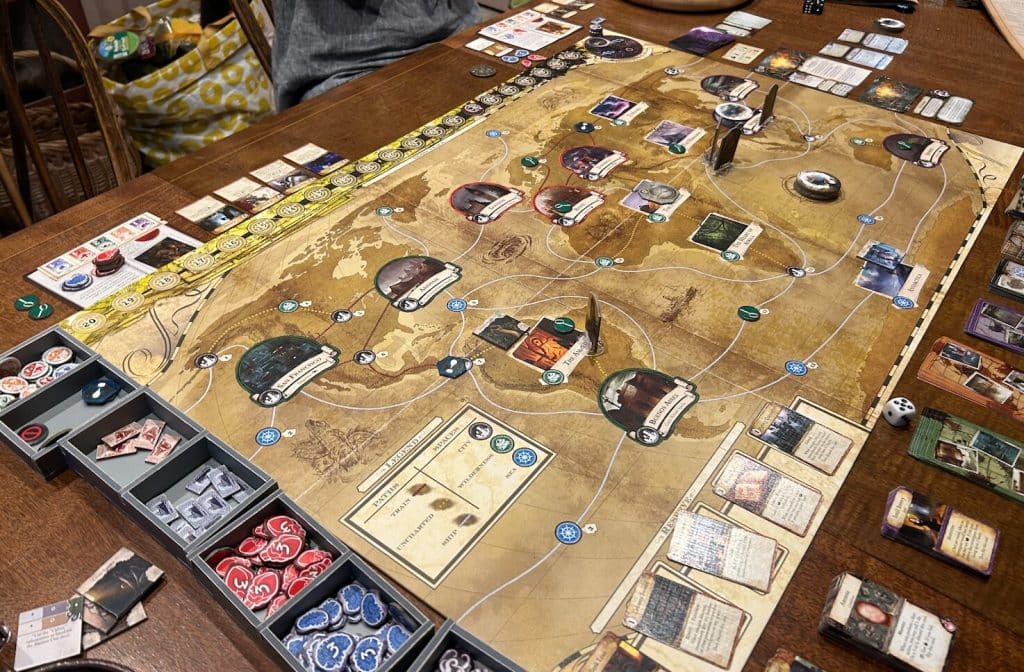
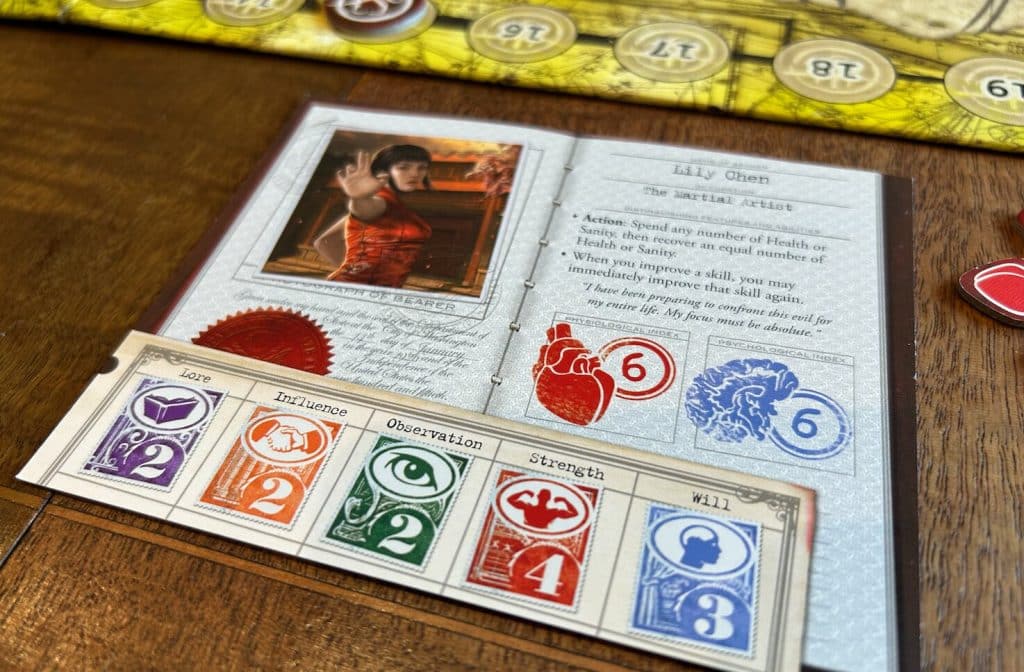
The board is a map of the world dotted with locations and routes – mostly train or ship – linking them. As with the classic co-op game Pandemic, the game is a mix of reaching your objectives whilst firefighting interference along the way. Each player takes the role a specific character from Lovecraft’s mythos, and each character has their own strengths and weaknesses across a number of skills – Lore, Influence, Observation, Strength and Will – along with a special action or exception specific to that character. Lily Chen, for example, is a good character for combat whereas Jim Kane is better for solving clues. Each character also starts with a specific Health and Sanity quota: if either of these hit zero, your character has died or gone and mad and are out of the game – although as a player you simply take a new character and rejoin the action on your next turn.
Each turn your character takes two actions, which must be different from each other. One action is to travel: simply move your character to an adjacent location on a route. But you can move further if you’ve Prepared for Travel: this prepping action can be taken in a city, letting you take train or boat tickets to cash in on a later travel action. If your character has lost health or sanity, you can bump up both by Resting, and you can trade assets with players in the same location as you. You may start with assets, depending on your character, but you can also try your luck at gaining assets by testing your influence whilst in a city location. This is called a Skill check.
Skill checks are a core part of the game, and occur after all players have taken actions and the round moves into the Encounter phase, which is the meat of the game. Each skill check is a matter of rolling dice and succeeding with a 5 or 6 on any – usually one is enough – of the results. How many dice you roll depends on your score for that particular skill: returning to our examples above, Lily gets four dice in combat (because her Strength score is 4) but only two if she tries an Influence skill check (Influence: 2). The aforementioned assets are, as the name implies, all helpful things that aid you individually or collectively on your quest. But what is your quest?
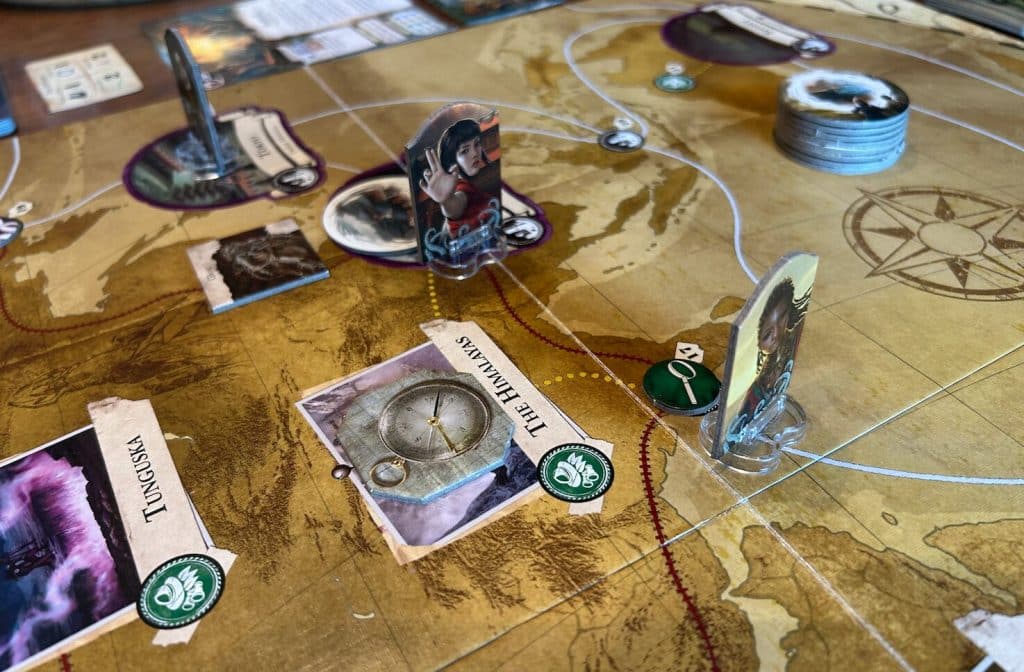
There are several mysteries that need to be solved for players to win the game. Each requires the solving of clues – which pop up around the board in the form of tokens – and each ‘solving’ will involve a skill check of some kind. If you’ve enough clues, getting to a certain location and ‘cashing them in’ against a mystery resolves it, and you can now flip the next mystery card.
In the way of that objective is the Ancient One and its shenanigans on the board. Gates pop up around the place – portals to a dark realm – and monsters come out of them, that if left unhampered will escalate the marker on the game’s Doom Track. If the marker reaches zero before the final mystery is solved, the players lose the game. There are a couple of other ways to lose, but this is the most common: after each round, the Ancient One itself gets a turn of sorts: a Mythos card is flipped and causes bad things to happen on the board, usually triggered more doom than you really want to see. If you can complete the mysteries before this happens, you win. If not… it’s goodnight Vienna. And everywhere else.
Sam says
Although I wouldn’t go near this with eight players – I’ll get to why – for 3 or 4 it’s a fun undertaking. I do love a game with a narrative and like Tales of the Arabian Nights, Xia, Merchants and Marauders and others, Eldritch Horror is firmly in the tell-a-story camp of game design. It’s perhaps not as elegant as some, but the fun of Eldritch Horror is in how catastrophically dark and relentlessly brutal it is on the players: the first time I played one of us picked up 3 internal injuries and another, upon failing a skill check, was instantly eaten. It’s blackly and bleakly comic in its misery and fatalism, and – with a manageable number of players – moves along fairly speedily, which for me gives it licence to eat up the 2-3 hours it can take. But the pacing is fairly staccato because of the way rounds are structured and for that reason, although it officially plays up to 8, I suspect that would feel like far too many. With 3-4 of you things move fast enough that you can plan speedily without the game devolving into protracted conversations amongst numerous voices. I’m not a fan of Lovecraft, but I do enjoy this game for the darkly funny shared experience it generates.
-

Take That!
None from the other players; plenty from the game
-

Fidget Factor!
Highly dependent on player count, and how those players feel about player count (see Sam says)
-

Brain Burn!
The rules are not particularly overwhelming. The challenge is finding the balance between furthering your progress with the mysteries whilst holding off the threat of the Ancient One
-

Again Again!
Although the number of cards is limited and you will start to see repetitions fairly quickly, there's enough variation baked in to keep the game's not inconsiderable challenge intact


