
Endeavor: Deep Sea
Designed by: Carl de Visser, Jarratt Gray

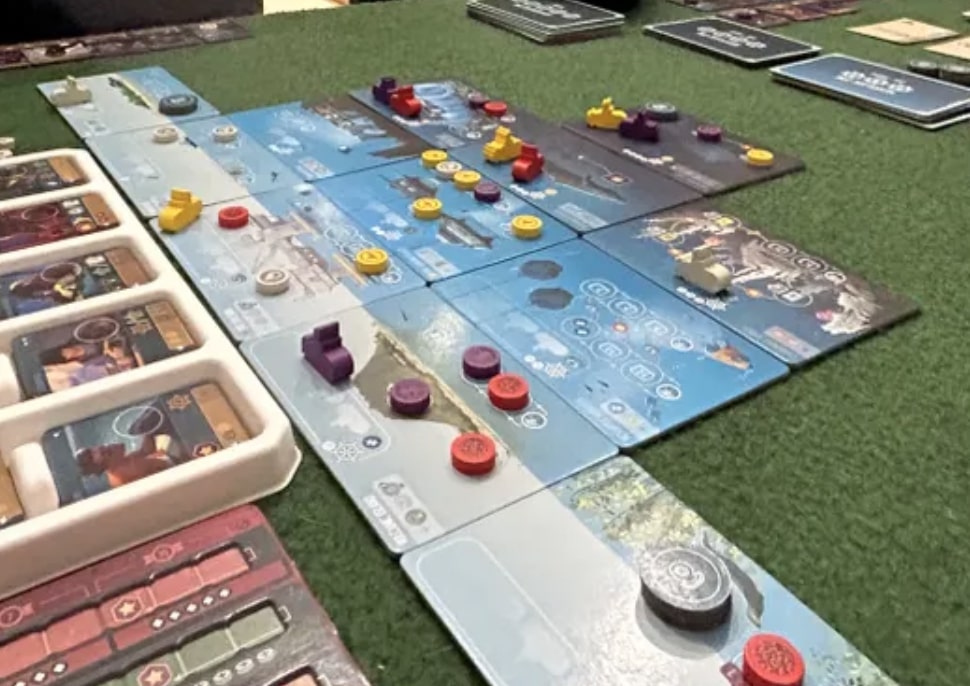
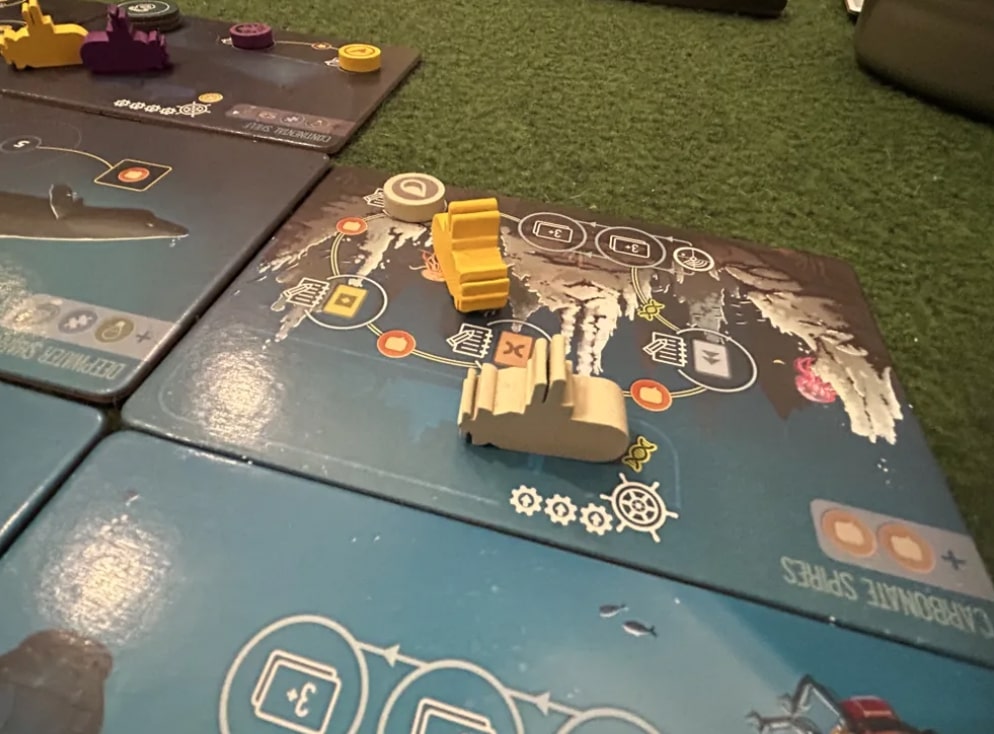
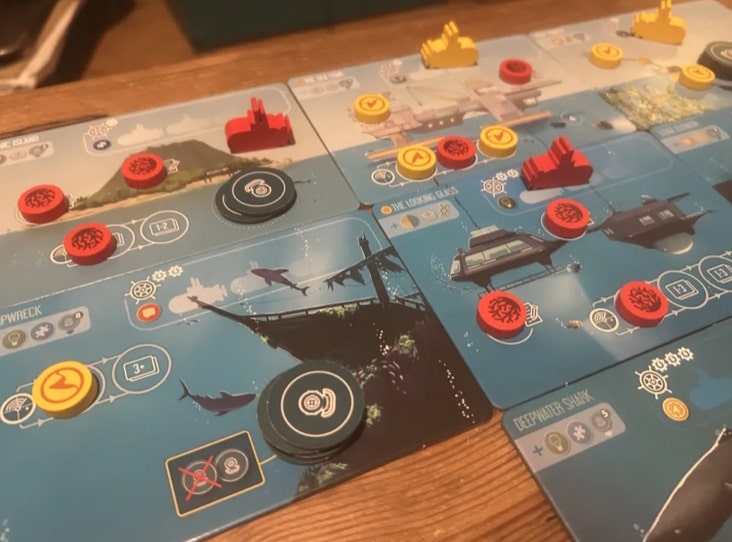
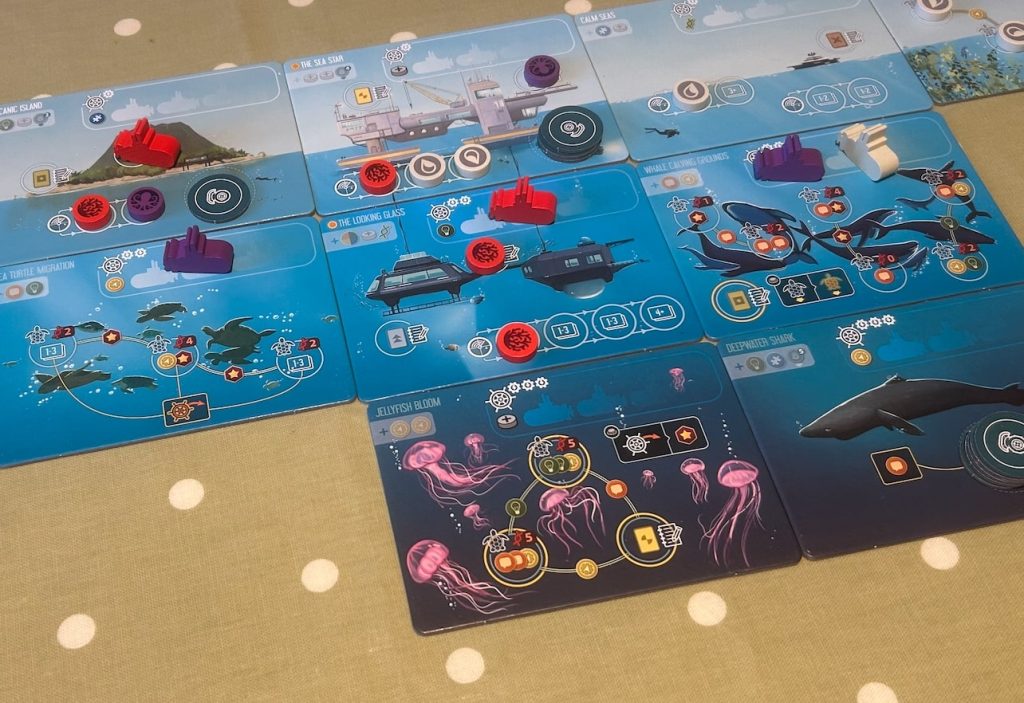
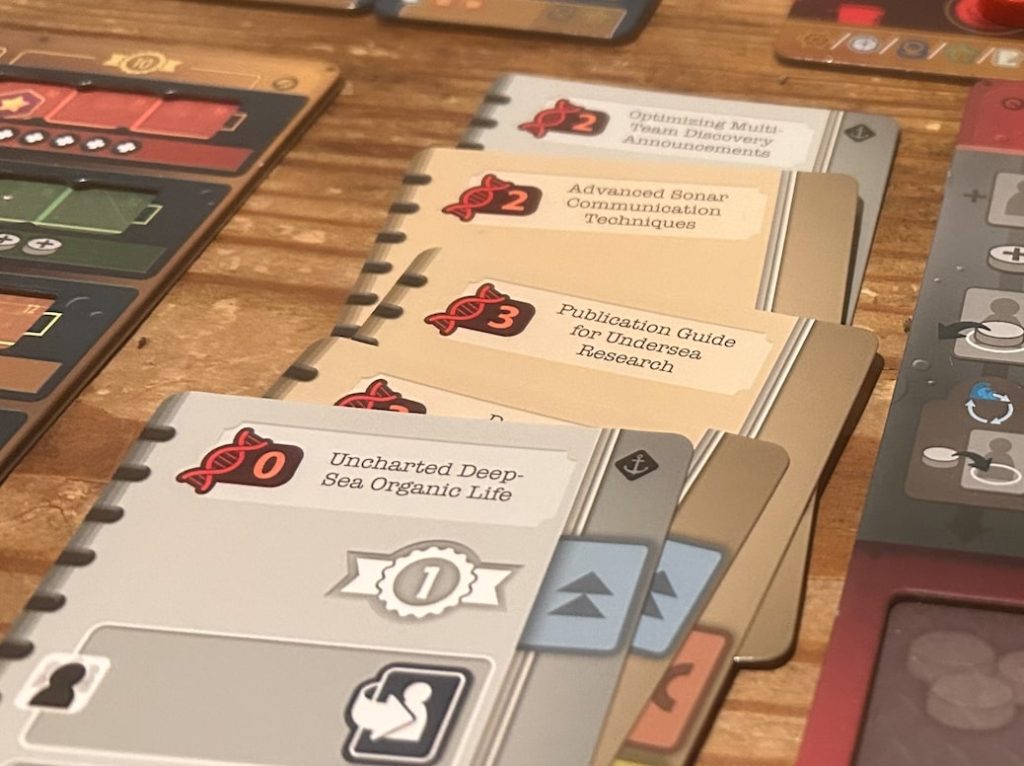
In Endeavor: Deep Sea, players are scientists exploring, cataloguing and conserving the ocean. The game plays over six rounds, and in each round you grow your team of specialists, and send them out to the deep waters to harvest knowledge… and victory points!
Each round begins with a Preparation Phase, where players get to add a new Specialist to their team, gain more discs – representing potential actions – and recall discs that were ‘spent’ in previous rounds. After that, the Activation Phase begins: where you place discs on specialists in order to put them to work. Each specialist offers one or more possible actions: travel, sonar, dive, conserve, or journal. These almost entirely take place on the shared playing area, which is a modular set of boards denoting particular depths of the ocean. Travel allows you to move your vessels around the board, in order to take actions there. Diving is simple: take a dive token and gain the reward – more on rewards shortly. There are specific spaces on the board for your discs if you want to sonar, conserve or journal: as well as placing a disc on your specialist, add one to the specific spot on the board. Sonar explores the depths, adding further boards that extend the play area of the game. Journal and conserve are both about harvesting knowledge, but almost everything you do in Endeavor Deep Sea gains you a reward.
Discover via sonar, arrive somewhere, conserve, dive or journal: everything you do has a cost – usually just a disc or two – but gives you something back. Each player has their own player mat which tracks their capabilities: what strength of specialist they can recruit, how many freebie discs they get from their supply each round, how many discs they can recall from their specialists – not just to access the disc, but also free up the specialist to use again! – and a final track that shows how far and wide (-and deep) your vessels can travel. The rewards you gain in the ocean push your markers up these tracks, and improve your standing in the oceanographic society – and the game. After the sixth round concludes, you score for how far you’ve moved up these tracks as well as a couple of other criteria: most notably, the Mission Goals. Deep Sea Endeavor has nine different scenarios – missions – that are each replayable, but give you a different starting set-up and different in-game objectives. In Mission One for example, there are big bonus points for having done the most sonar, journaling and conserving. By the time you get to Mission 9, however, the basic rules are appended by some story-specific Mission goals that add a few specific rules. Be aware also that if you manage to recruit some top-level specialists before the game is out, these may give you a way to score extra points.
Sam says
Since we started GNG my tastes have generally veered away from games as complex as Endeavor Deep Sea: there’s a fair few rules (fifteen pages) a lot of iconography, and more than one or two concepts to hold in your head. Add in the Mission-specific rules and it does at first start to feel like your brain itself is sinking into the abyssopelagic zone. However, while there is a slightly sprawling sense to this endeavour, it’s a setting that really resonates, and the actions you undertake do feel thematic. And while we are in competition in the game, the efforts we go to in ‘the ocean’ feel, to some degree at least, collaborative: everyone is serving the same masters. The lack of plastic is also a welcome bit of meta-design: it’s not a small box and plastic inserts and minis would have felt a little ironic, given the theme. I like it. I enjoy it, and I’ll play it again. Complexity-wise, it is pushing at the edges of what I relish, but it’s a game I’m very happy to revisit.
-

Take That!
Very little. Specialists can run out, and spaces can be claimed, but it’s pretty much passive interaction rather than dirty deeds.
-

Fidget Factor!
A fair amount of the game is situational in that by the time your turn comes around your plan – if you had one – may be changed, by circumstance or opportunity. As a result, embracing the ‘discovery’ vibe is a good idea, and not expecting turns to always rattle by like a speeding billionaire’s yacht.
-

Brain Burn!
How best to combo your specialists? How to push up those track markers? Can I get to the Coldwater Reef before someone else claims the last conserve action there?
-

Again Again!
The numerous missions are all replayable, and each game contains randomized elements as well. Plenty here to discover for budding oceanographers.


