
Flip Pick Towers
Designed by: Adam Porter, Rob Fisher
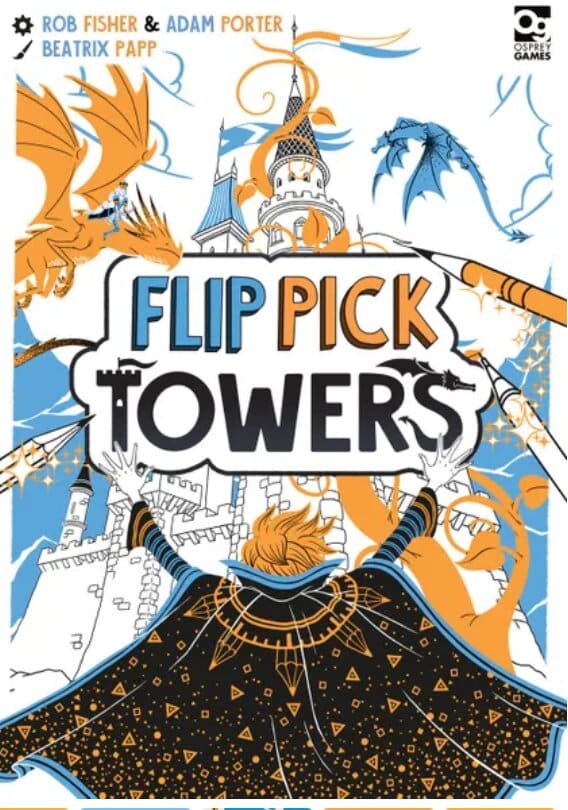


Flip Pick Towers is a flip-and-draw game where we’re all drawing castles. Everyone begins with their own foundations, and during play we will build our own construction – and populate it – floor by floor.
A deck of cards is shuffled and each round three are flipped face-up. Each player chooses one of these cards to add to their castle – multiple players can choose the same card – and draws it in. Floors are pretty simple and make up the majority of the deck: draw in a floor on one of your towers, adding the number to it shown on the card. The catch here is that each floor must have a lower number than the one supporting it: the stability rule. When you choose a floor card – when you choose any card, in fact – you also cross off the resource it comes with at the bottom of your sheet: gold, glass, fabric, or magic beans. We’ll come to what these do shortly.
Other cards are Bridges that connect towers (and may subsequently be built on) Roofs that top them, and Royals and Creatures. Royals are the King, Queen and Princess, and they score very differently game by game: Flip Pick Towers comes with a second deck of cards from which three are randomly assigned to this family before play starts, and define how they get you points. The Queen might want to be the only Queen in a tower, for example, and the King desirous of lots of windows at the same height as him. When you choose a royal, you add them to an empty floor of your choice: either draw them in or simply write a big letter there.
Lastly there are the Magical Creatures: when you choose a magical creature you don’t add them to your castle, but simply draw a diagonal by that creature at the bottom of your pad: each magical creature gives you a power you can use in the future, once for each box you have (add another diagonal to show it’s now been used and crossed-off). These are little temporary rule-breaking advantages like ignoring the stability rule or harvesting extra resources.
We said we’d return to the resources: these are used for extra adornments in your castle. When you take a resource you cross off a matching box anywhere on your pad, and when any column in a box is completely full you can draw the related item in your castle. Gold (bag of cash) and Glass (a window) require and empty floor to be drawn in. Fabric allows you to hang a banner from any tower. And Magic Beans let you draw a beanstalk, the height of which is relevant to which column you fill. All of these things bring you points at the end of each round, although you may decide to use the gold another way: to pay off a Dragon. There are two dragons in the deck and when they arrive you have a choice: you can either cross off one of your gold bags to ‘feed’ it, or you can sacrifice any upward construction on a tower by drawing a dragon there, making it now inaccessible.
A round ends when the deck runs out and players score across multiple criteria: their highest tower, all their beanstalks and gold, each royal and the players with the most/second-most windows get two points. Players who placed roofs will also get points for flags, which are drawn on top of a roof: 3 flags if you are first to place a roof, then two flags for second and one flag for third. Cards are shuffled and a second round begins, and after the second round points are scored the player with most points wins.
There is another way the game can end though. When you choose a card the resource is always optional but you must draw the feature, and if any one player finds that they can’t do so three times, the game ends instantly.
Sam says
This is a sweet little game, themed endearingly for the more romantic amongst us whilst offering a decent challenge for the puzzlers. I don’t hanker for it hugely but I’ve enjoyed a couple of visits well enough. For me the X-and-write genre (roll a die/flip a card: everyone does their own thing with the results) seems to work best in its simplest forms: when they are fast, silly and laced with the tension of your options dwindling and desperately needing a certain thing to hit payload. I don’t get that drama or silliness from Flip Pick Towers, but I can’t deny it’s a small pleasure regardless – there is something nice about building your castle from the ground up that satisfies, and I enjoy the luck-pushing aspects and small elements of interaction (first to roofs/most windows) And if you don’t exactly feel the fiery breath of the dragons during play it does keep hold of its theme in a way that many games don’t.
-

Take That!
Pretty much zero
-

Fidget Factor!
Slim to none: there are three options each turn
-

Brain Burn!
It's a puzzle, with a streak of luck running through it.
-

Again Again!
The way the royals score changes dramatically in each game


