
Gazebo
Designed by: Reiner Knizia
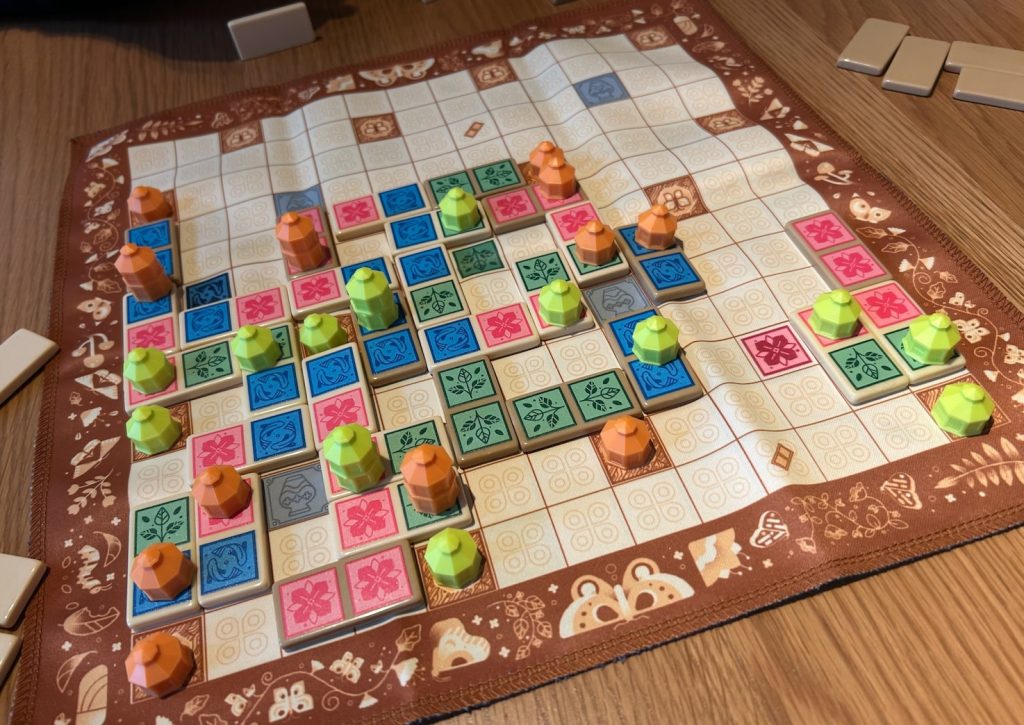
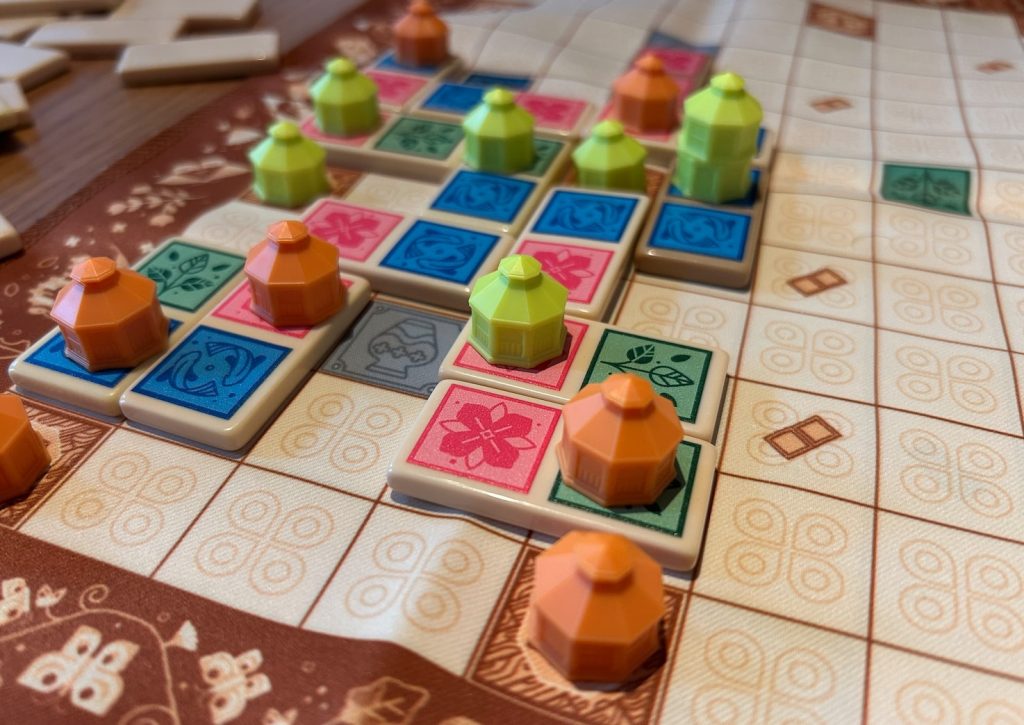
Gazebo has a garden-building theme, but really this is an abstract game for 2-4 players, and a pretty fast-moving one.
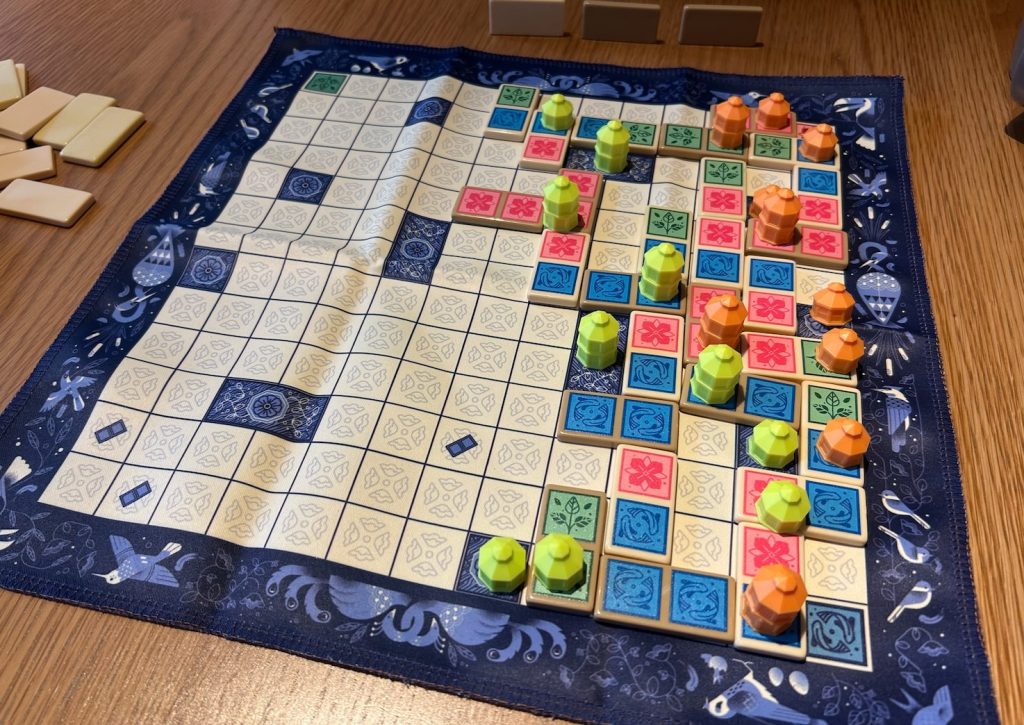
The board – actually a double-sided cloth mat – represents the play area, which during the game will fill up with dominoes. On top of these dominos, you’ll place gazebos, and the objective is to get all of yours out on the board before anyone else can.
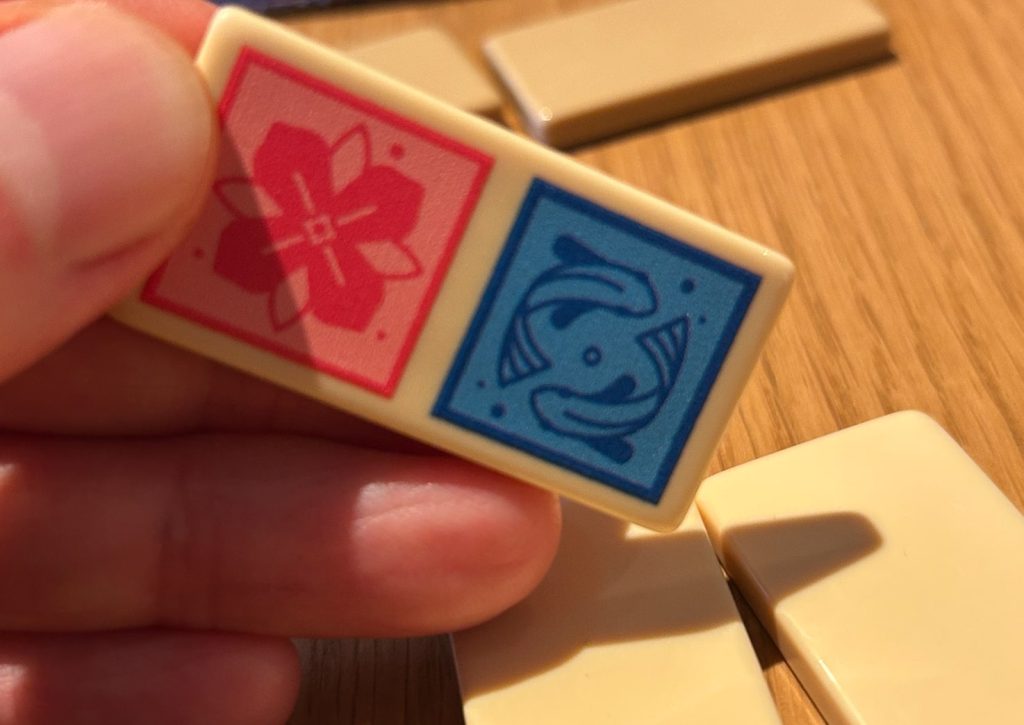
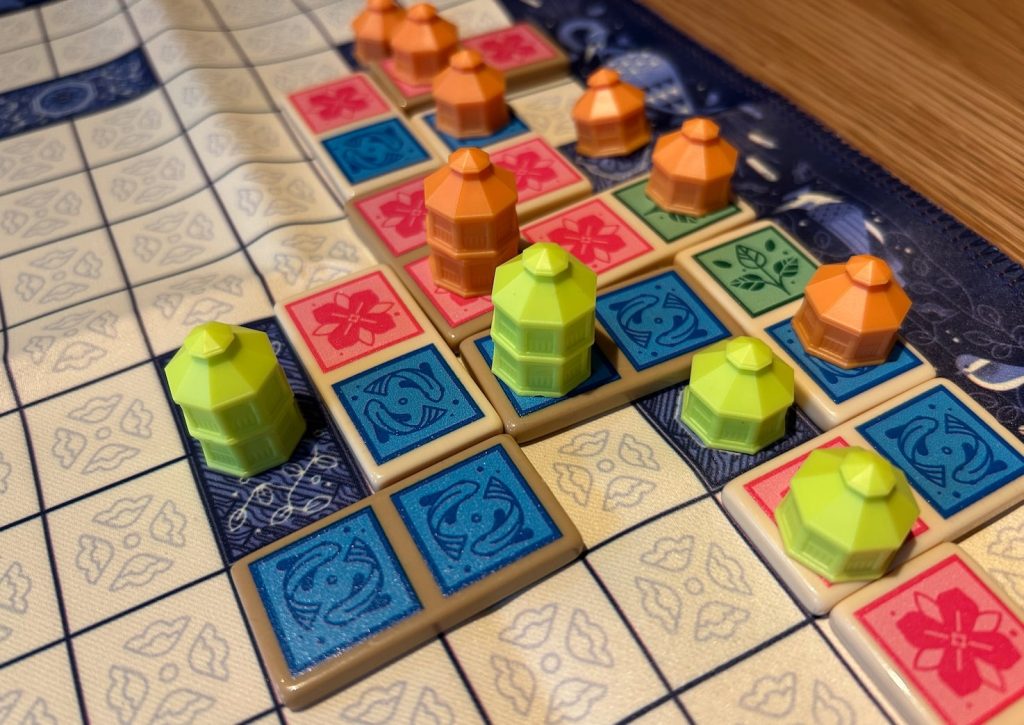
Each player begins with a bunch of gazebos in their own colour and a hand of dominoes, each combining two of the three colours: blue, green and pink. On your turn, you add one of your dominoes to the mat, connecting to either one of the ‘starting’ positions printed on the mat, or next to a previously-placed domino. The colours do not need to match – but it’s usually helpful if they do. If you create an area of at least two half-dominoes of a matching colour, you’ve now made what the game calls a Nook, and can place one of your gazebos on top of the domino you just played. If a noos grows over time to be five or more connected half-dominoes of the same colour, you can now place a second gazebo on top of the first one – which is helpful on two counts. One is that you’re trying to get your gazebos down on the board as quickly as possible. The other is that a two-tie gazebo can’t be ejected from the board. So let’s look at how a single gazebo can.
If two matching-coloured nooks should ever join up (by someone placing a tile to connect them) then the player with the largest of the two pre-joined nooks absorbs the smaller one, and the owner of the smaller nook is forced to remove their gazebo (you can’t join two nooks if the result would be a tie, and you can’t join two nooks if both have two-tier gazebos in them).
In terms of placing dominoes, that’s pretty much it except for the doubles: dominoes that are the same colour both sides. Each player has a reserve of doubles, and when your turn ends you can either pick up a standard domino, or one from your doubles, the catches being that they are rather limited and you’re not allowed to look at them before taking one.
The other thing to factor in are effects on the mat: both sides have small ‘patio’ areas where the first player to create or connect a nook next to them gets to place another gazebo on the patio itself (but beware, patios can change hands if another player connects more nooks than you do!). One side of the mat also has the larger Fancy Patios (place two gazebos) and the other Vase spaces: when you connect or create a nook adjacent to a vase space, you get another turn. Both sides have Zen spaces: unlike the patios and vases, you can play onto a Zen space, and doing so allows you to refresh your hand with a double from the supply, instead of a standard domino, if you want to.
The moment anyone places their last gazebo, they instantly win.
Sam says
Gazebo (based on an older game called Qin) is a very solid game for two, and decent with three as well. As you hit four players it gets a little more chaotic-feeling – that may suit some, of course – and less calculating. Although I’d prefer a board over a mat, it has brow-furrowing aspect to it that’s deep enough to be enjoyable without becoming a headache, with the pieces all in front of you it’s very easily learned/taught as well, and packs into a satisfyingly compact box. Does this all sound a bit vanilla? If so it’s only because this designer has made so many games, and his best are so, so good, that he sets a particularly high bar. My all-time favourite is probably Babylonia: it has a little more going on under the hood than Gazebo, with a dollop more strategy alongside the tactical play evident here. But Gazebo is a fun undertaking all the same, and one I’m more than happy to return to.
-

Take That!
Present enough to be factored in to your approach
-

Fidget Factor!
It's a relatively brief game, but one that does demand a bit of tactical thinking, and banging down dominoes without it will make the experience seem random
-

Brain Burn!
However the limited options in your hand (there are multiple dominoes of the same colour combinations) and the way the nooks grow on the board can limit your choices. The challenge is in making the best of what your have.
-

Again Again!
Although the domino types are limited, there's quite a bit of variety on offer here, with the doubles and the elements on the mats playing a significant part in proceedings.


