
Orongo
Designed by: Reiner Knizia
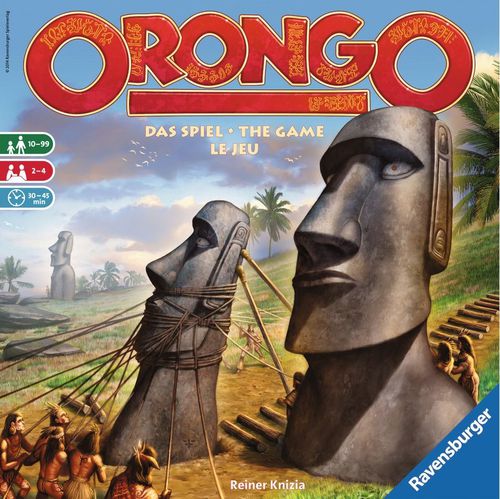
In Orongo – recently republished as Nyakuza – you are the Rapa Nui inhabitants of Easter Island, hoping to be the first to erect seven of the famous Moai statues overlooking the sea.
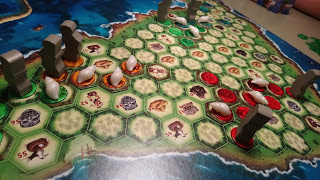
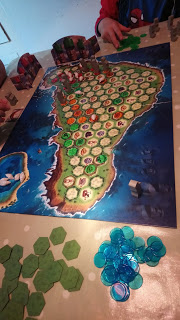
The board shows a map of the island, broken into hexes. Some hexes are empty, and some are numbered, with symbols in; the latter will be filled up with tiles as the game progresses. Each player starts with several markers of their own colour, six moai to build and a bunch of shells, which function as money. Your objective is to build all of your moai and then be first to build the (communal) seventh moai that sits on the board.
At the start of each round, a number of tiles will flipped over and assigned to their matching number on the board. Then the players will bid for turn order, by placing the number of shells they wish to bid in their hand. Everyone reveals simultaenously, and the top three bidders get to place three, two and one markers on the board respectively – grabbing the hexes for their tribe. There are two catches here though – only the top bidder actually pays, and their shells go in a communal space on the board. Is anyone bids nothing, they don’t get to place a marker this turn, but they do get however many shells are currently available on the board from others’ spending them.
There are several ways to build a moai and they all involve controlling tiled hexes (supply) and linking them to a coastal hex (where you can build). Another catch here is that each moai you build costs you one or, more likely, two of your shells – they are placed on the supply hexes to represent depletion – they now can’t be used for anything else!
So each moai you build depletes your stock of shells too, and managing your money is as important as managing your presence on the board as the game continues. The player who builds the seventh moai is the winner.
Sam says
Another game from the exceedingly industrious Reiner Knizia where he wrings a good deal of depth out of pretty simple rules: it is all about the bidding here, and I love how that stops the game becoming repetitive – you can recover from a bad bid, too, if you can successfully read the table. So a nice family game, if the family in question doesn’t mind the slightly combative nature of play here. The one minor criticism I have is when the tiles go on the board, they’re rather hard to spot, so visually it can feel a little chaotic.
-

Take That!
There is a bit. You can be cut off from the coast on the board, or outbid and find a neighbour takes control of a hex you need even though they can't use it themselves.
-

Fidget Factor!
Not much at all.
-

Brain Burn!
The combinations on the board are clear (even if the tiles aren't) but the head-scratching here is about the bidding - when to bid high, when to bid low, when to not bid at all...
-

Again Again!
The tiles always come out randomly even if the board doesn't change. But Orongo's variety and replayability is more about the bidding.


