
In The Footsteps of Darwin
Designed by: Grégory Grard, Matthieu Verdier

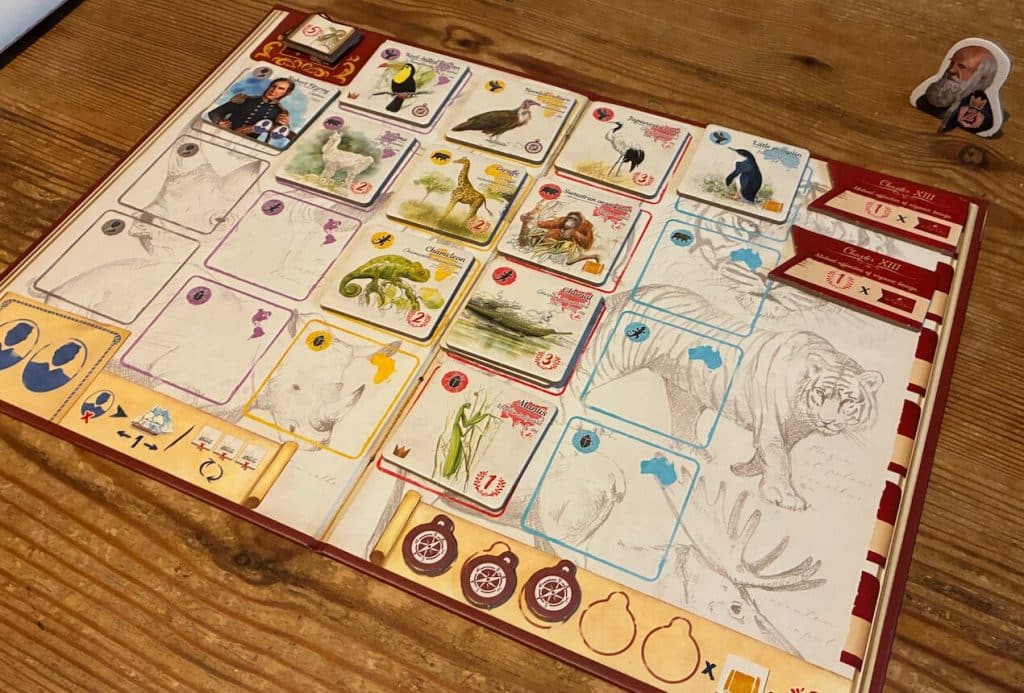
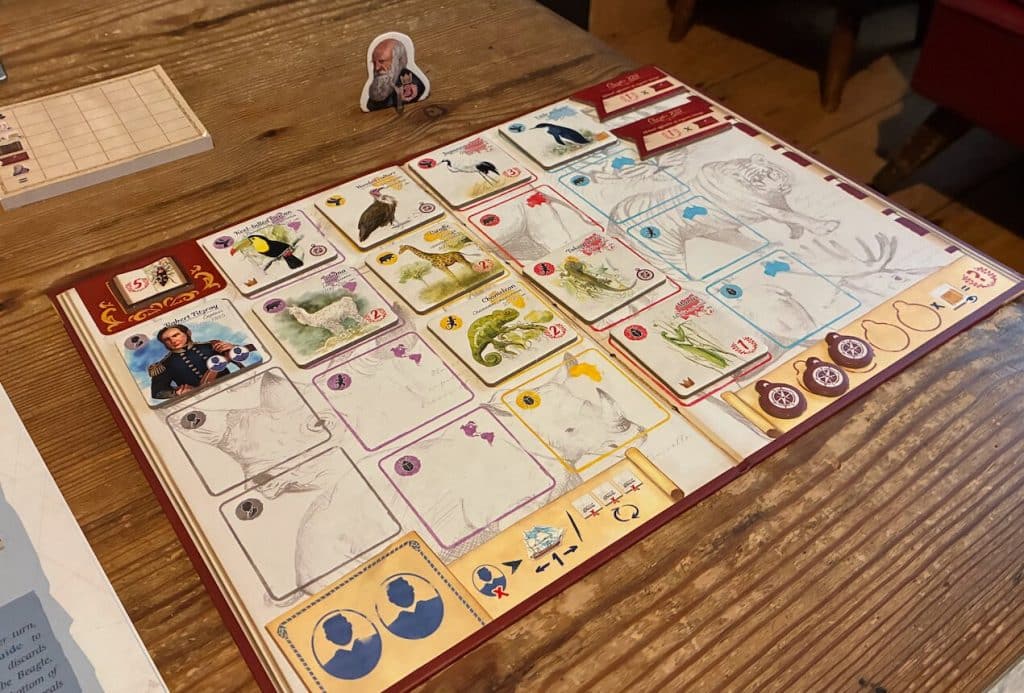
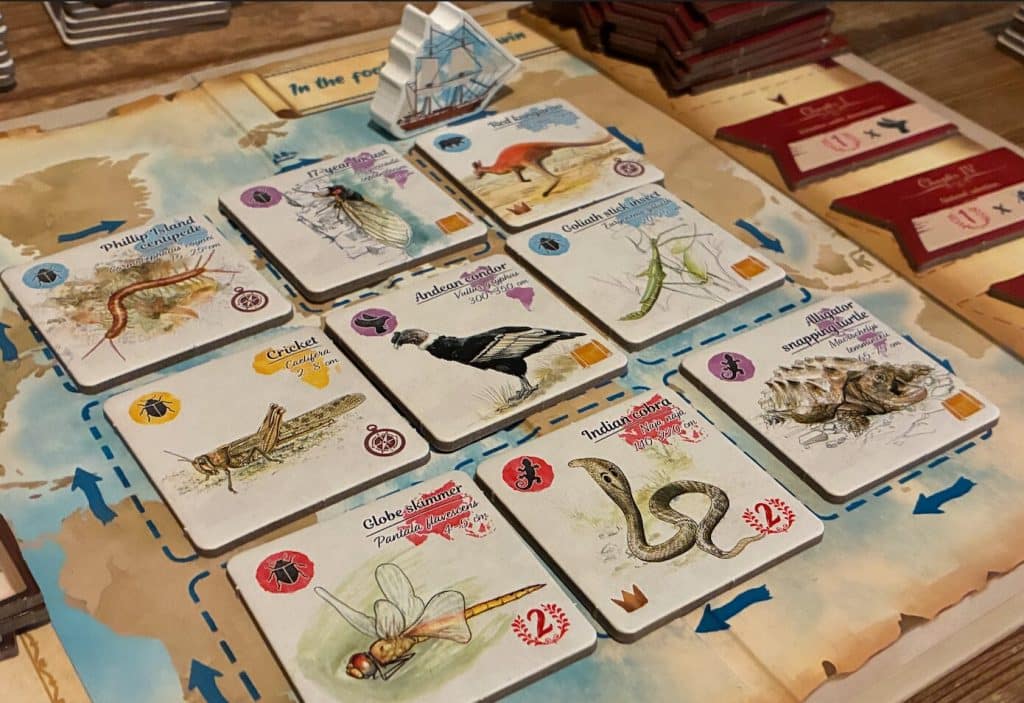

In The Footsteps of Darwin is a puzzle sort of game where players sail on the famous Beagle, collecting – or bearing witness to – multiple species of the animal kingdom.
The shared board shows nine animal tiles, each of which shows a species type and a home continent. On your turn, you take any of the three tiles on the row or column the Beagle is currently adjacent to, and then a replacement tile is added as you move the ship on, as it sails around the perimeter of this 3×3 grid. If you took the closest tile the ship moves one space, if you took the next tile it will move twice, and the tile furthest away, it moves three times. This may be helpful strategically (see Sam Says)
The tile you take goes on your own board. You have a column for each continent and a row for each species: place it on its matching spot. Some tiles have an instant reward, such as gaining a Guide, Chart, or Compass. Guides can be spent to push the Beagle on one space before you take a tile in a later turn, or to refresh the tiles in your current spot. Charts and compasses we’ll come to shortly.
Although your personal board has 19 spots on it, the game will actually end after everyone has had twelve turns, and if at any point you place a tile on top of another tile – because it’s the same species and continent combo – you get to take a Theory token. Theories are another way to score points – you begin the game with one theory already – depending on what tiles you end the game with. At that point all visible tiles score their points value (if they have one) and the number of tiles with charts on them are multiplied by however many compasses you have. You may also score for Publications, which are simply points for filling a row or column, and finally see how well you did on all your theories. Most points is the winner!
Sam says
This is fine. As a winner of the prestigious Spiel Des Jahres award I perhaps expected a little more back from it: some drama, some laughs, some luck-pushing thrills. But the puzzle is more pleasant than compelling, more pedestrian than breakneck, with the only interaction of any kind being taking a tile someone wants – or deliberately pushing the Beagle past one. That said, the fact it’s pretty easy to learn and teach, and pretty friendly to all ages, does make it a highly accessible game in a time where many are cognitively overwhelming, so there’s something to be said for the friendliness here. Sometimes, pleasant is what you’re in the mood for. If you’re a fan, there’s also a sister game called In the Footsteps of Marie Curie.
-

Take That!
Very little, although the late-game claiming of tiles may feel more competitive than the early ones
-

Fidget Factor!
Light. There's pretty much only three choices each turn, unless you consider moving the ship
-

Brain Burn!
It's really a game of set-collection where focusing on one thing is better than a smorgasbord of tiles
-

Again Again!
It's not a game that feels hugely deep, but it's accessible, brief, and offers that gentle dopamine drip of making connections


