
Ingenious 3D
Designed by: Reiner Knizia
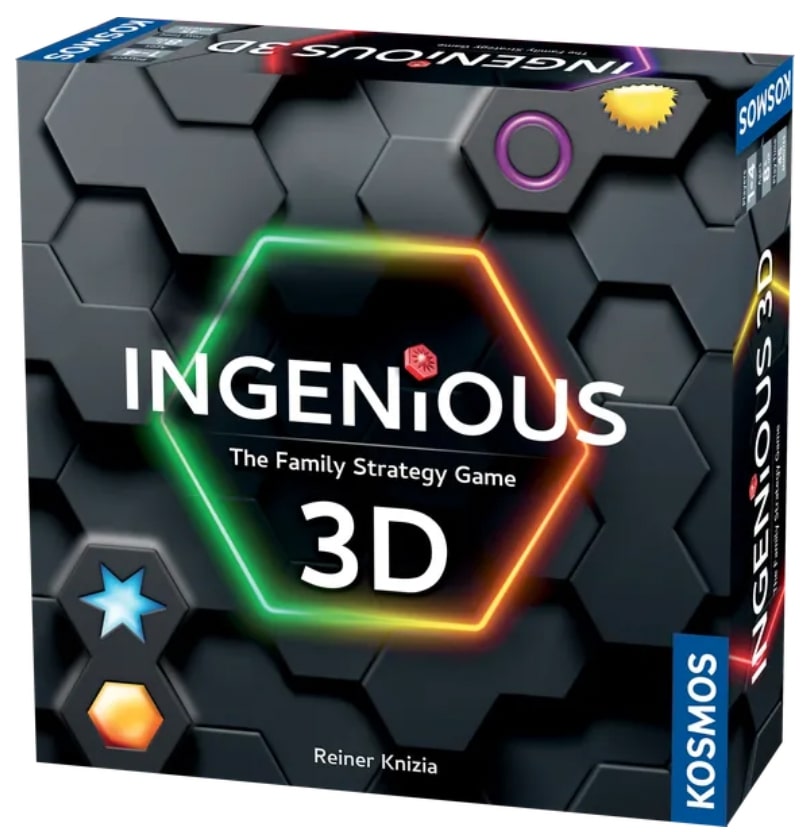
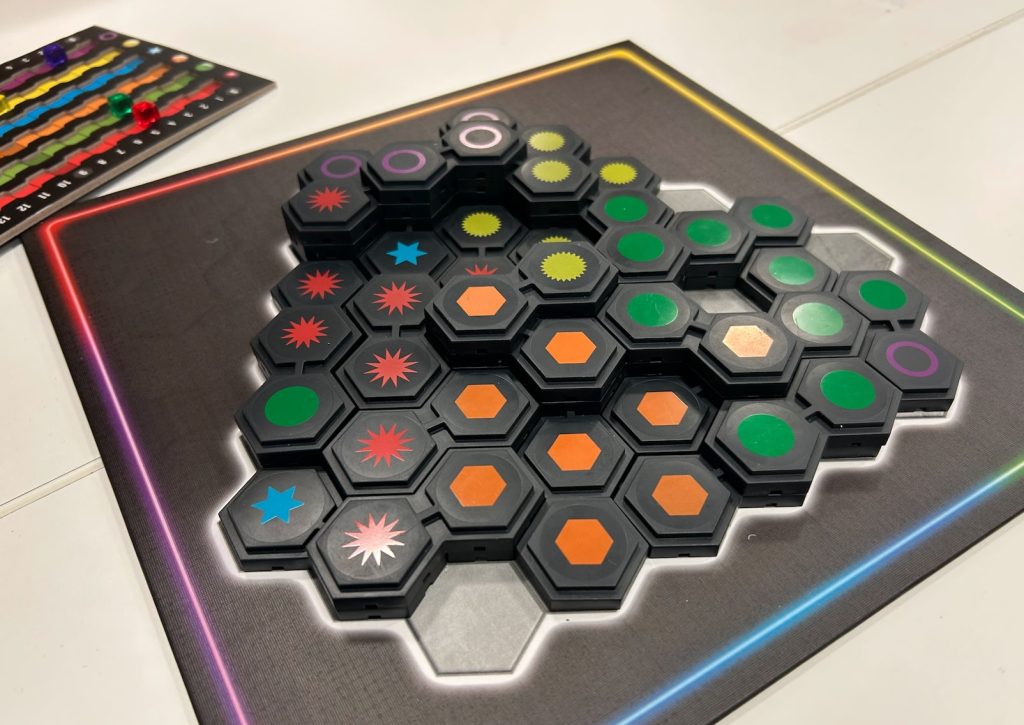
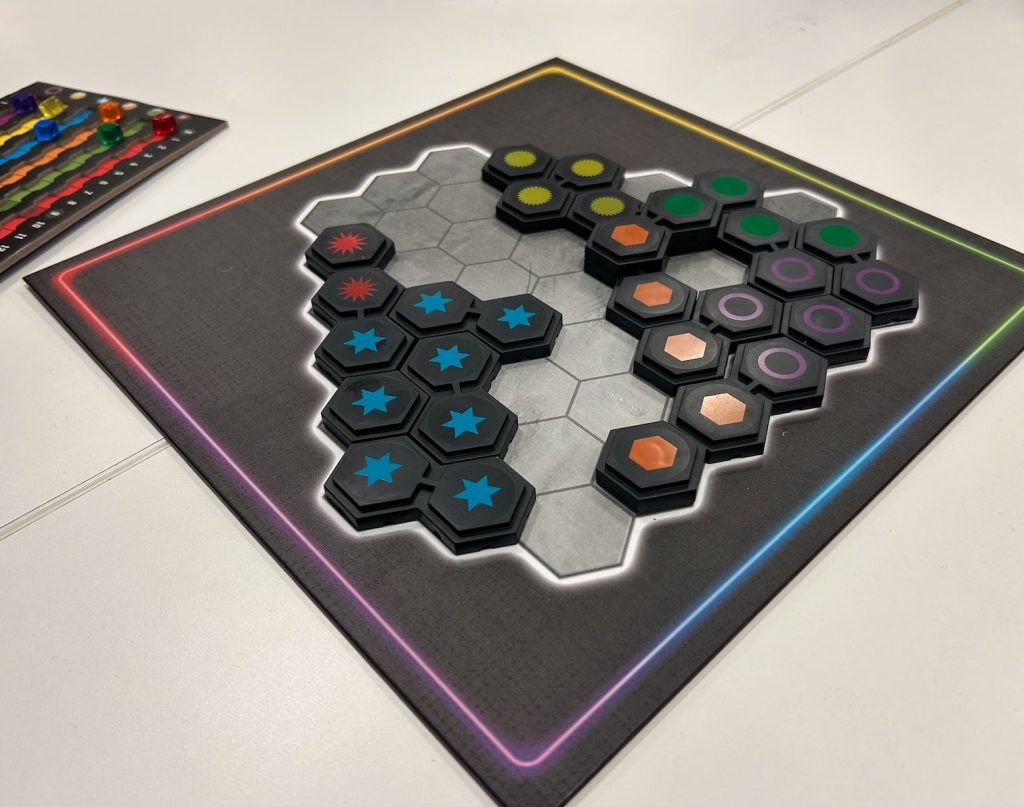
Taking its cue from the notoriously two-dimensional original, Ingenious 3D allows 2-4 players to engage in an abstract battle across a shared board, placing tiles not only adjacent – but also on top of each other.
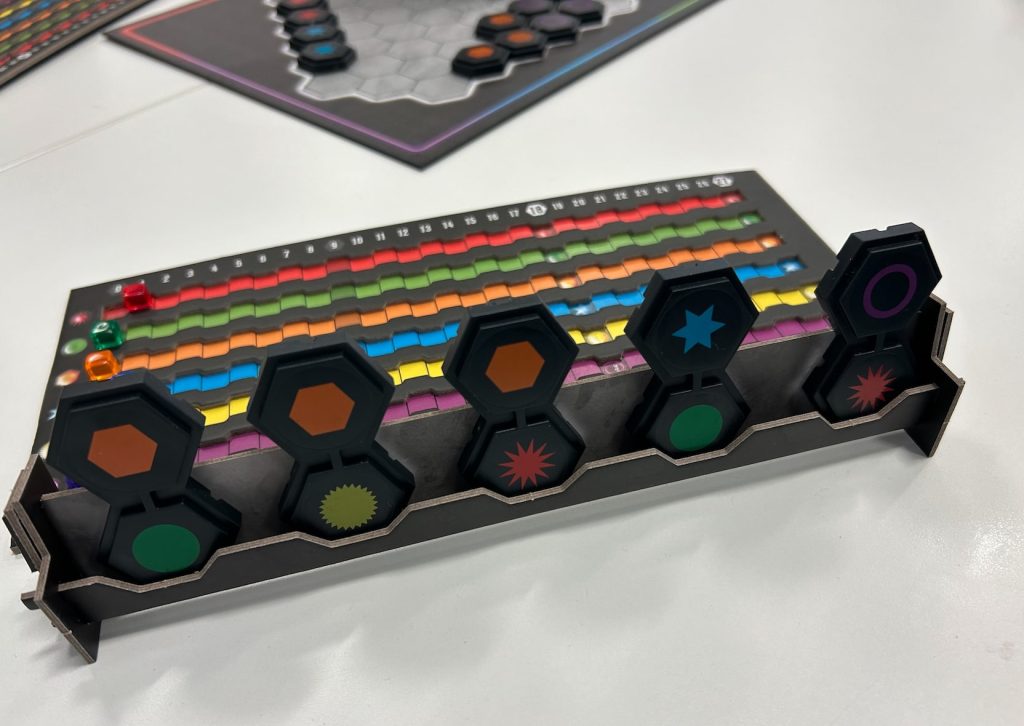
You have a rack of five tiles to choose from, each shaped like a pair of adjoining hexagons with a different colour on each side. On your turn, you add a tile to the board and score both the colours on it by counting how many adjacent tiles contain the same colour in each of the five surrounding directions. If there are contiguous unbroken lines of the matching colours in any direction, you score a point for each colour symbol in that line.
Ingenious’s catch is that each colour scores separately – keep track of them on a separate board – and your ultimate score is that of the colour you do worst at. So if for example you have five colours scoring over 20 points, that’s no good to you whilst your sixth colour languishes back on three points: your current score is three. Note that at certain junctures on the score tracks (18 and 27) any colour reaching them grants you a bonus tile placement.
This is all as per the original game, but now the tiles stack as well. There’s a caveat: a tile can’t go exactly on top of another tile (-it must always cover two halves of two adjacent tiles) and this stacking both creates more options but also creates obstacles, as ‘sinkholes’ in the growing landscape become impossible to build over. When your turn is over, you draw back to five tiles again and may optionally refresh your entire hand if you’ve no tiles of your lowest value colour.
Apart from a couple of situational rules, that’s it. Play continues until there are just five tiles left in the bag then complete the current round: the player with most points (ie the highest ‘worst’ colour) wins. If there’s a tie, the tied players compare their next-worst score and so on until the tie is broken.
Sam says
Pure abstract games don’t tend to be hall-of-famers for me, but when they’re done well there is something appealing about the combination of simplicity and challenge, where – with many abstracts – you can teach it in a couple of minutes and whilst accessible for kids, it’s also a bona fide experience for adults as well. Ingenious 3D ticks all those boxes: I don’t yearn to play it, but I’ll always enjoy it when I do.
-

Take That!
The board is a shared space and you can make determined efforts to compromise a colour you know an opponent needs - especially in a two-player game - the immediate focus is your own needs.
-

Fidget Factor!
Low! With 2 or 3 especially, the game moves surprisingly fast. Be prepared for a little slowing of the pace in the endgame, however, as opportunities dry up and everyone needs to wring the last few points where they can.
-

Brain Burn!
90% spatial
-

Again Again!
It doesn't vary much from play to play, but you always get the same satisfaction from a move that vacuums up a huge points haul.


