
Just Wild
Designed by: Leo Colovini, Marco Franchin
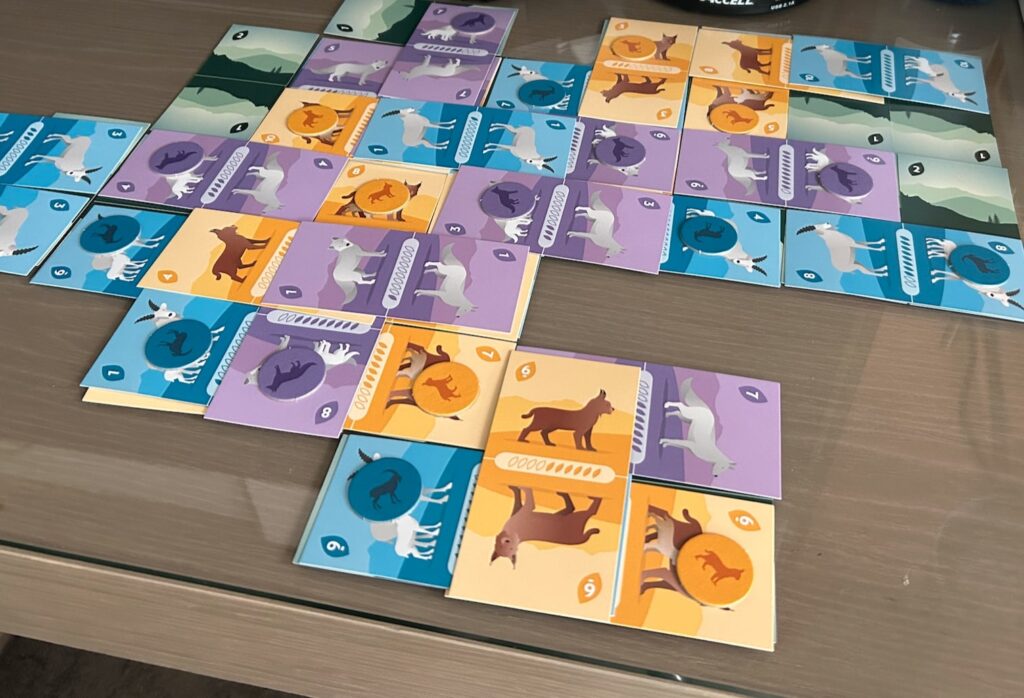
In Just Wild players are different animals, fighting for dominance over a landscape created by domino-style card placement. Having the largest presence at the point when your cards run out is the objective!
Each player begins with a deck of their own cards and some animal tokens. Everyone lays a single card down on the table next to each other to create the play area and then the game kicks off wih everyone holding a hand of three cards from their own deck.
On your turn you have two options. The first – ideal – one is to lay one of your cards on top of already-played cards (it must be over two half-cards, not atop a single card), but to do this the number on your card must be the sum of the two numbers it covers up. For example, if there are a 4 and 3 next to each other on the table, I can play my 7 card over them.
If you can’t – or choose not to – play this way, then you must play a card face-down (also numbered!) onto the table in a way that expands the play area without covering anything. Another situation where this happens is if anyone wants to cover a number larger than ten: let’s say there is a 4 and an 8 adjacent (making 12), I can cover them up but it costs me two cards: a 2 over 4 and 8 and another card sacrificed face-down expanding the play area, representing the ten I needed to make twelve (in this instance the numbers on the back of the cards are ignored).
If the card you played has a baby animal on it as well as an adult, then you can optionally add a token onto it: this protects one-half of the card from ever being covered by other players (or yourself!) but beware, you only have five tokens to spend this way. At the moment your cards run out, you score a point for every half-a-card you have visible on the play area – even if other players subsequently cover them up, as everyone finishes at different moments. The player who scores highest is the winner.
Sam says
Just Wild has the kind of screwy interaction I quite like in a game, but the problems we had with it are twofold: one is that each turn is spent looking around the play area searching for potential card placements, which is a matter of low-level maths and sort of administrative scrutinising that, for us, doesn’t feel massively fun. The other is that your options for placement feel constricted by circumstance – certainly, it’s not a game that’s 100% luck and the tokens can be used badly or well. But it feels a combination of ponderous and vaguely luck-driven, which isn’t a quality that combines well with the take-that vibe of the card placement. We ended with everyone rather underwhelmed by it, and I’d recommend any of the games on the right as alternatives.
-

Take That!
It’s there, it’s tangible, but it also governed by collateral circumstances rather than strategy.
-

Fidget Factor!
Not too high
-

Brain Burn!
If you can set yourself up for something then there are tactical decisions. But they’re more evident with two players: with 3 or 4 it feels increasingly random.
-

Again Again!
It's reasonably speedy, but the experience doesn’t feel massively thematic (animals vs numbers) or engaging. Probably best experienced with two players.


