
Kerala: The Way of the Elephant
Designed by: Kirsten Hiese
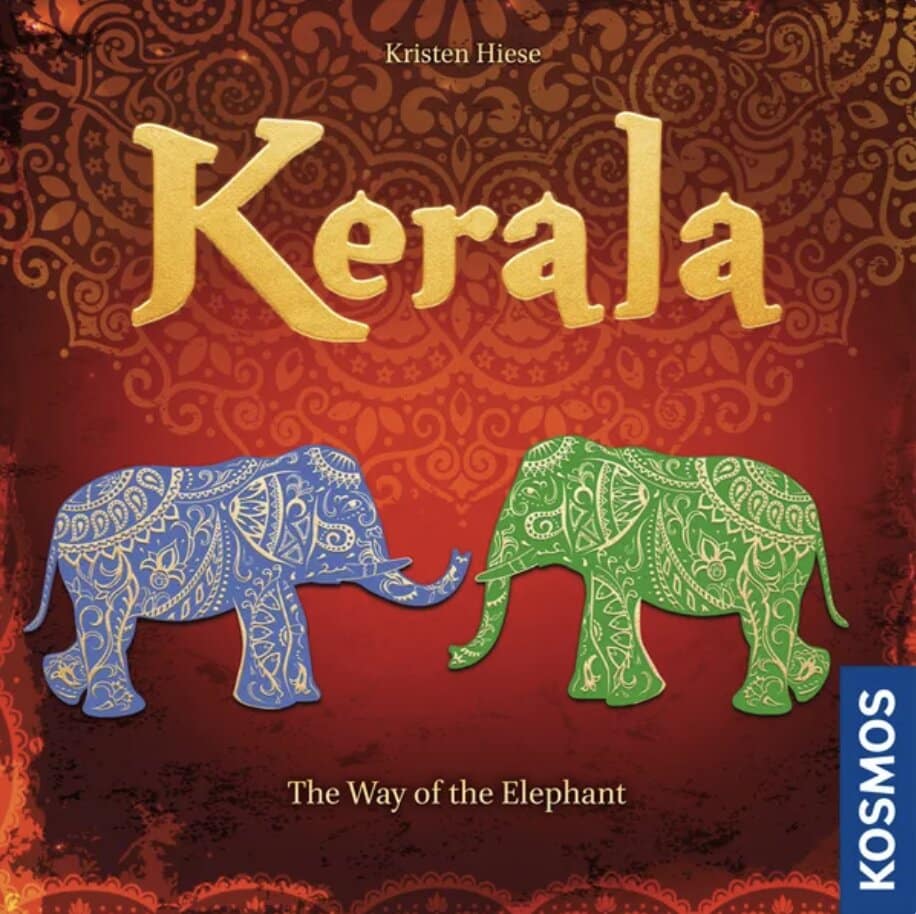


Inspired by the elephant festival of the Kerala province of India, Kerala: The Way of the Elephant sees players trying to build the most attractive fairground, brimming with pachyderms. The catch? Everything is made up of tiles, and where you can place them is highly restricted.
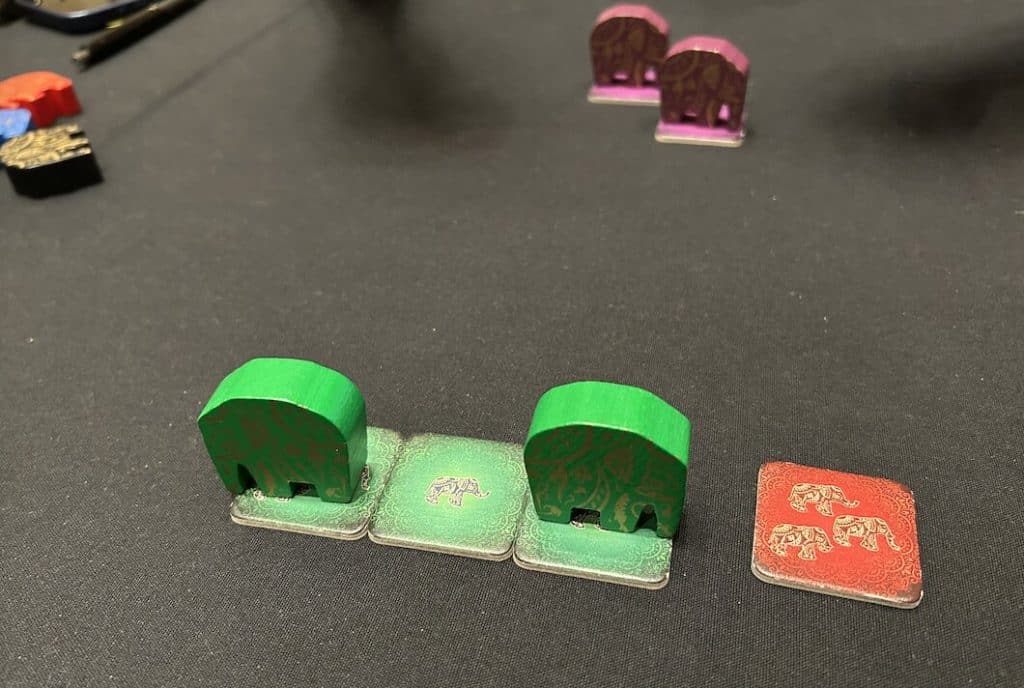
Each player begins with a single starting tile with their two (physical, wooden) elephants sat on top of it. In each round the active player will draw tiles from a bag equal to the number of players. They take the tile they want, and then everyone else takes a tile going clockwise around the table. Then everyone adds what they’ve taken next to their starting tile, and moves one of their elephants onto it. The bag is handed clockwise to the next player, and this pattern repeats for the rest of the game.
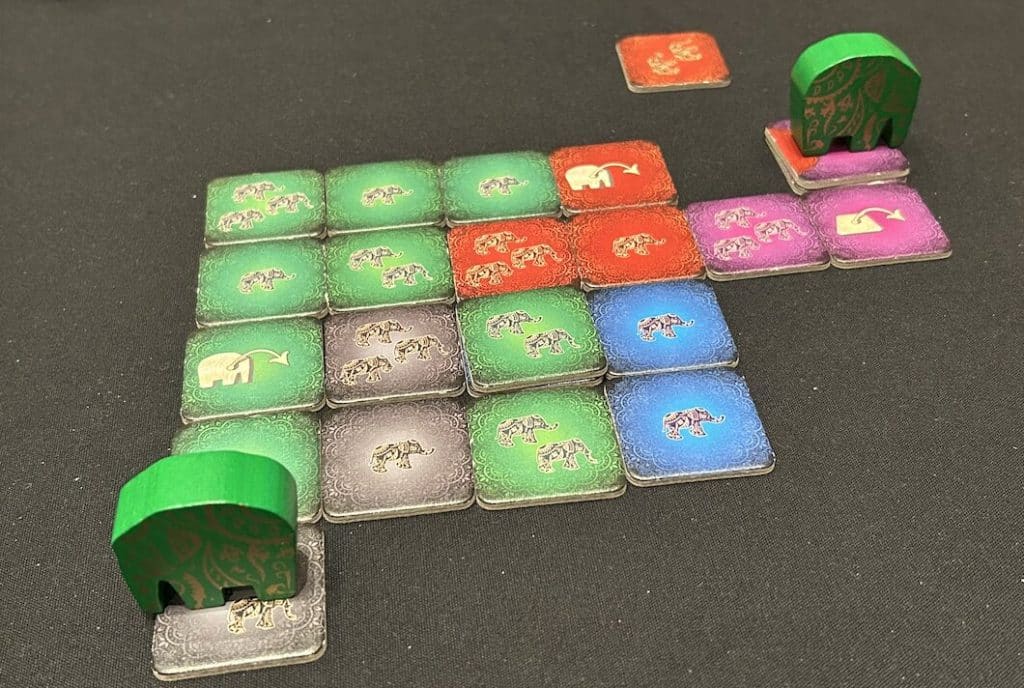
What you’re trying to do is create tiles of a matching colour next to each other: there are five colours (red, blue, green, purple, black) and at the end of the game you’ll score one area of each colour (- although each player can score two areas of their own colour, so for example if you are green you have some more flexibility on the green tiles) The catch is when you add a tile it must always be adjacent to one of your elephants, so they can move onto it. But! You can also place a tile on top of another tile, meaning your elephants can double-back on themselves, for example. You sacrifice any points on the hidden tile, but may want to do this for strategic reasons. Bear in mind: elephants don’t move diagonally, and you cannot have holes or unconnected tiles in your fairground. Twice during the game you can pass and simply throw your tile away – lie one of your elephants down to keep track of this (a lying-down elephant can still move as normal).
Most of the tiles show elephants, which are simply points. But there are three special tiles mixed into the bag as well. One allows you to move an elephant to anywhere you like, another allows you to move a tile (or stack of tiles) and one shows two colours instead of one: if these connections are visible at the end of the game they’re worth a considerable five points. But…
When the tiles run out players can only keep one area of each colour (and two of their own colour) face-up. The rest flip face-down and each face-down tile is minus two points! Then everyone scores elephants still visible on their tiles, two points for their standing-up elephant pieces and one point for their lying-down elephant pieces. Most points is the winner.
Sam says
I’d read and heard some very underwhelmed opinions on Kerala so came to it with low expectations. Maybe that helped but we all thought it was rather good. I might cap it at three players, personally, because it’s not a roller-coaster of drama and laughs and half an hour (which I’d expect with three) feels about right. It’s a nice puzzle; a blend of luck, risk, and passive interaction in when to take a marginally-less rewarding tile for yourself just so you’re not gifting the next in line something brilliant. Played in that strategic fashion does add a little time, of course, but it works on a different – and more rapid – level if you just want to focus on your own fairground. That may be enough for the win anyway! It doesn’t need that big box, really, but it’s all rather nicely produced as well.
-

Take That!
The only interaction is direct. You can - and should - see what others want (especially in a 2 player game) so you're not gifting them the perfect tile
-

Fidget Factor!
Everyone's involved in all turns. A two player game is probably under half an hour, but with the full 5 the playtime will be higher
-

Brain Burn!
A mix of spatial puzzle and luck-pushing. There is a decent amount of chance involved, so how you feel about the game may come down to that
-

Again Again!
The tiles always come out randomly, so the challenge in that sense always resets. It's not a game with a lot of different notes, but it hits its' own resoundingly


