
Link City
Designed by: Émilien Alquier
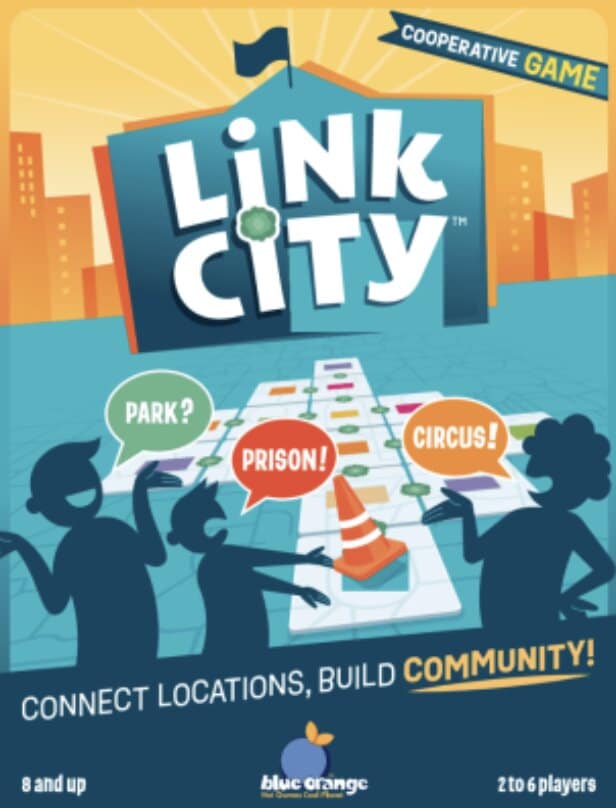
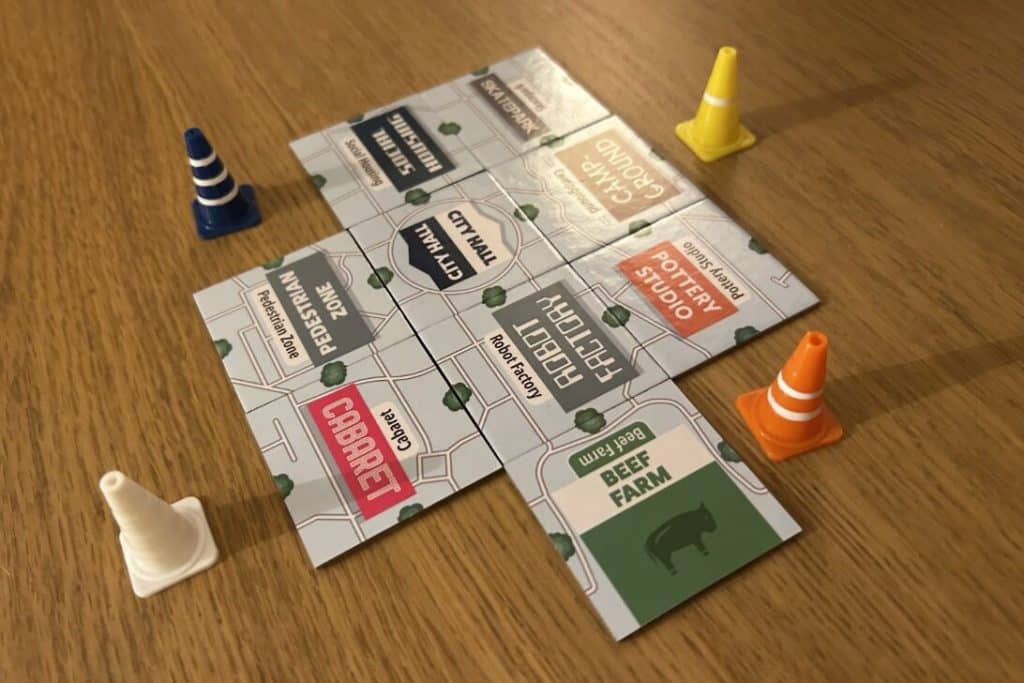
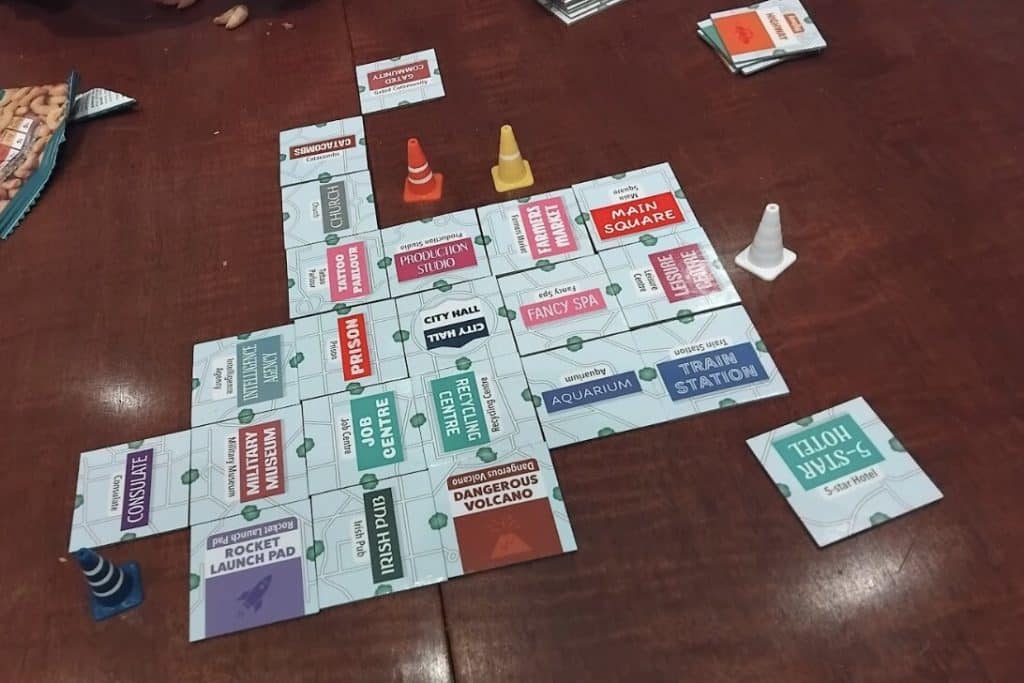
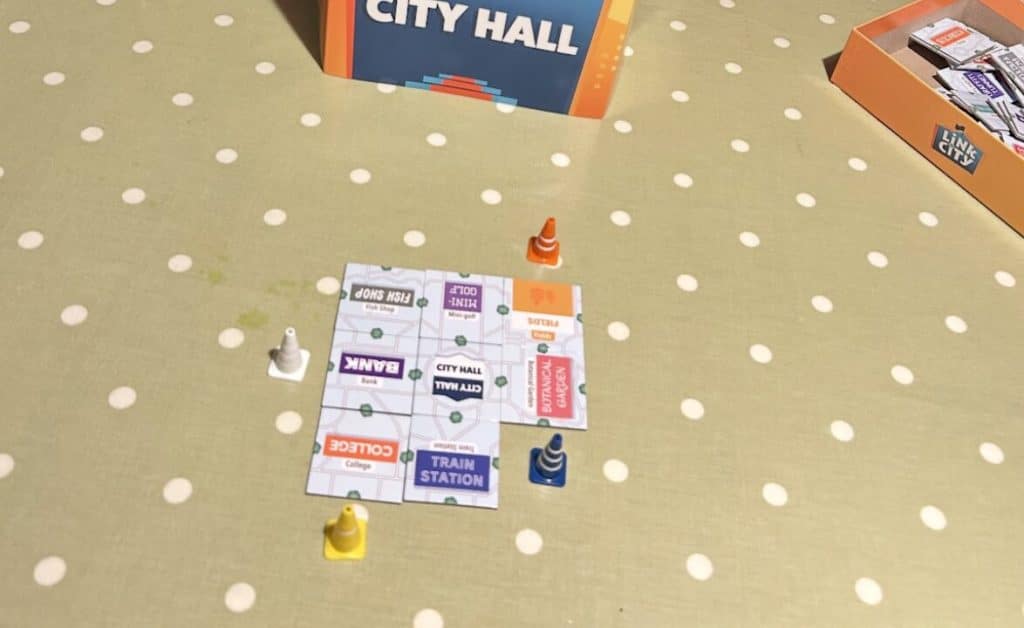

In Link City, players collaborate on building a city out of tiles, each one representing some small part of it: the train station, the cinema, the school. The challenge is to agree on the same locations for each tile whilst game severely restricts communication.
At the start of the game there are five tiles visible: City Hall, and a random tile placed at each of its four sides. One player will start as the Mayor, who draws three more random tiles and places them behind a screen (not showing the other players what they are). The Deputy Mayor – the player left of the Mayor – chooses three places in the city that these secret tiles must be assigned to, using three cones – orange, yellow and blue – placed out on the table. They must got next to at least one tile, but apart from that the choice is entirely up to the player.
The mayor decides which tile will go where out of the three choices, using three tiles that match the colour of the cones and placing them face-down beside each tile, using whatever town-planning logic they feel works best. Do the public toilets go next to the train station? Does the tennis court make any sense by a nightclub? Would the catacombs be next to the medieval tavern? Sometimes choices are obvious; more often it gets a little tricky.
Once the mayor has made their choices, they reveal the three city tiles (keeping the location choices secret for now) and it’s up to all the other players to try and figure out what they’ve decided, assigning their own cone tiles next to each location before the big reveal. Players can discuss as much as they like here, but the mayor must keep a poker face and let them make their own choices!
If the players choice matches the mayor for any tile, place it at that location. If it doesn’t match, the tile still gets added to the city, but adjoining it only by the tip of a corner: ie not directly next to any other tile. This is relevant because you really want as much orthogonal adjacency as you possibly can: connecting tiles like this makes a tree (see pics above) and after six rounds the number of trees in your city defines your score, which can be – according to the rulebook – anything from pithily disdained to rhapsodic.
If the players get all cones right at any point, you now get a bonus (white) cone for the rest of the game. You also get to place a bonus tile somewhere in your city, which means more trees but be aware, the bonus tiles all have one ‘unbuildable’ edge that you cannot place next to. The game is easy to learn, but can be tough to pull off: one option is allowing the mayor to flip tiles (which are double-sided) to give more variation in choices.
A variant we suggest is the Mayor chooses where to place the cones after looking at their tiles. This could make the game easier from a scoring perspective, true, but it also makes it less of a lottery for the mayor and the challenge figuring out the mayor’s thinking more interesting)
Sam says
Having someone on the same wavelength as you really does help, because Link City occupies brain space that does veer from the practical into the subjective: it might seem like the Spa would go next to the Swimming Pool, but what about beside the Yoga Retreat? Or even the hospital, for its recuperative qualities? And I wouldn’t have the Nightclub beside the Volcano – which seems like a stretch in city planning anyway – but someone made a very convincing argument for it. Really, the delight you do or don’t find in these moments of synchronisation in thinking are where the fun of Link City is. Like other games exploring this space (Wavelength comes to mind) it can invoke groans of dismay – and moments of high-five joy. A big tick from me.
-

Take That!
None
-

Fidget Factor!
Extremely low. There are pauses whilst the mayor tries to make sense of their options, but apart from that everyone is active all the time.
-

Brain Burn!
Rules-wise there's nothing complex here. Success though can be elusive, as sometimes the tiles just don't seem to have strong correlations with their potential locations in the city. Playing the 'flippable' option here can help.
-

Again Again!
If you enjoy the puzzle, why not?


