
Naishi
Designed by: Alex Fortineau, Mathieu Bieri
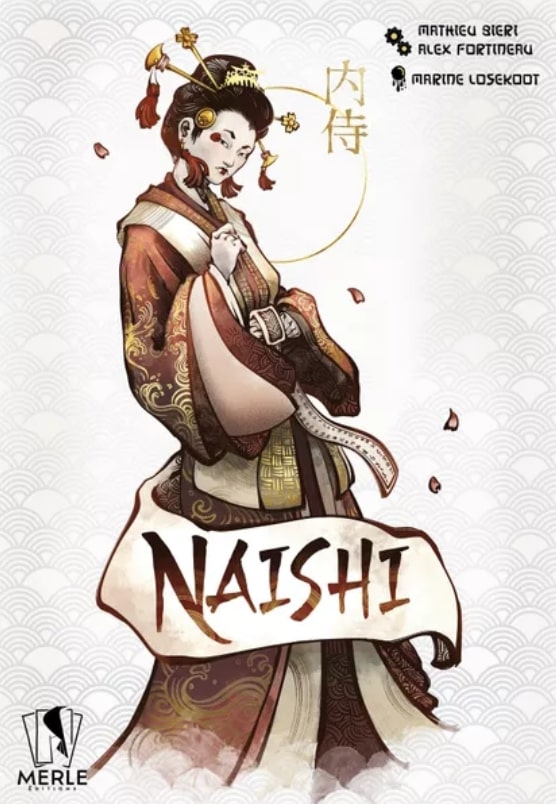


The theme of Naishi is that you are building your own province in feudal Japan, and, in doing so, choosing the components it will be made from. Temples and Monks? Rice fields and Forts? The catch is that how much your province is worth at game-end will be determined not just by the cards you settle on, but their positions in relation to each other.
Naishi is an easier game to play than it is to explain. It’s almost easiest to start at the end – when the game concludes, there will be five rows of cards on the table: The River between the players, then two rows each side belonging to each player – firstly the line and then your hand.
But your hand is only revealed right at the end. During play it’s hidden, and the line for each player initially consists of the mostly-useless Mountain Cards. In the River are the more rewarding Development cards, and during play you’ll be adding these either to your line or your hand and discarding whatever card they replace. The caveat here is that the cards can generally (with one exception we will come to below) only move from the river into an adjacent card: either in your line or in your hand. For example: the fourth card in the river can go into the fourth position in your line, or the fourth position in your hand (you cannot change the position of the cards in your hand). Whenever someone takes a card from the River, the next card beneath it is flipped over.
So in essence play proceeds through players shuffling cards around and trying to get them into the most rewarding positions in terms of scoring points. Forts only score at the edge positions. Sentinels score points for being next to Forts. Naishi score only in the central column, and are worth more in your hand than in your line. Rice fields score points for being grouped together, and so on. There are two ways the game can end: as soon as two of the River piles are empty, or when either player announces they want it to. In the latter case, the other player gets one last turn before scores are totted up.
There’s a couple of extra things to consider as well: namely the Emissaries, which can be sent to the Imperial Court to politic on your behalf. Whilst that suddenly suggests a host of extra rules, they’re actually quite simple. They allow you to swap the position of two cards – before then taking your turn! – or even swap one of your cards with one of your opponents. This latter dastardly move only happens once per game, however, and if a player takes this opportunity they lose the emissary token for the rest of the game. Otherwise, you can spend a turn recovering your emissary tokens in order to use them again.
Sam says
As mentioned in the overview, it’s a far easier game to play than it is to explain. Rivers, lines, hands, emissaries, imperial courts. That’s before you get to the cards themselves (a dozen) and the distinct ways they score, many of which involve what their relationship is with the cards around them. It feels like you’ve fallen into a deep well of terminology and variance. When you play Naishi, however, by the time you finish your first – maybe second – game (each of which will take 20 minutes, tops) things do come into focus. Let go of the theme and it’s a matter of the objective: scoring the best possible points, and the turn by turn actions, which are all about how you go about doing that. I’m generally not very good at these types of multiple-overlapping-ways-to-score-points type of games, and two decades of failing to master them has taught me that that probably won’t change. But I enjoy Naishi regardless: I like the presentation, I like the speed of play once you’re up and running, and I like the puzzle it presents, which feels nicely pitched to be tactically-reactive, rather than intensely strategic. It feels like the type of game you can play again and again without it becoming rote.
-

Take That!
Present without being overwhelming. The one thing that can be brutal may only occur once per game, and does involve a sacrifice for whomever perpetuates it.
-

Fidget Factor!
Light.
-

Brain Burn!
Moderate. Naishi is basically a game of shifting sands where you're trying to exert geographical control over them.
-

Again Again!
There are 12 different card types, each with their own way of scoring. For two like-minded players, there's plenty to wade through here over multiple visits.


