
Nunatak – Temple of Ice
Designed by: Kane Klenko
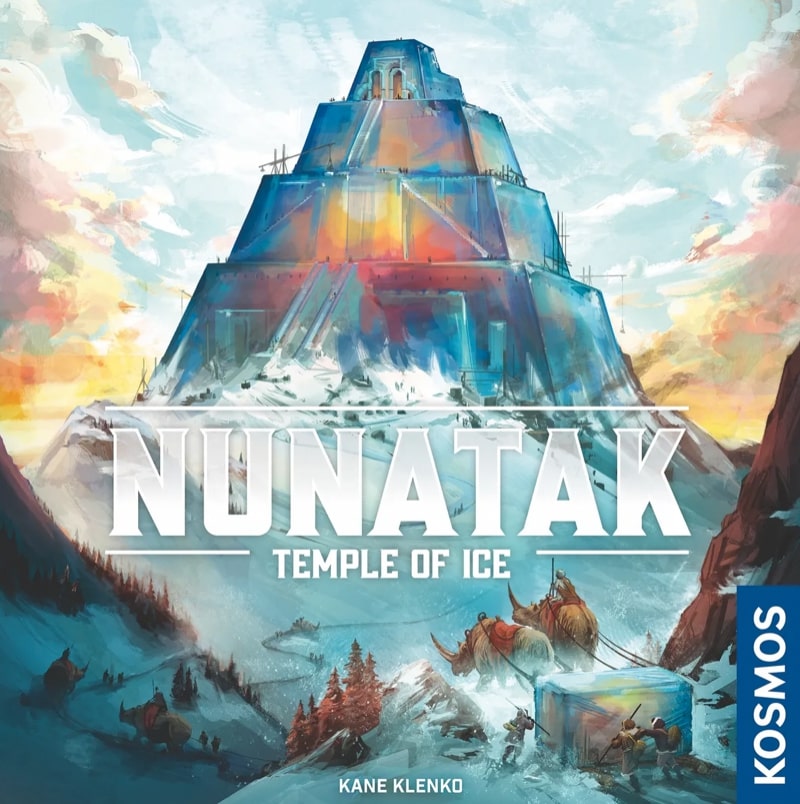



In Nunatak, we are collaborating over the building of a vast pyramid that, if a great thaw ever comes, will become a huge puddle. In the meantime, we’re out to score the most points.
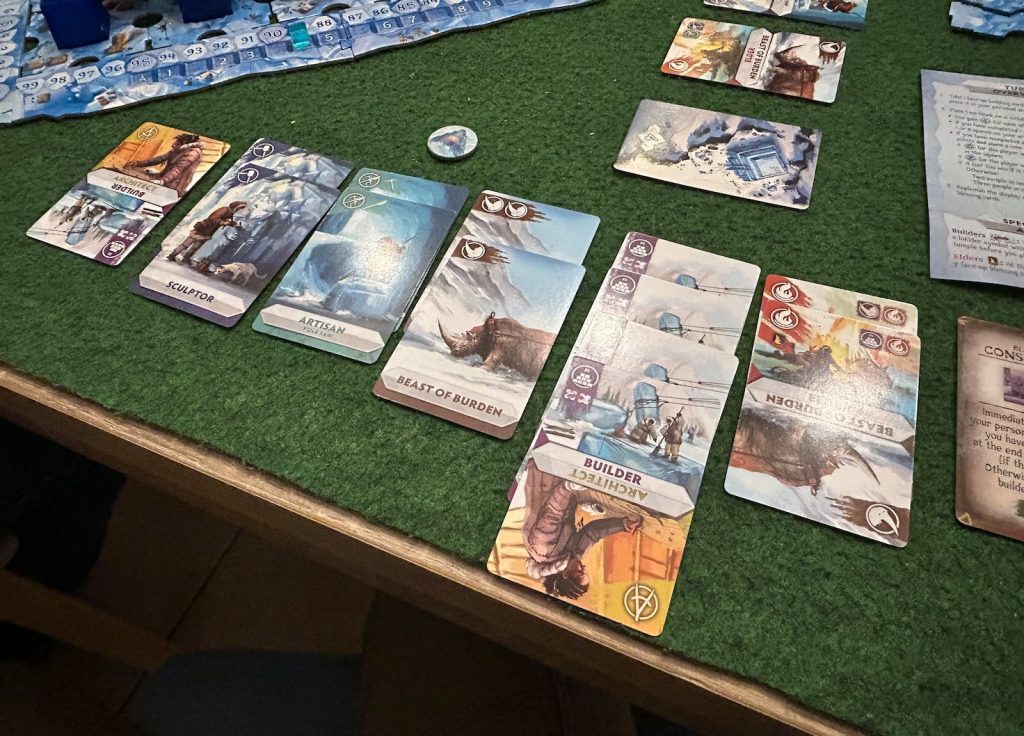
The board is set up with a series of tiles that will serve as the pyramid base, and several cards are laid out in a tableau. The cards are made up of different suits – builders, architects, et cetera – that match one or more tiles on the pyramid. On your turn, you choose one of the available cards and place one of your pieces – chunky plastic things in your own colour – on a matching base. The goal is twofold: score for your pyramid piece now, and your cards at the end of the game.
As play continues, you’ll find you can build up as well as on the base. Whenever a pyramid piece makes up a square of four of them, the active player lays a new tile on the quadrant of supporting pieces, scoring a point for each of their own pieces first, before points are awarded for the players with the first and second-most pieces present. Say three out of the four supporting pieces are in your own colour: you’ll get three points (one for each piece) then more points for having the majority as well. The player with the fourth piece will get a smaller haul for being second.
The cards are scored at the end of the game: ten points for having one of each suit, but potentially a lot more for having a lot of a single suit: players need to police each other to some degree and make sure nobody is picking up all the Beasts of Burden, for example!
There are a couple of other wrinkles: each suit has a special ability, and utilising these at the right time can be critical. One Elders grant special powers, for example, and Builders let you swap tiles around before placing. Completing rows or columns is great for scoring Architect cards.
The game continues until the last piece is laid and the player with the most pieces on the edge of the pyramid gets to lay the cap on top. The finished thing looks quite impressive on the table, but how well did you do? Players now score their cards and the most points is king of the Nunatak!
Sam says
The challenge with Nunatak is that it feels – to me – like you’re playing two games at one time: a simple game of set-collection with the cards, and an immediate-points puzzle with the pyramid. Cannily, the two things overlap, and whilst the rules are pretty straightforward mastery of them is not. You can feel pulled in different ways by simultaneous opportunities, and it’s this opacity that will frustrate some whilst exciting others. I’m in the latter camp: I’m not very good at it, but I enjoy the fact that every turn feels consequential and the speediness (it can be literally a half-hour with three players who know the game). Designer Kane Klenko has a diverse catalogue from 10 minute bomb-disposal challenge FUSE to the hilarious space-ship flipper Flipships. I like how he thinks about games: speedy, silly, interactive. This is probably his most abstract and puzzly.
-

Take That!
While there’s no arbitrary targeting of each other, the shared space of the pyramid has a lot of ramifications for everyone.
-

Fidget Factor!
Probably high on a first play or two, with Nunatak being more puzzle than narrative. But dropping substantially.
-

Brain Burn!
In the few games we’ve played, the burning is palpable - but it’s a light singe.
-

Again Again!
We can’t say every game of Nunatak tells a story, but it’s certainly never predictable.


