
OROS
Designed by: Brandt Brinkerhoff
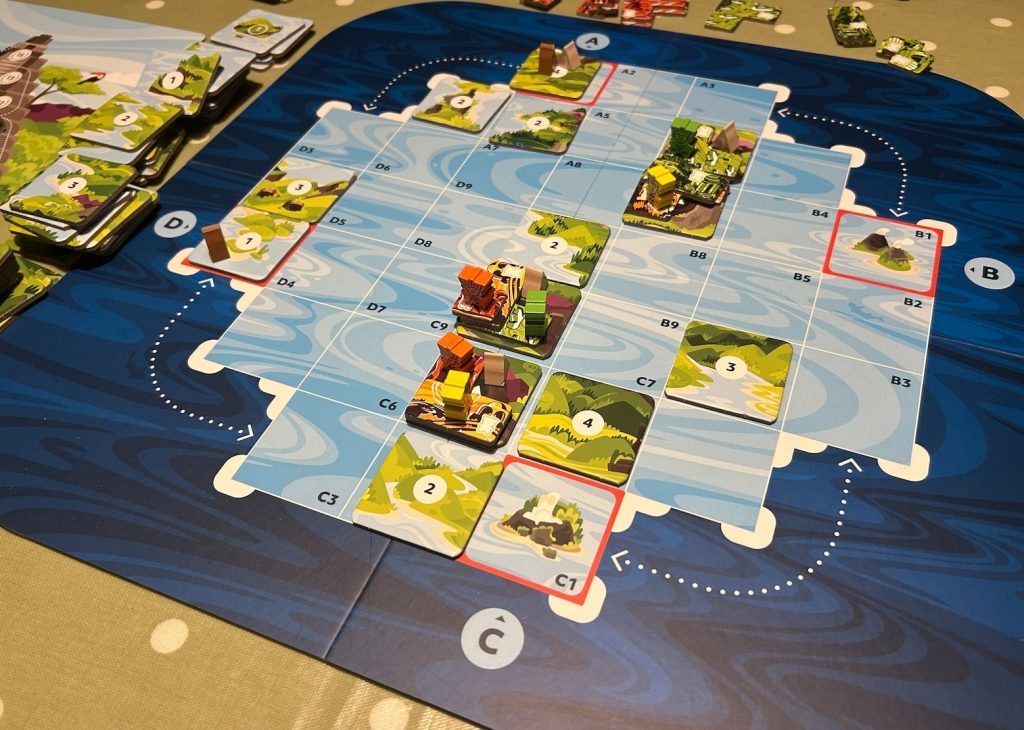
In OROS, we are Demigods, churning land and sea together in order to build sacred sites and achieve higher wisdom. The wisest Demigod of all gets to crow in a booming voice that they won a game.
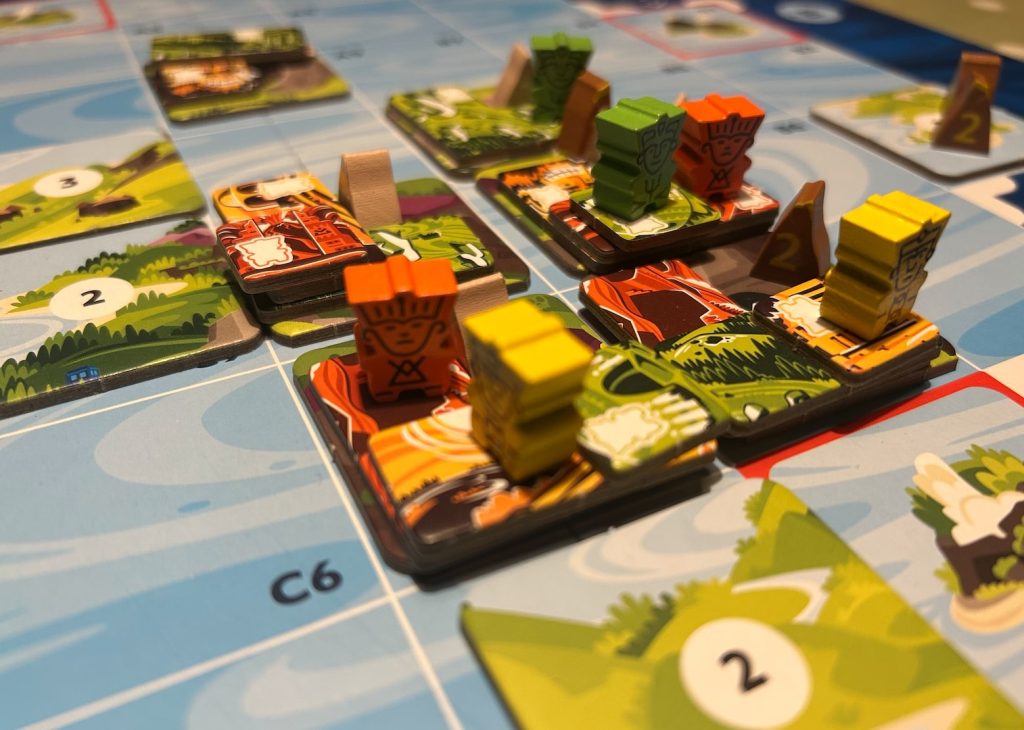
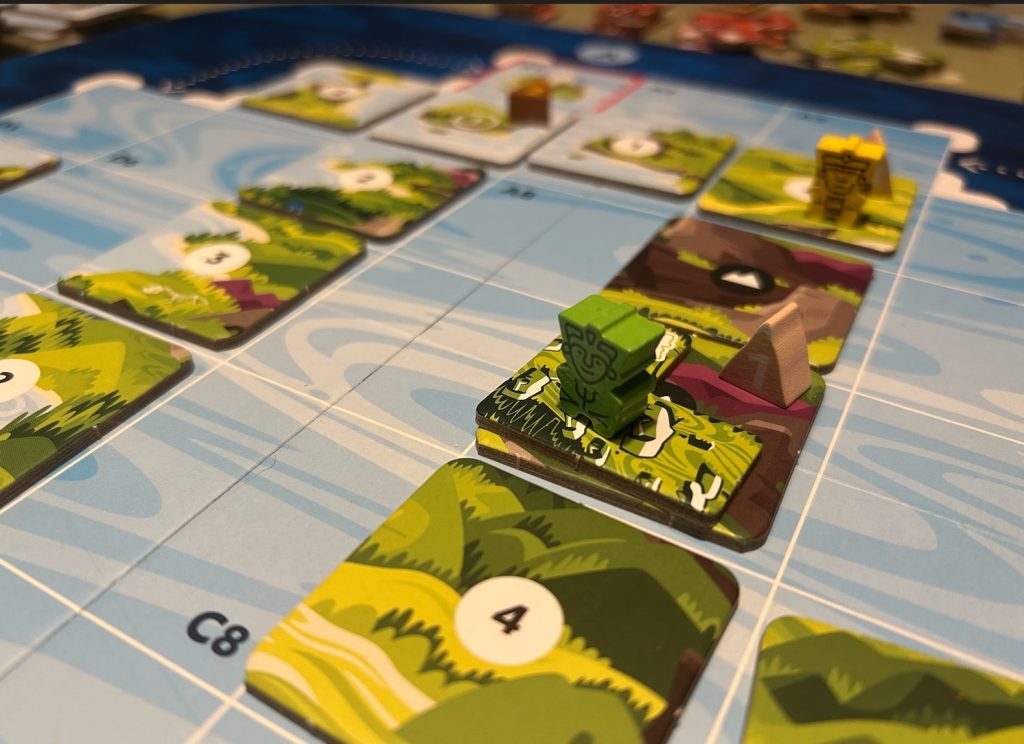
Before play begins, the board is carefully seeded with a bunch of landscape tiles, with values varying between 1-4; the number representing a sort of tectonic heft. As well as placing a worker out on the main board, players each have a board of their own and a bunch more workers you can use to for actions: on your turn, you take three of them.
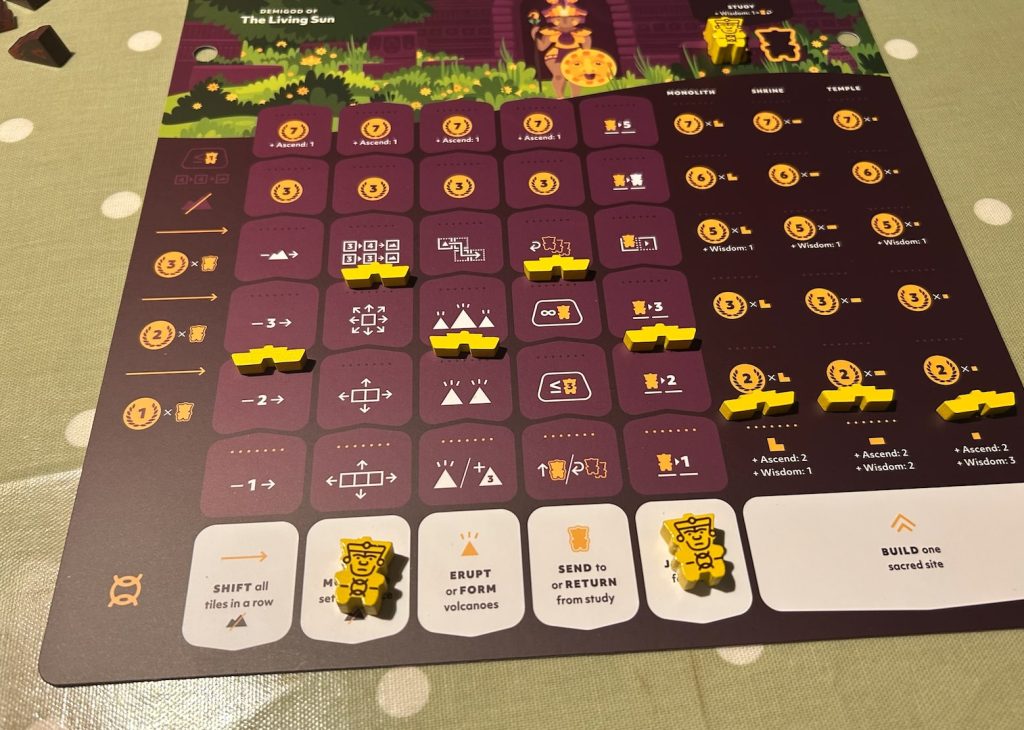
At the start of the game, these are – reasonably – simple: shift all the tiles in a particular row a single space, move a set of three tiles, move your worker around the board, build sacred sites. You can also explode volcanos and study, but we’ll come to those actions later.
What’s all this land manipulation in aid of? You want to make mountains, and to do that you must (eventually) move one 4-value tile into another: crunch! And to do that, you need to get two 4-value tiles adjacent: whilst shifting is a kind of passive manipulation, with the move action you can crash tiles into each other, combining their value (any value above 4 becomes a volcano, placed on top of the new 4 tile). Once you have a worker on a mountain, you can start building sacred sites there – which is ultimately the point of the game: doing so moves you up the ascension track (for points) and also grants you wisdom.
Wisdom is precious: it is instantly spent improving your basic actions into more powerful ones (we couldn’t possibly list them all here) and also – potentially – generating large hauls of points at the end of the game. The personal player boards have quite a bit going on in them – including the study action for more wisdom, and the volcano action to add or erupt volcanos – but suffice to say as you continue through even an exploratory game, you’ll find yourself getting more and more powerful, like a God growing out of shorts and into long trousers.
What hampers you? Well firstly, when one of your workers takes an action, that action is currently blocked until that worker moves off to another action. The other thing is that Oros is a game of a lot of (literally) moving parts: the board state is constantly changing, and planning your turn is often impossible, especially in the late stages when the other Demigods are all up to their nonsense. If you can master the spatial puzzle on the board and the intricacies of your personal board, however, you may be well placed to ascend to victory.
Sam says
I love what’s going on at the heart of Oros. I’m far more at home with tactics than long-term strategy and Oros feels like a boldly tactical undertaking. It’s highly interactive to the point of occasional brutality, snark, and explosive surprises. What slightly sullies it for me is the fiddliness – there is a lot of iconography on the player boards and even if you can readily reference them (the rulebook is pretty clear) the tile movement rules, whilst having a basic nub, do also have a mite more complexity than I’d like. Overall I feel the shared board is so dynamic and uniquely interactive, it’s a shame that the puzzle of the individual player boards takes up as much time as it does – for me, it gets in the way and slows everything down unnecessarily. However, I can’t argue it’s a very clever design, and beautifully presented.
-

Take That!
Plenty to go around. And around.
-

Fidget Factor!
Potentially pregnant – bring a fiddle toy! With two players you have to operate a dummy third player, with four players Oros gets a bit too epic. Three is perhaps best..
-

Brain Burn!
Plenty of that too, although one benefit of the worker system is it does limit your options.
-

Again Again!
Oros will be different every single time – there are just so many moving parts.


