
Raccoon Tycoon
Designed by: Glenn Drover
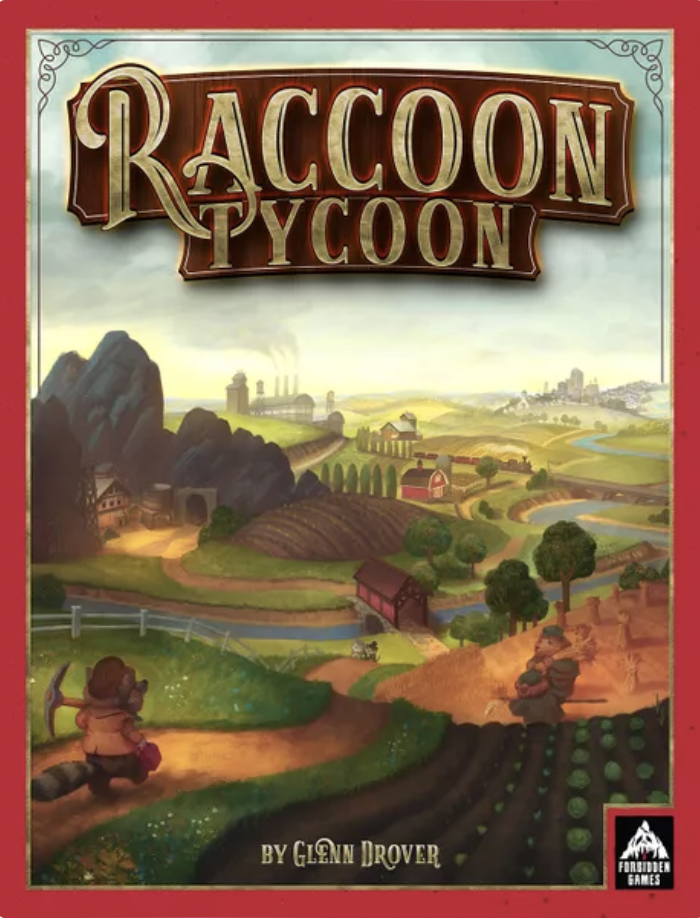
Despite the cuddly critters on the box, Raccoon Tycoon is a game of stock manipulation: buy cheap, sell high, and use the profits to build railroads and towns!
The board has space for the town and railroad cards, and also the helpful buildings you might purchase. But mainly it’s used to track the current values of the games six types of commodities (coal, iron, etc) as they ebb and flow. Commodities themselves appear as small cardboard chits. Players all have a hand of three Production cards, and on your turn you always take one of the game’s five actions.
A simple action is to play a production card. This gives you any three commodities from the bottom of the card, and pushes up the price of all commodities on the top half of the card. Another action is selling as many commodities of one type as you have. You get the current price multiplied by the amount you sell, and then the price drops down the track – if you sold four iron, your iron goes back to the supply and the iron price drops four spaces.
But all this market malarkey needs to manifest in bricks and mortar. So other actions are buying Town cards (cost shown on the card in resources) and buying Buildings (cost shown on the card in cash). Each building has a helpful benefit for the rest of the game: additional commodities or cash, extra points et cetera. But the juice in Raccoon Tycoon is really in the Railroad cards. These are paid for in cash, but they must be auctioned off, so the price shown on the card is merely the minimum starting bid – starting the auction does not guarantee you’ll win it! Railroad cards come in sets, and having multiples of the same set score you escalating points at the end of the game: a single Fat Cat railroad card, for instance, is just three points, but get all four and they’re worth closer to twenty.
The game continues until either the town or railroad cards run out, at which point players score a point per building, points for town and railroads, and additional two points for each town and railroad you can pair together. Most points: wins!
Sam says
If the pictures on the cards are soft and furry, the game itself looks a bit dry and mathematical when set up. Decks of cards, some tracks. How can this be fun? Well, firstly Raccoon Tycoon is pretty straightforward once you’re through the fog of learning. I’ll get some stuff. I’ll sell some stuff. I’ll buy something. But what elevates it beyond that are the auctions, where players can force up the costs for others or get lumbered with something they didn’t really want, for cash they didn’t want to pay. I suppose you could play without the artificial price-hiking, as it’s entirely down to the players. But it wouldn’t be as entertaining. Raccoon Tycoon comes alive when two or three people want the same railroad, but it has enough flex about it to still give the losers of the auction room to manoeuvre.
-

Take That!
Nobody can steal your capital-gotten goods, although a couple of the buildings allow commodity 'theft' from other players - but only a single one, so not devastating. The chief interaction here, while indirect, is still a juicy one: the auctions of Railroads.
-

Fidget Factor!
Remarkably low. Production, buying and selling are all brief and breezy undertakings. The slightly longer auctions involve everyone - even after you've dropped out, it's still engaging seeing what prices railroads are going for.
-

Brain Burn!
Largely you want sets of railroads, paired with towns. Collecting only buildings probably isn't a route to victory. So it's about judging how much you're willing to pay to outbid other bidders - or how much you want to pretend you're willing to pay.
-

Again Again!
Although Raccoon Tycoon's mechanical variety largely down the order things appear, the replay value is down to player input and decision-making, the risk-reward of high bidding and timing of sales.


