
Railway Boom
Designed by: Hisashi Hayashi, Simone Luciani
Railway Boom tells the story of the early years of Japan’s rail network, as industrial tycoons swallowed up smaller companies and competed with each other. But Railway Boom’s unusual approach to the theme is to do almost everything via the medium of auctions.
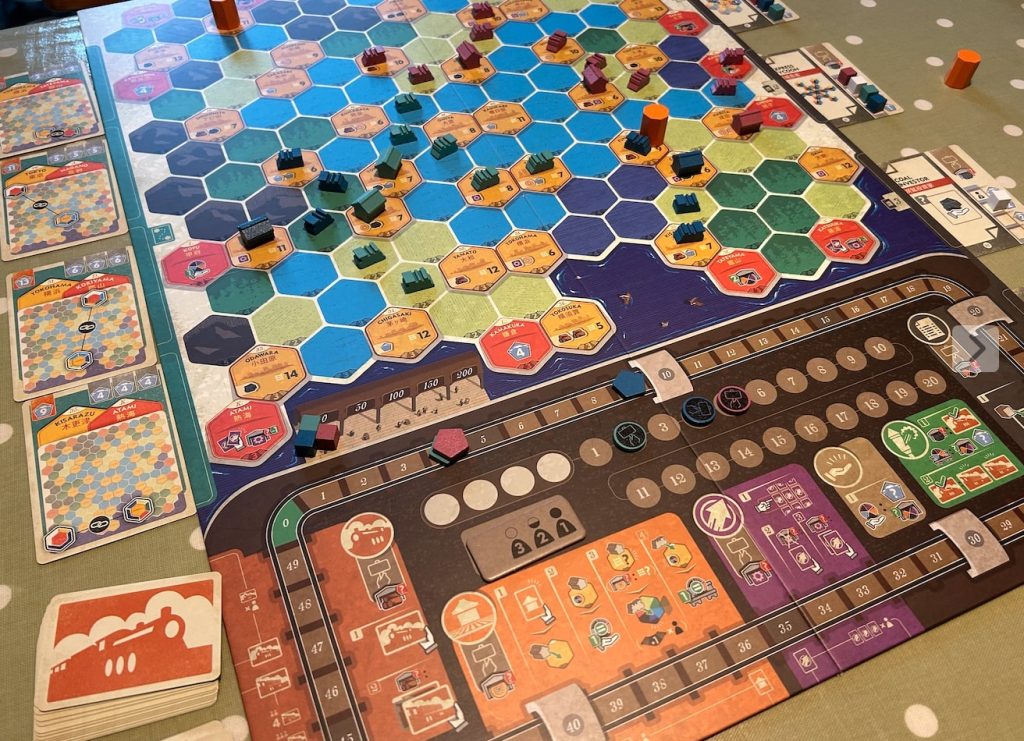
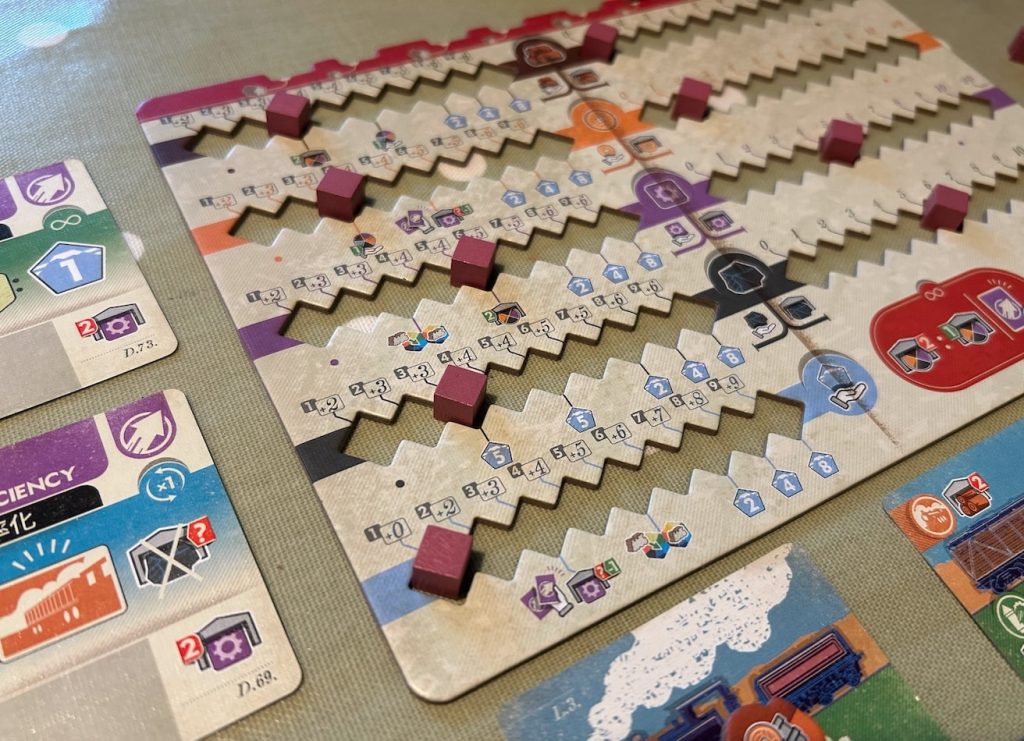
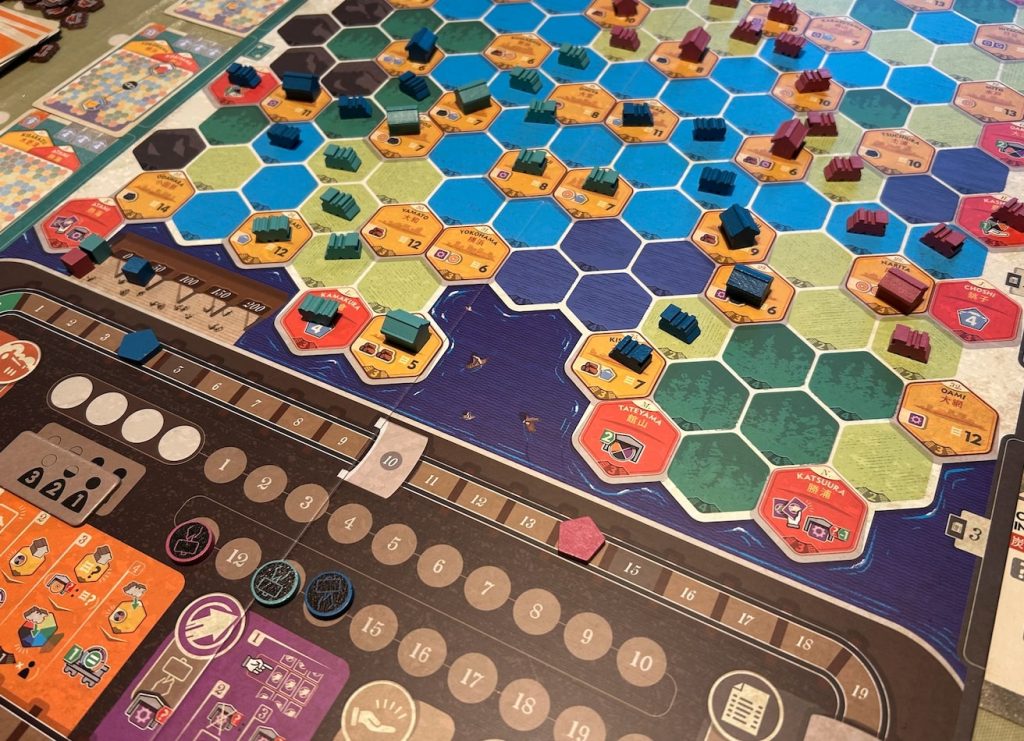
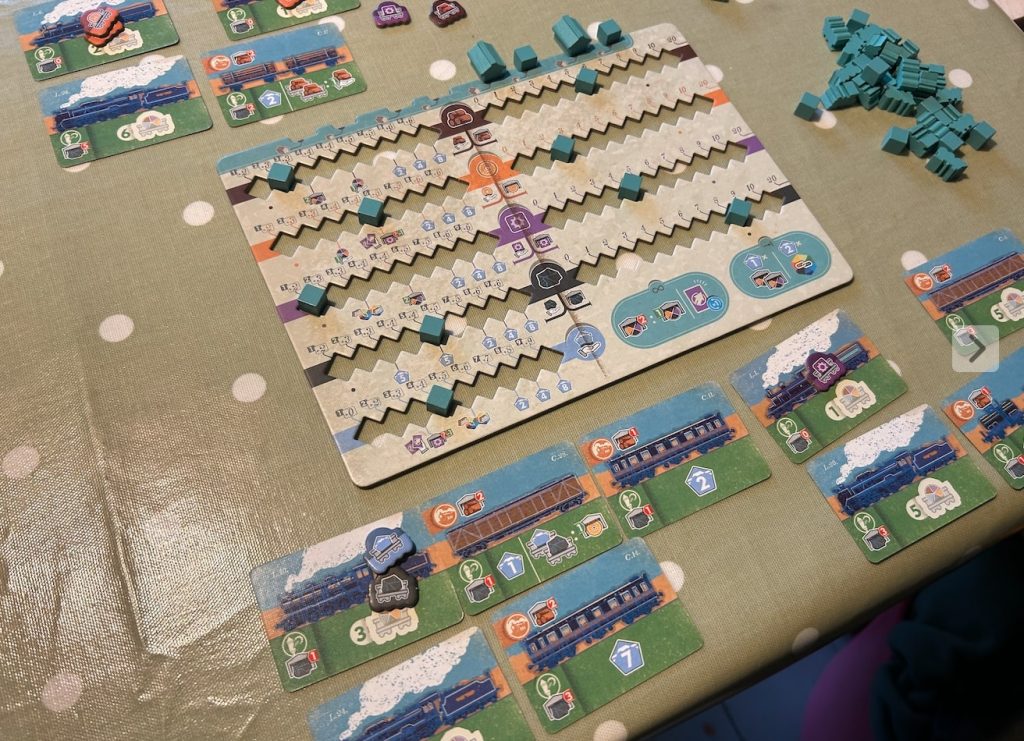
The board shows a map, broken into hexes, where you will build your railroads: across plains, forests and mountains – even water – and cities, where you’ll be rewarded with precious resources. Beneath the map is both a scoretrack, an auction track and a somewhat icon-heavy guide to the phases of the game, which we’ll cover in brief below. In the meantime, your own personal board has a bunch of tracks on it that keep tabs on how much you have of the resources in question – materials, money, technology and coal – and another bunch of tracks that show how much income you’ll get of these resources at the end of each round. There are only four rounds in the game, so you have a decent amount in your coffers before the game begins.
There are four auctions in each round, and they use different resources. In the first phase, everyone bids for Locomotive cards (and attendant Carriage cards) spending materials. Each auction works the same – you can only bid what you can afford, and the bidding keeps going up until all players have settled on their highest bid. The winner gets first choice of the cards, but pays full price – how much everyone else pays depends on the number of players, but the cost drops the lower down the bidding you are: last player gets last choice, but doesn’t pay anything. We’ll return to what these cards do later.
The next phase- Expansion – involves bidding (with money this time) to establish train Stations in cities on the board. When you place a station in a city, you also add train pieces connecting to it, using the ‘power’ value of the city to spread your network across the board. When a station goes into a city, it bumps up your income on the marked resource (sometimes two) and if your railroad goes into a city, you gain the resources shown there. In the Development phase everyone bids power for Development cards, which give you either one-off or ongoing in-game advantages over the other players. Next is the Income phase, where all your resources get replenished, just in time for the Operation phase. Now there’s no bidding: instead, everyone can spend coal to ‘run’ their Locomotive cards, which in turn gift you rewards of either resources, income boosts or points, depending on what resources you harvested during the expansion phase.
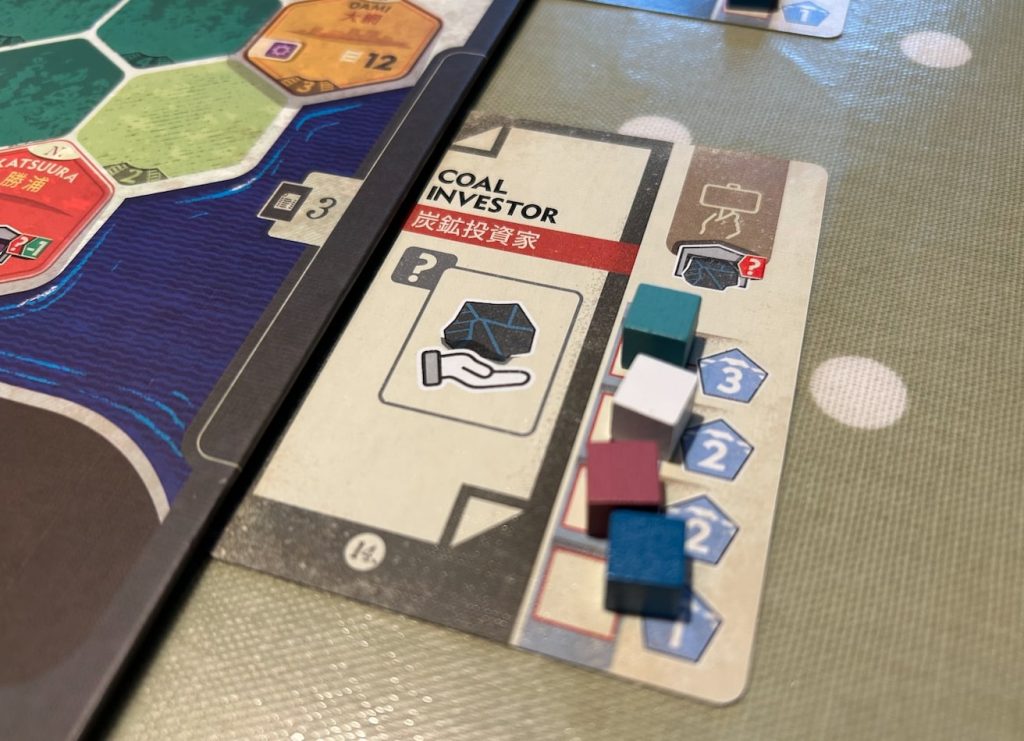
Then finally, there’s an Objective phase: now what is bid depends on the Objective card for the current round, but in essence all the objectives are about scoring points at the end of the game for having met certain criteria: lots of trains around a city, for example (City Tycoon) or a bunch of trains in a straight line (Express Tycoon) or having the highest income on a particular resource (eg Coal Investor). All players will get to trigger these scoring cards, but the higher bidders get a better return: your score in the criteria multiplied by four, say, instead of one or two.
That’s the gist of the game: you repeat these phases four times, and then the game ends with some extra scoring for the Objective cards, your biggest railroad and any leftover resources you have. Most points is the best tycoon. Boom!
Sam says
Designer Hisashi Hayashi is responsible for the much lighter network-building game Trains, logical deduction puzzle Bomb Busters and the super-simple route-builder Metro X. Co-conspirator and developer Simone Luciani is responsible for a host of more complex designs, and my tastes don’t tend to skew very far in that direction. I really like the auctions here, the route-building, and the fact our destinies are somewhat entwined on a shared board. But the array of Development cards, Locomotive cards and Objective cards push the game into a more complex, cog-connecting place – one that suits the optimising long-term strategist over the freewheeling tactician: none of these are overwhelming by themselves, but collectively they give you quite a bit to compute, a fair bit of table-sprawl and a moderate amount of rulebook-referencing. Familiarity would negate that, but I suspect you’d need the same group of players to avoid the what-does-this-do-again-isms of my couple of visits. Overall I came away from Railway Boom respectful of this intricate and clever design, but considering the pace, referencing and cognitive load, not sure I would really class it as my type of fun.
-

Take That!
A bit. There's no direct conflict, but the spaces on the board can heat up the competition and obviously, the bidding is directly impactful on everyone
-

Fidget Factor!
Probably not a game for those who want to speed along breezily - there's a fair bit to compute around that bidding core (see Sam Says) and some referencing time will be needed on a first 2-3 plays, or if anyone is new to it
-

Brain Burn!
The simplicity of the game is that what is constantly pushing it forward is the auctions. But what to bid when is about managing your economies, where to build on the map has a spatial element and both link back to your Locomotives and Development cards.
-

Again Again!
There are plenty of elements in the game to shake things up from play to play


