
Ride the Rails
Designed by: John Bohrer


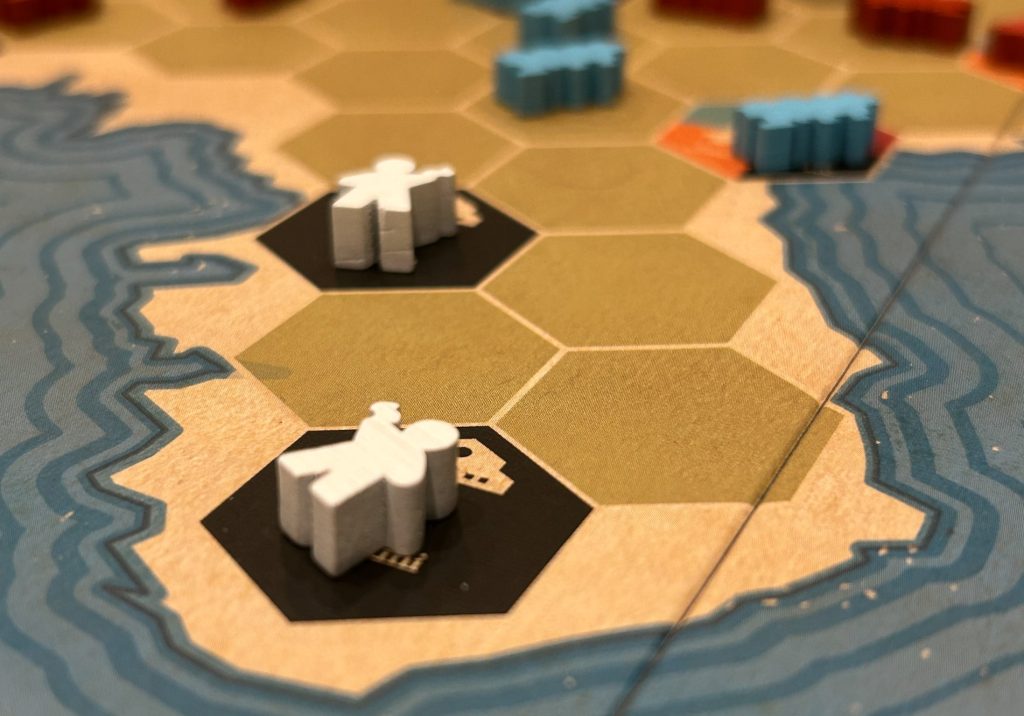
Ride the Rails is a route-building and passenger-delivering game, where players share the developing network on the board and score points in, almost exclusively, two ways: how far they take a passenger in each round, and which routes they use.
Each round has three distinct phases. The first one is simple: everyone chooses a share in one of the train companies: in the opening round, there are only two to choose from (red and blue) but in every subsequent round bar the final one, another company becomes available.
Then players take turn building track. You can only build track in a company you have shares in, and there is some criteria to bear in mind over where each company begins. After that, subsquent track must connect to existing track: blue connecting to blue, red to red and so on. Track may branch off – although strategically this can be risky – and each hex on the board has room for just two trains.
Then everyone takes turns delivering exactly one passenger. The game begins with a single passenger in every city, and delivering them means moving them along any built track on a route of your choosing: the only restriction here is a passenger can’t visit the same hex more than once. Each player scores a point for each link (ie city-to-city) their passenger passes through, including their starting and final destination, at which point they’re removed from the board.
During all the passenger delivering, players track – using markers on the board – how many times each colour train company gets used, and after the final passenger is delivered, everyone scores for the shares they have in each company: for example, if the red track was used a total of seven times and you have three red shares, that’s 21 points.
That is largely the game, bar a couple of little wrinkles. Bustling Chicago is the exception to the two-trains-per-hex rule, and can fit all six companies in it. Some mid-west cities award points to the first player to deliver a passenger there, and there’s a 12-point bonus for the first player to connect the east and west coast, by whatever track (shares in this instance are irrelevant). After the sixth round the player with the most points is the winner.
Sam says
I find these ‘cube rail’ style games fascinating. At first glance Ride the Rails seems so simple: a matter of engineering a situation where passengers are regularly using the companies you have shares in. But that can be hard to achieve when others are building alternative routes under your nose. There are alliances with others when you both have shares in the same company, but obviously your largesse shouldn’t extend to the point where you’re helping someone excessively. And there’s the opaque space between specialising in one or two routes – which can be highly rewarding, but also risky – or trying to ride the coattails of others by having a little of everything. In either case, the passenger movement on the board is really interactive: while moving passenger X might get you ten points, passenger Y will reward with you less but prevent another player moving it for an even bigger score. If your mark of a good game is simple rules but tough choices, Ride the Rails will make for a satisfying and eminently revisitable experience.
-

Take That!
There’s no overt conflict, but players can take passive-aggression to sneaky heights: taking shares only to crash them, building track in unhelpful places, grabbing a passenger for minimal points to prevent another player harvesting more.
-

Fidget Factor!
Ride the Rail’s accessibility lies in the fact you do three simple things each round – get a share, build track, move a passenger. While each of these things a critical and there can be pauses, everyone is (literally) invested in what’s taking place on the board.
-

Brain Burn!
It can be deliciously agonising. Player order is critical and so is the fact there is a finite number of trains. Jumping into a company that’s about to run out of track is risky. If it’s running out of connected passengers too, it can be terminal.
-

Again Again!
The appeal is at least in part to its obtuse nature: it doesn’t for example engender players with the same sense of productive ownership as route-building games such as Railways of the World or Ticket to Ride. But it’s a lovingly produced and endlessly intriguing game.


