
District Noir
Designed by: Nao Shimamura, Nobutake Dogen

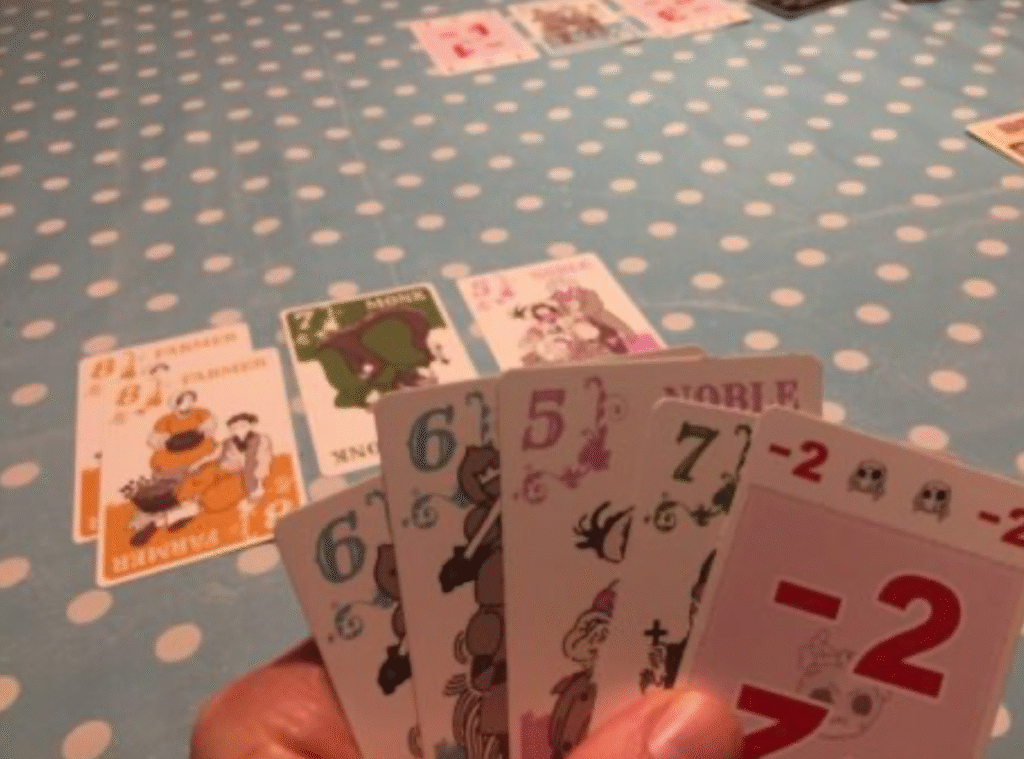
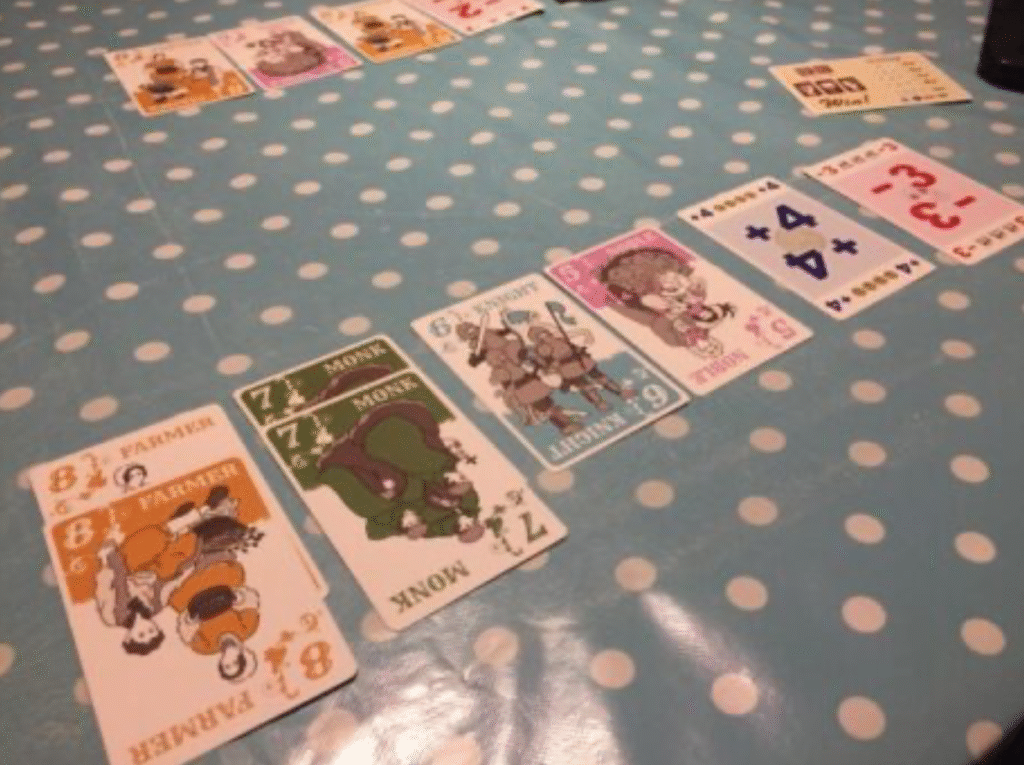
District Noir (previously published as The Throne and the Grail) is clever game of set-collection. We’ve only actually played the older version, which we’ll describe here. While the theme of District Noir is completely different (no grail etc!) the mechanics of the game are almost identical: apologies for the incongruous entry here, as we have pictured the new box but the old cards!
The deck of cards are made up of number cards (5 to 8) points cards (blue are plus points, red are minus points) and the three Grail cards. In each round both players are dealt five cards and two more are laid face-up on the table as the start of a communal tableau. Players then take turns taking one of two possible actions – either add a card from their hand to the tableau, OR take the last five cards played to the tableau. If you choose the latter, the cards don’t go into your hand but are kept face-up in front of you as the start of your sets. The catch is that both players may only make such a claim once per round, meaning that having done so any remaining cards will be played to the tableau and become available to your opponent. If either player collects the three parts of the broken grail, they instantly win.
If nobody claims the grail, then after three rounds scores are calculated by comparing sets: the player with the most of the 5, 6, 7 and 8 cards scores points matching that set (ie 5, 6, 7 or 8) and ties cancel each other out. But the number cards also score 5 points for a run: one of each number across the board. The points cards simply score their number value, either positive or minus, and most points overall wins.
But the game can end sooner if you or your opponent manage to collect all three grail cards, meaning you ascend to the throne and win the game instantly. This possibility adds a lingering tension to the rounds where you swoop in to grab cards, as your opponent may now play a grail card (or two!) and pick it up.
Sam says
I really like this game; a proper gaming experience in a deck of cards that puts some big-box publications to shame. No, the theme isn’t massively present and the artwork doesn’t blow me away. But this is a wonderful modern design from Japan (home of the similarly-canny Oink games publisher and other GNG favourites such as Tulip Bubble) where simple rules belie clever tactical opportunities and clever interaction. Without the grail cards this would still be a neat enough design – with them it becomes something of a mini-classic.
-

Take That!
The game doesn't feel harsh, exactly, but you certainly want to 'poison the well' if you can by dumping minus point cards into the tableau after you've claimed stuff for yourself.
-

Fidget Factor!
Low.
-

Brain Burn!
Moderate - the rules are light but the decisions, at times, are not. There's a vein of mystery to proceedings - where are the grail cards? Does your opponent have them? Do you? Are they still in the deck? You can't be totally certain, but you can try to read your opponents motives by which cards they are playing.
-

Again Again!
It's a short game, easy to understand, but with variety thanks to how the cards fall.


