
Trekking Through History
Designed by: Charlie Bink
There are other Trekking games such as Trekking the World and Trekking the National Parks by the same designer.
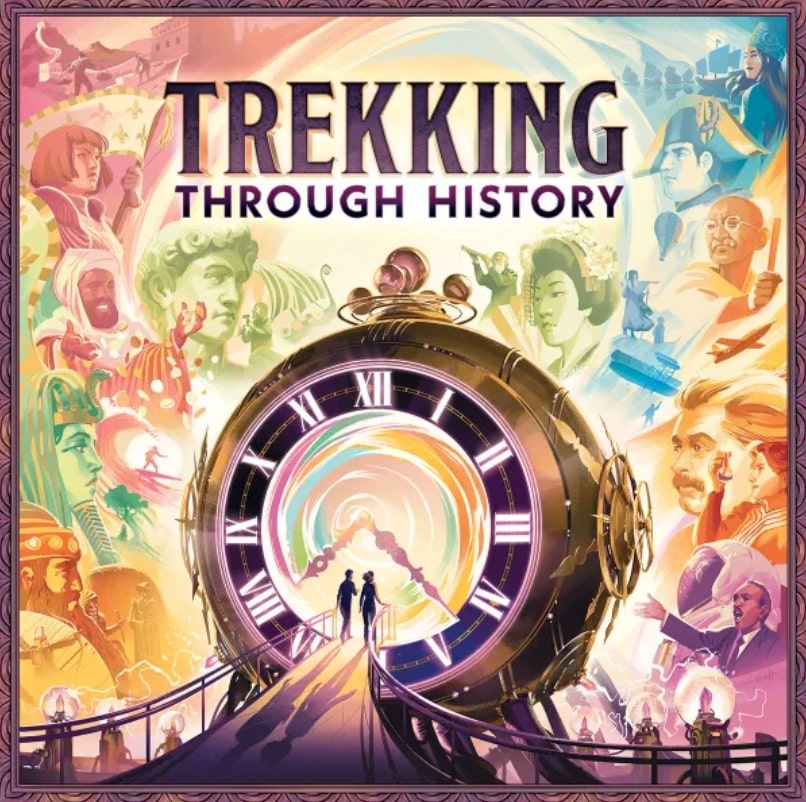
The game of Trekking Through History invites us, the players, on a tour through time. Each player will go on their own tour – three tours in fact; one for each round – and score points in two ways: when the tour in question ticks off boxes on their Itinerary, and for the length of each tour at the end of the game.
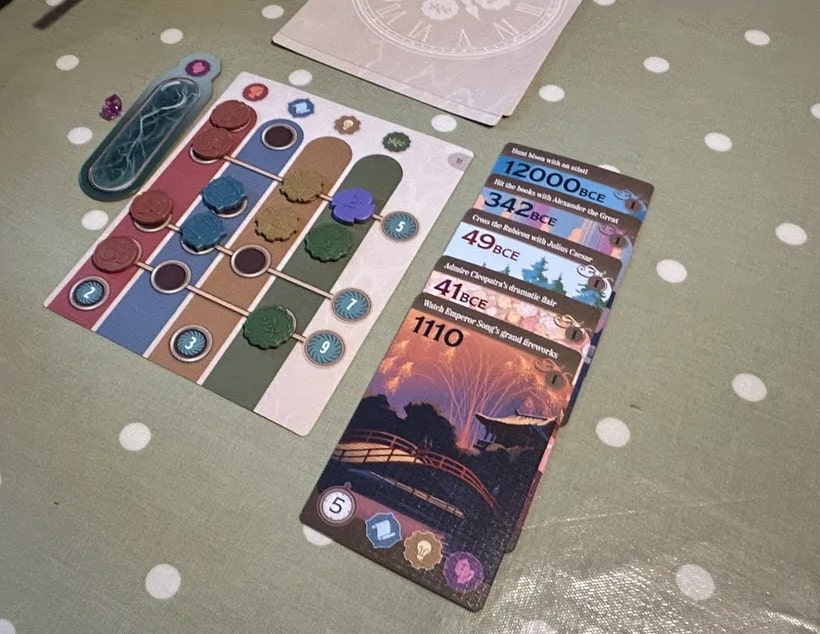
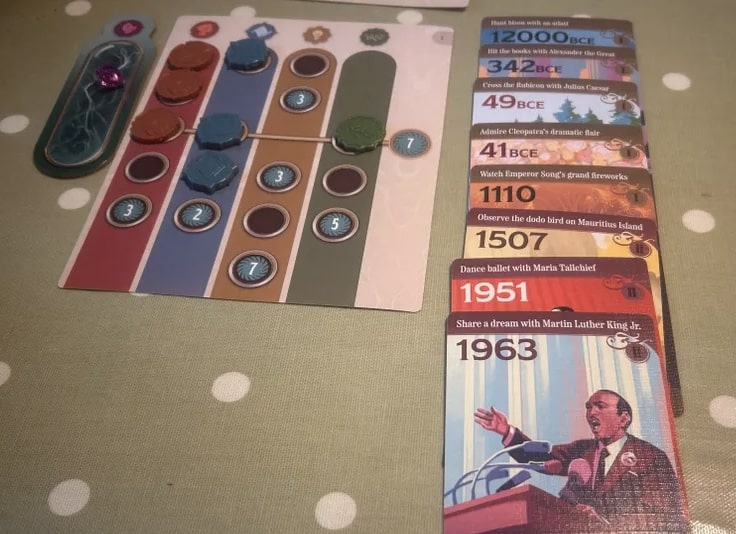
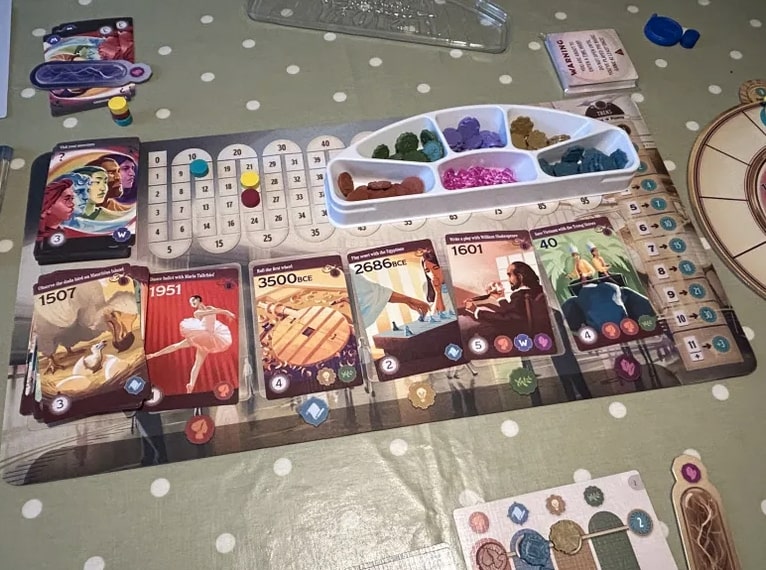
Each player chooses an Itinerary board to begin with, which has four columns on it representing the experiences you seek: meeting a Person, witnessing an Event or Innovation, or being there for a great step in Humanity’s Progress. From a mechanical point of view however, it’s simplest to just refer to each column by its colour. On your turn, you choose one of six available cards to be the next stop on your trek: both the card itself and the position its in on the board determine what rewards you get: rewards being essentially markers with which to fill your itinerary, starting from the top of each column and working down. When certain spots are filled, you gain points, which are also tracked on the board. The catch in all of this – and the nub of the game, really – is that the cards in each trek must go sequentially: while you can start a trek at any point in time – hot chocolate with the Mayans, for example – every card you then add to your trek must be later in time. If you can’t (or don’t want to) do this, your current trek ends and you must begin a new one. Be aware that longer treks are worth more points at the end of the game!
The card you take also determines another sort of time – time spent travelling. In each round you have a certain amount of time to spend (-tracked on another board), and whomever is furthest back on the time track is the active player – even if they just had a turn, they will still be next to go. Players can manipulate how much time they spend by utilising crystals: you begin the game with one, but certain cards will reward you with more, and these can be key to victory. After three rounds the treks are scored, with longer ones worth more points. Most points wins.
Sam says
In like how accessible Trekking Through History is – and by extension, I assume the other Trekking games also. But I confess I found the experience unexciting. It’s certainly satisfying chaining a long high-scoring trek together, but the itinerary boards feel both an arbitrary exercise in matching symbols and, essentially, abstracted and administrative feeling. The theme didn’t stick at all and whilst I like the illustrations and the family-friendly vibe, it felt like a lot of gubbins (and plastic) built around the idea of putting numbers in consecutive order. I didn’t actively dislike it but in an age where we are, game-wise, completely spoiled for choice, it left me almost impressively underwhelmed.
-

Take That!
There’s no direct interaction, though certainly you may find a card you have your eye on gets snaffled up by another player.
-

Fidget Factor!
Things move along pretty fast.
-

Brain Burn!
The game pulls you in two, potentially different, directions: short-term gain on the itinerary boards, big points in the finale if you prioritise the trek length. Successfully aligning the two is the jackpot, points-wise.
-

Again Again!
There’s multiple itinerary boards, and a multitude of cards.


