
A Feast for Odin
Designed by: Uwe Rosenberg
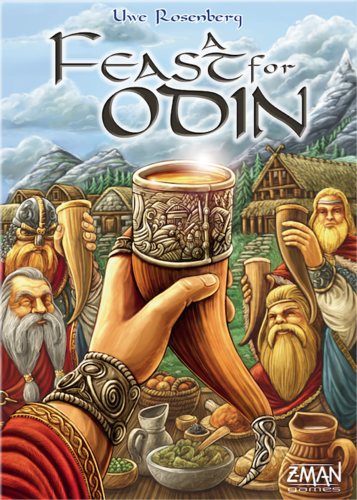
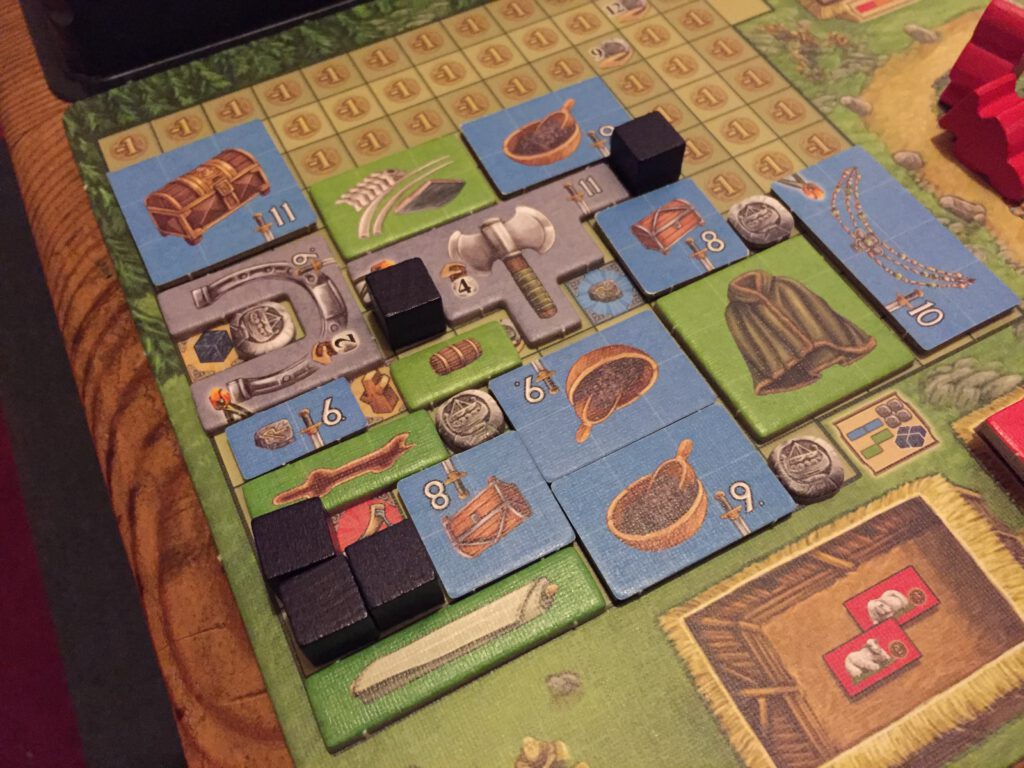
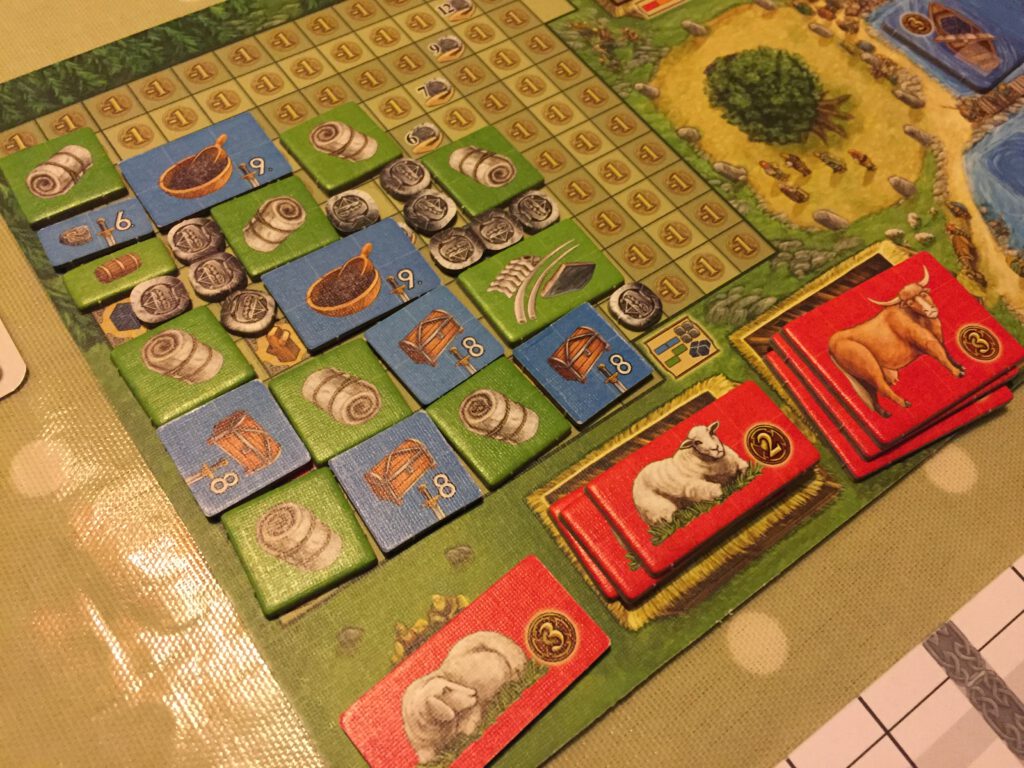
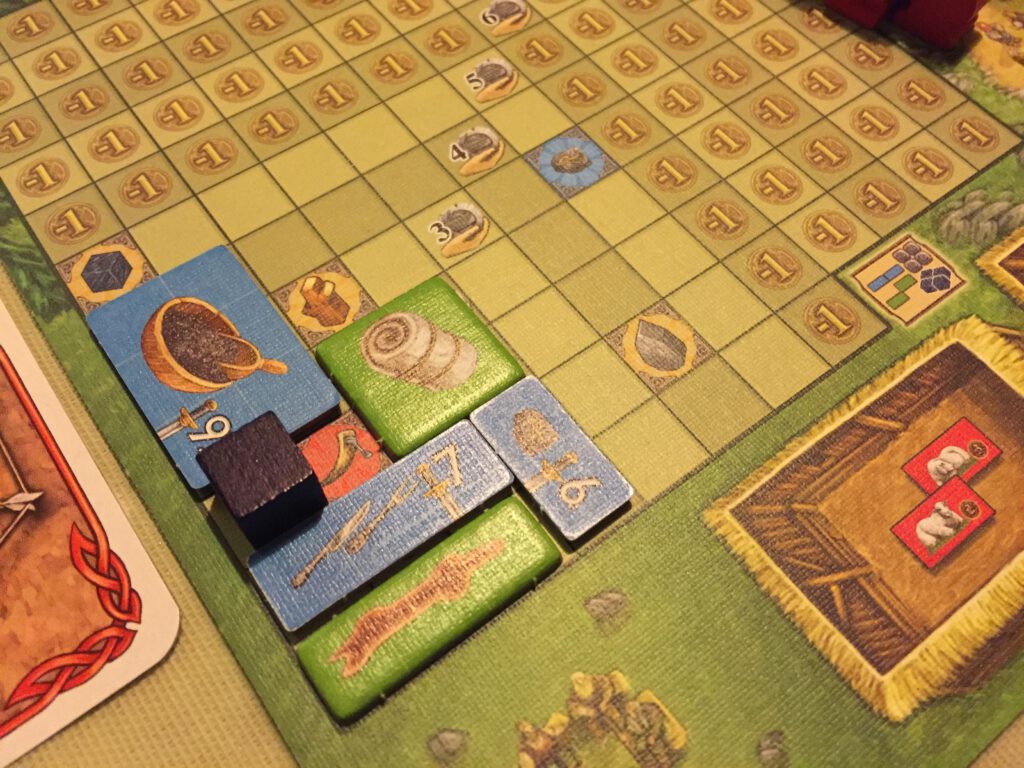
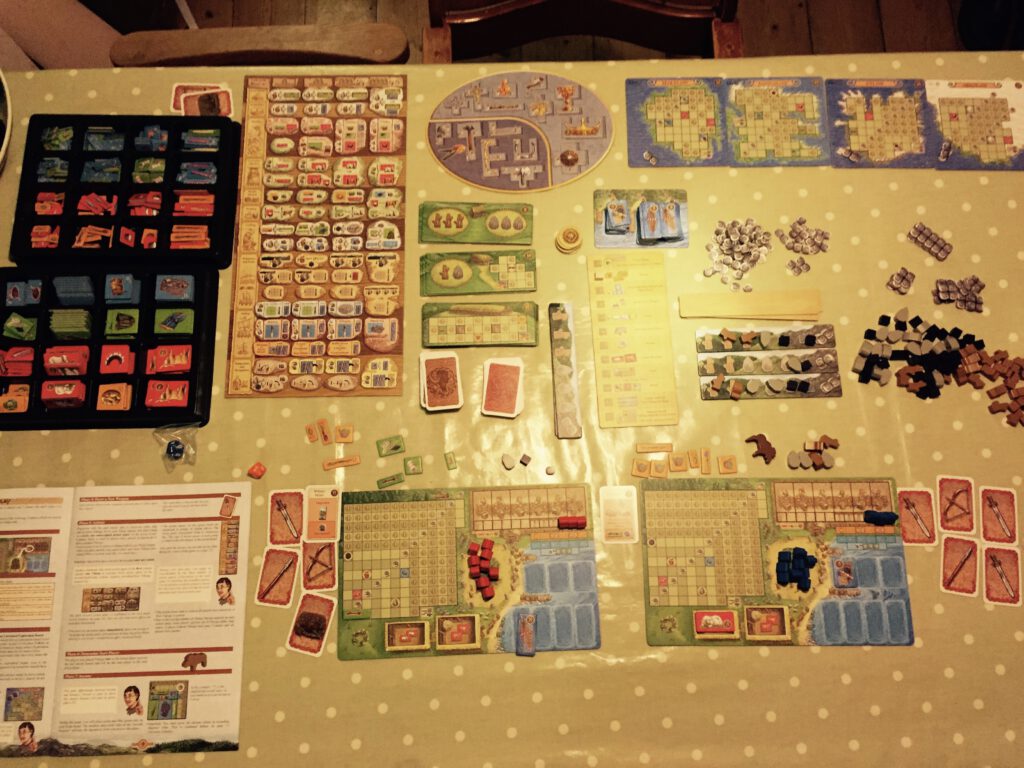
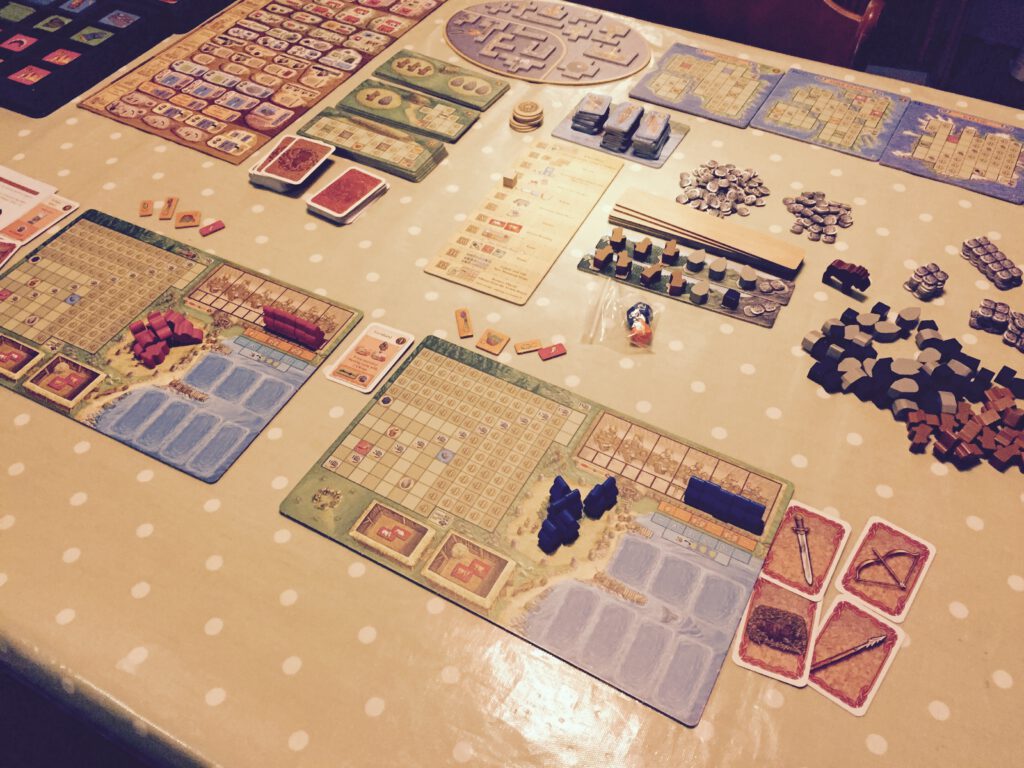
In A Feast for Odin the players are viking leaders, trying to establish themselves by doing all kinds of vikingy things over the course of 6 or 7 rounds.
Each player is given a board that is broken down into a grid, and on the grid are a number of penalty points. Your goal during play is to cover as many of these up as you can, and you do this with an ever-expanding gang of vikings: on your turn, you play one or more of them to the action board. How many you assign depends on the action you’re taking: the board is broken into four columns with a cost of 1-4 vikings. The actions let your vikings do such things as gather wood, chop stone, husband sheep or cattle, hunt, build houses and ships, go travelling in the ships and get up to all sorts of nonsense at sea: whaling, raiding, pillaging and plundering.
How all this viking activity manifests though, is in the vast amount of tetris-like tiles that come with the game. They come in four colours that have an order of importance: orange, red, green and blue. And these pieces are gathered via the actions before being placed on your player board: the orange and red to feed your vikings at the end of every round, and the green and blue to cover up those nasty penalty points, and get your score into the black.
Also evident on your player boards are some spaces showing silver (income at the end of each round) and some bonus spots that are awarded at the end of each round if you have surrounded them with your tiles. The catch is that your green tiles can’t be adjacent to each other, whereas the highest value colour (blue) can be plonked down anywhere you like. Silver and ore can be used to plug the little gaps (and ore can also be used to increase your whaling productivity when you load it onto boats!). Players can also gain more boards during their exploits, for more income and potentially, more points.
After the final round, players score in several categories, then take away any visible penalty points, and the highest score wins.
We have only touched on the bare basics here; there’s a lot going on in Feast (card play, dice-rolling, and more) and trying to cover every aspect of it here would be nigh on impossible!
Sam says
While I generally desire more interaction in a long game, designer Uwe Rosenberg seems to constantly defy this preference and draw me in. His Caverna is one of my favourite games, so I was looking forward to playing Feast. I have to confess on a first play I felt like the game simply had too much: too many options (over 60!) and too much to think about. But I’m glad I stuck with it, because a second play was much more fun, and since then I’ve enjoyed many more. It has a big learning curve, and the abstract pattern-forming element (also used to much simpler effect in the likes of Cottage Garden, Patchwork and Blokus) doesn’t feel remotely thematic – as though Vikings arranged their bounty geometrically across the fjords of Norway – and if you’re looking for the clash of steel, Feast sounds more like a scythe and plough. But it is fun, and although I think Caverna is still a far more intuitive and new-player-friendly, A Feast for Odin still gets a tick from me. My caveat is I think it’s best for two or three players maximum: four can drag on a bit.
-

Take That!
Minimal. You can potentially block each other - more likely with more players, for obvious reasons - but it's not a game with much player interaction at all.
-

Fidget Factor!
High on a first play, dropping with familiarity. The game isn't 'hard' but what makes it complex is the sheer, bewildering amount of options at your disposal.
-

Brain Burn!
Repeat plays will show the challenge is getting the seemingly random options to work together.
-

Again Again!
It's long and involved, but one thing that can't be levelled at A Feast for Odin is a lack of variety.


