
Patchwork
Designed by: Uwe Rosenberg
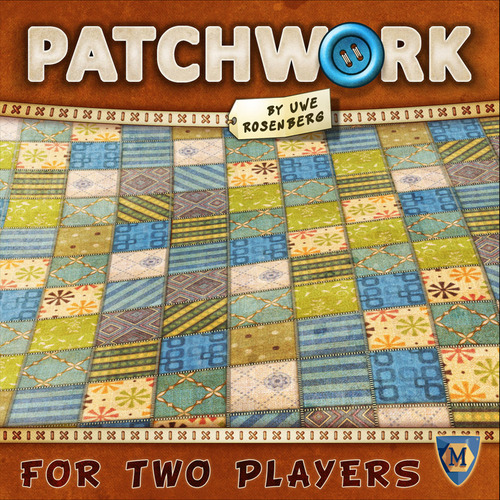
Patchwork is a very pretty two-player game, in which players collect tetris-like tiles to fill up their 9×9 square player board, whilst racing to grab bonus tiles along the way. All the tile pieces are arranged in a large circle, and a pawn is placed by the smallest. On your turn, you can move the pawn to any of the next three tiles, purchasing the tile you stop at and placing it on your ‘patchwork’ player board. The cost of tiles is twofold – buttons (players start with five buttons each), and time.
Time is counted down on a shared board, with players moving their pieces forward a number of squares according to the time cost of the tile. Whoever is furthest behind on this time track is the active player, so occasionally you may have two or even three turns in a row.
But once you’re out of buttons, how do you buy more tiles? Well, there are spaces on the time board that pay out buttons when you pass them – you get buttons equal to the number of buttons on tiles on your board; so you want to time your advancement on the board to ensure you have a steady income of buttons with which to buy more tiles. Buttons are also your points at the end of the game, making them a doubly precious commodity. Dotted along the time track are tiny bonus tiles, awarded to the first player to pass them.
Once both players have reached the end of the time board, the game is over. Players subtract two points for each empty space on their patchwork, and add up the number of buttons they’ve accrued to find the winner (there’s also a 7 point bonus for the first player to fill a 7×7 section of their patchwork). Most points wins!
Sam says
If the theme is quaint enough to put you in mind of kindly old Aunts or school projects, the actual play can be brutal! If you like a battle, you might find Patchwork can be harder on you than many games of combat. For a gentler game with a similar pattern-laying challenge, try Cottage Garden. For a similar game that plays more players, try Barenpark or the slightly more complex Planet Unknown. Or if you want a serious cognitive challenge, try the viking-flavoured beast that is A Feast for Odin!
-

Take That!
To play efficiently requires spotting moves that will benefit you and mess up your opponent. But as with many games, you can play gently if you're less worried about winning.
-

Fidget Factor!
Play moves swiftly, even if you are able to take several goes at once.
-

Brain Burn!
Again, if you're playing to win, it's worth working out the cost versus reward for each tile you buy; but it's not necessary in order to enjoy the game.
-

Again Again!
A game takes 30 minutes, and you could easily play best of three in a session if so desired. The random set-up of the tiles will make each game play out quite differently, and there's some interesting strategic depth to be discovered once you've played a few times.


