
Foundations of Metropolis
Designed by: Emerson Matsuuchi

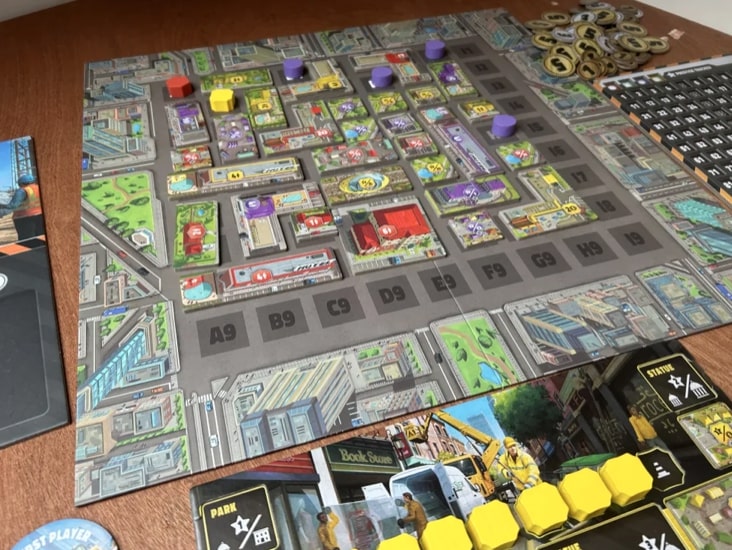
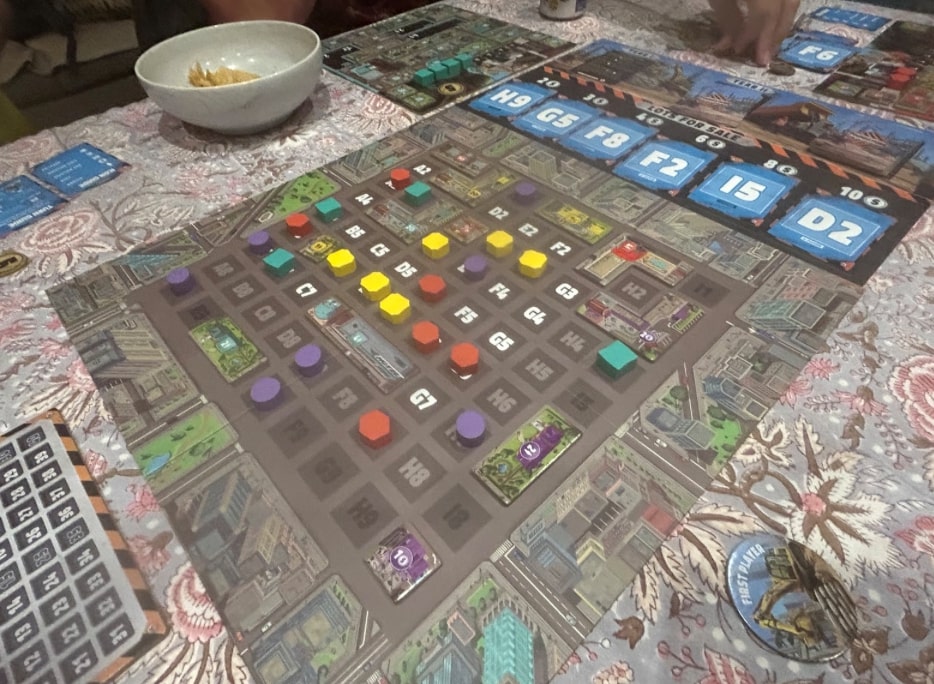
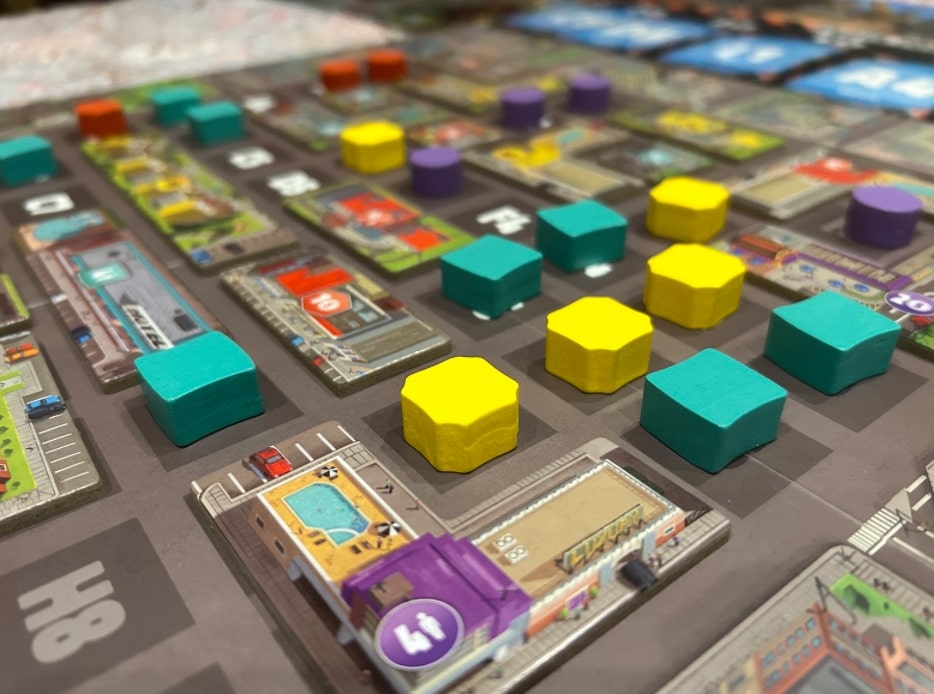
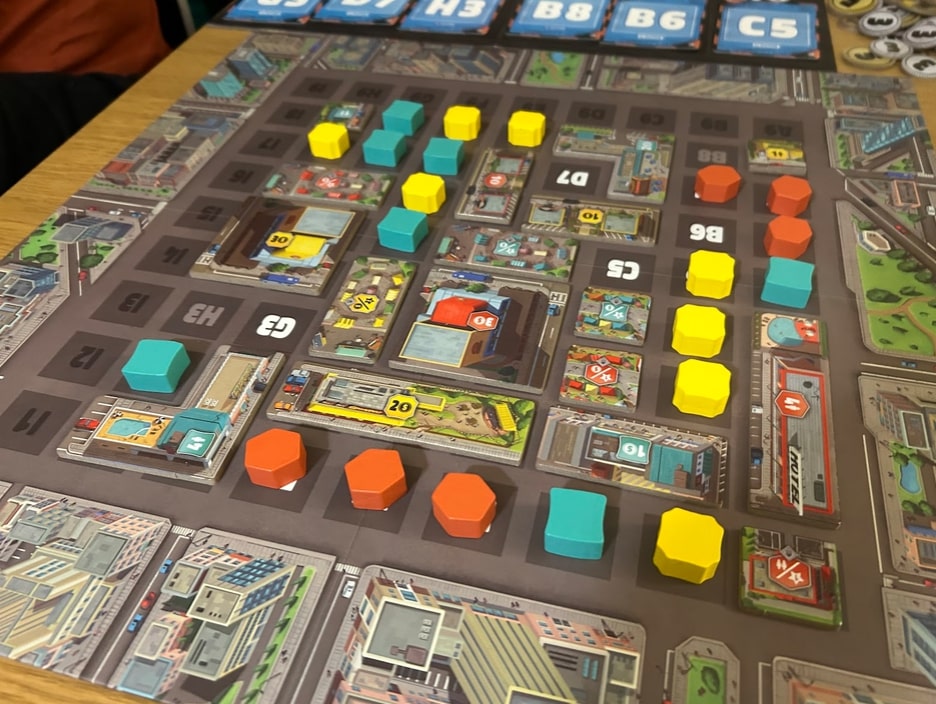
In Foundations of Metropolis (there’s also a ludicrously ornate/expensive version called Foundations of Rome) the players collectively – but competitively! – build a city on the board, constructing their buildings as strategically as possible in order to score the most points.
You’ll start the game with a bit of cash and a board that houses all your buildings, represented by illustrated cardboard tiles. The shared area is the footprint of the city – you get six plots of land on the board before the game begins in earnest (placing markers on them to show your ownership) and on a separate board there are a display of Deed cards.
On your turn you take one of three options: buy a deed, construct a building, or take income. Buying a deed is simple: pay the associated cost, take the card and place a marker on the matching plot. Constructing a building is even simpler: place one of your buildings on the board onto a plot of plot you own – returning the markers to your supply.
And taking income is easy too: you always get five cash from the bank, but may be rewarded with more depending on what buildings you’ve constructed – so let’s look at those. There are three kinds: retail, residential, and civic. Retail buildings are what will push up your income, as well as awarding you some points at the end of each round (there are three rounds). Population buildings push player markers up a population track, which has a quirky way of awarding points at the end of the round: each player scores the points of the player ahead of them on the track – and the player in first place scores their own position plus a bonus.
Finally civic buildings are where Foundations gets really canny: they score points depending on what buildings they are adjacent to on the board: retail, residential, other civic buildings, or any buildings at all. Positioning these can often be absolutely pivotal, which brings us to overbuilding. When you take a construction action you can, if circumstances allow, build over one of your already-placed buildings, as long as you own all the relevant lots. The only additional rule here is the new building must be bigger than the old one! Such is the nature of construction…
After the third round ends and scoring is completed, the player with the most points wins.
Sam says
I very much enjoy Foundations of Metropolis for combining simple rules with a surprisingly dastardly – the buying of deeds; the parasitic civic buildings and population track – experience that tends to play in around an hour. Although the game officially plays 2-4 I don’t think it’s anywhere near as much fun with two players: you need the jostle for space and the tension of not knowing what everyone is going to do. It’s nicely-produced and if the iconography could have done with being a little bigger on the tiles, at least it isn’t submerged under the weight of its’ own production like sister game Foundations of Rome.
-

Take That!
Nobody can be targeted, but there’s a good deal of passive aggression here: expect the deeds you want to be snapped up and the population track to be tightly contested.
-

Fidget Factor!
Only three options and sometimes circumstance can constrict things further – the game usually moves along at a relatively perky rate of knots.
-

Brain Burn!
It’s about positional work on the board, managing the population track and the advantages of certain deeds versus how much a purchase might hinder someone else!
-

Again Again!
Foundations of Metropolis doesn’t really tell a story or generate a lot of laughter. But as a game of tactical chicanery, it’s an excellent option.


