
Fromage
Designed by: Ben Rosset, Matthew O'Malley
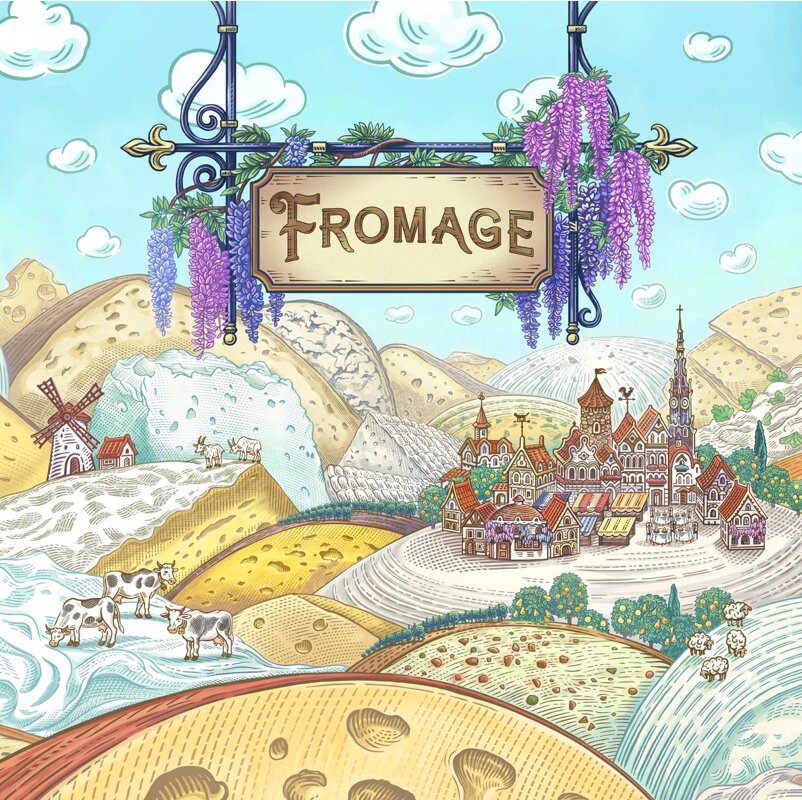


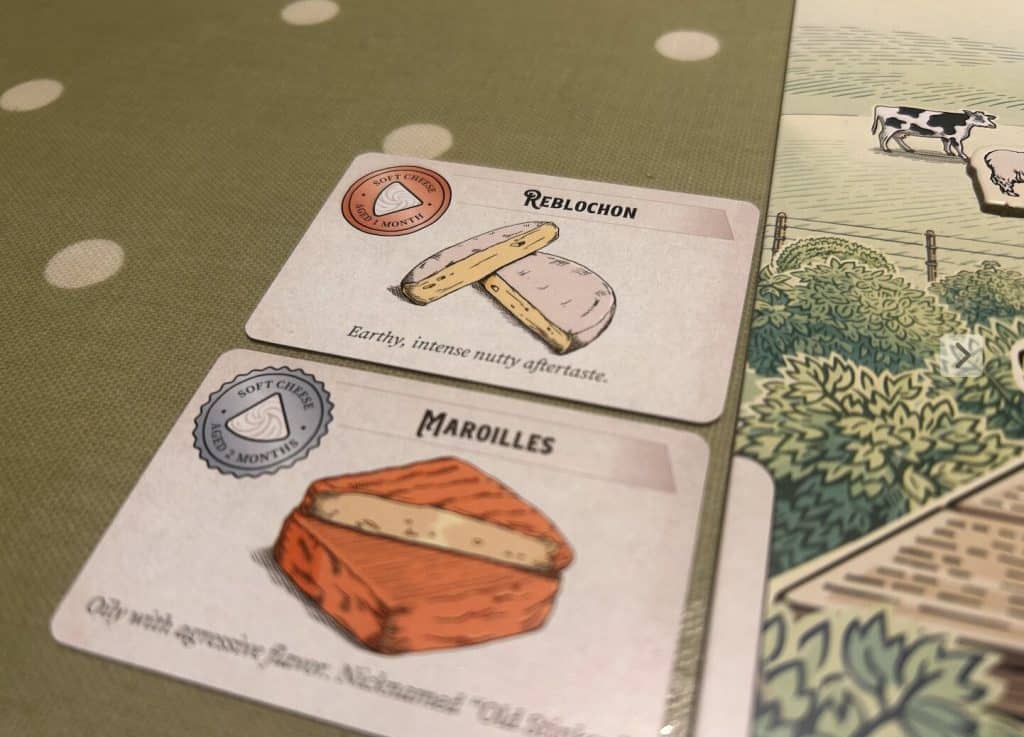
Fromage is a game of cheesemaking. Or to be more precise, it’s four overlapping games, of making three different cheeses, with three different cheese-makers. Confused? Wait until the board spins in front of your eyes!
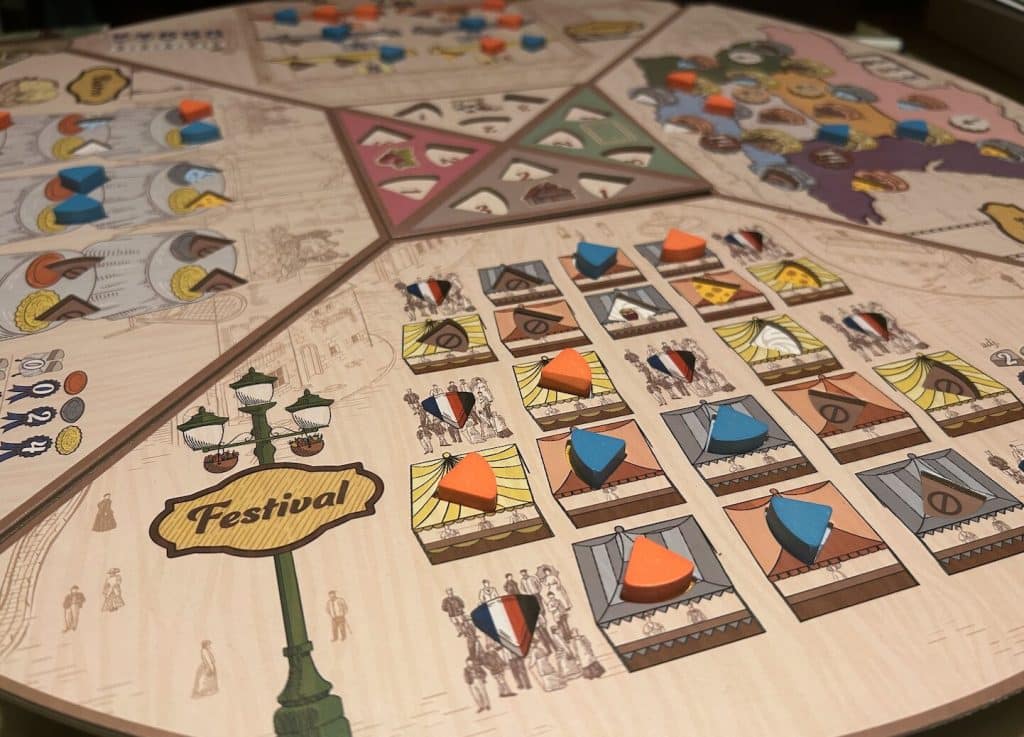
The board is broken into four quadrants, each representing four different destinations for your prized cheese: the Fromagerie, Festival, Bistro and the wider regions of the Villes. You have three workers and can place up to two of them on each turn – either in the centre part of each quadrant to collect resources, or delivering a cheese – your cheese pieces literally fit underneath your worker pieces – to the aforementioned destinations, each of which score in very different ways.
Fromage’s twist is how your workers return to you. In each turn players simultaneously assign workers to the quadrant facing them, and then the board rotates ninety degrees, bringing new options to you. Each worker space has an orientation that means the worker assigned there faces a particular direction, and only when a worker faces you again can you recall them to reassign. Naturally, the places that are more rewarding on the board are also the ones that keep workers absent for longer: the spaces all have a hierarchy of gold, then silver, then bronze.
The game will end when someone places their final cheese and, in brief, the regions score like this: in the Fromagerie you want cheeses on as many different shelves as possible, at the Festival you want your cheeses to all connect to each other spatially, in the Bistro you score for which plates your cheeses are on (and score higher if you have pairs of plates on the same table) and in the Villes you’ll score a kind of area majority, where your placed cheeses influence the regions around them, but you need to out-influence the other players to claim points.
Around the core game are some secondary elements to bear in mind, to do with the resources. These come in four forms: Fruit, Livestock, Buildings and Orders. As you play the game certain spots on the board allow you to move fruit from your fruit basket to the cheese and jam baskets on your player board, and in the end game these are multiplied (cheese x jam) for points. Animals can be cashed in for one-off special actions, and Buildings can be placed on your board to make constructions such as a barn, cheesery or headquarters that also help you gather points or reward with one-off actions. Finally the Orders relate directly to the placement of your workers: an order might ask for a yellow cheese in a silver place, for example, and if you place a worker in such a space in any quadrant, that order is considered filled and will now be worth points at game end.
Sam says
If you said ‘Let’s play a game about making cheese’ I’m not sure I’d be yelling sign me up, but I enjoy Fromage for what it doesn’t do almost as much as what it does. Many titles that home in on the optimisation aspects of things can start to feel – for me – a bit long, slow, and grinding, the themes and setting evaporating in a sea of protracted turns as players pull levers and push buttons. I’m not enough of a puzzler, strategist or deep thinker on those terms for those returns to work for me. But Fromage is, like its lactose-infused produce, this experience in snack form, playable in an hour (far less with two) and integrating enough passive-aggression in the taking-of worker spots to prevent it drowning in its own curd. It’s a satisfying puzzle, pitched in a way that feels revisitable: the canny ticking-clock timer of each worker brings a little tension to each turn.
-

Take That!
Players can - and probably should - look for ways to block each other, although much of the options-narrowing will be inadvertent
-

Fidget Factor!
Once you understand the mechanisms and scoring, it's quite a fast-moving game
-

Brain Burn!
How to score versus how to sacrifice: getting your workers back quickly is good because you need them for actions. But the juicier returns are in the longer-term commitments.
-

Again Again!
There are enough random elements at play here to stop the game being prescripted.


